The French and Spanish Protectorates: The Colonial-Era Roots Still Visible in Morocco Today
The Treaty of Fes and a country split in three
Morocco's protectorate era has a precise birthdate. On March 30, 1912, at the Royal Palace in Fes, Sultan Abd al-Hafid signed the Treaty of Fes with French diplomat Eugene Regnault, negotiated over roughly six hours the previous evening while French troops surrounded the city. The treaty did not formally annex Morocco; it established a protectorate, under which France took control of Morocco's military, foreign relations and finances while nominally leaving the sultan on his throne and Moroccan officials in charge of Moroccan subjects. Real authority sat with a French Resident-General appointed in Paris, the first of whom was Marshal Hubert Lyautey.
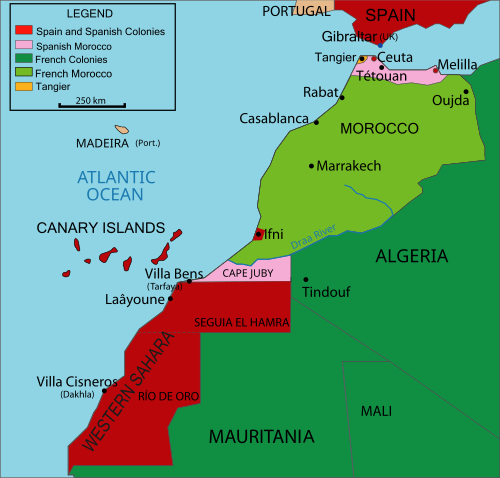
France did not take the whole country. A separate agreement that same year, formalized on November 27, 1912, carved out a Spanish protectorate covering a northern strip along the Mediterranean and Strait of Gibraltar — administered from Tetouan — plus a separate southern zone around Cape Juby bordering what was then Spanish Sahara. A third arrangement, signed in Paris in December 1923 by France, Spain and Britain, placed the city of Tangier under its own international administration, a status that lasted, with a wartime interruption when Spain occupied it, until 1956.
So for 44 years, one country answered to three different administrations at once: French Morocco governed from Rabat, Spanish Morocco governed from Tetouan, and the international city of Tangier governed by a multinational Committee of Control with judges appointed by several European powers. That three-way division is the single fact that explains almost everything else in this article — why French dominates business language today, why Spanish still lingers in the north, and why Tangier developed such a singular, cosmopolitan identity.
Lyautey's Ville Nouvelle: a policy still written into every Moroccan city map
If one person's decisions shaped how Moroccan cities look today, it is Hubert Lyautey. As Resident-General from 1912 to 1925, he paired with urban planner Henri Prost on a deliberate policy: rather than modernizing or absorbing the historic medinas, France would build entirely new European quarters — the Ville Nouvelle, or new city — alongside them, close enough to administer but separate enough not to disturb what was already there. Lyautey's own description of the approach was that the new city should sit "far enough from the native city not to absorb it, but close enough to it to live in some extent" alongside it.
The practical result is why a city like Fes, Marrakech or Meknes today has two distinct urban faces: a dense, walled, centuries-old medina of narrow lanes and traditional riads, and, a short distance away, a grid of wide boulevards, roundabouts and European-style administrative buildings dating to the 1910s-1930s. Historians studying the policy note a paradox in it — the separation was framed as protecting the medinas from disruptive modernization, but by routing new investment, infrastructure and population growth into the Ville Nouvelle instead, it also left many medinas under-resourced and, over time, contributed to their physical decline.
Not every French intervention followed the separation model strictly. In Casablanca, colonial planners built the Habous quarter between 1917 and 1926 — an entirely new, purpose-built "new medina" in a Moroccan architectural idiom, designed to absorb the rural migrants pouring into the fast-growing port city. It is a reminder that protectorate-era urbanism was not one uniform doctrine but a set of overlapping, sometimes contradictory policies that nonetheless shared a common thread: modern Morocco's cities were substantially re-planned, not merely occupied, during this period, and the dual-city layout remains the default mental map most Moroccans and visitors still use to navigate them.

Casablanca's Art Deco skyline, the protectorate's most visible legacy
No single legacy of the protectorate era is more immediately visible than Casablanca's architecture. Under Lyautey and Prost, the French government explicitly treated the city as a "laboratory of urbanism," and the Ville Nouvelle that rose there through the 1920s and 1930s absorbed the era's dominant international style: Art Deco, popularized after the 1925 Paris Exposition Internationale des Arts Decoratifs et Industriels Modernes. Architects working in Casablanca, most prominently Marius Boyer, fused that style with local Mauresque elements — zellige tilework, arabesque patterning, horseshoe arches — into a hybrid often called Art Deco Mauresque.
The scale of it is what makes Casablanca unusual: by the 1930s the city held more than 4,000 Art Deco buildings, one of the largest concentrations of the style anywhere outside Europe and the United States. Landmark structures from the era — the former Prefecture on Place Mohammed V, the 1925 Palais de Justice, the domed former Cathedral of the Sacre-Coeur, now deconsecrated and used as a cultural space — still anchor the city center. Local heritage groups such as Casamemoire have worked for decades to document and protect this inventory, while also being candid in their tours that the same urban planning tools — a centrally placed clock tower to enforce punctuality, purpose-built workers' housing designed to encourage permanent settlement near factories — were instruments of colonial control as well as architecture.
The buildings have had an uneven afterlife. Many stand well-maintained and occupied; others have fallen into disrepair, prompting recurring debate in Morocco over preservation funding versus redevelopment pressure in a booming port city. Either way, the Art Deco core of downtown Casablanca remains the most concentrated, photographable piece of protectorate-era material culture anywhere in the country.

French as a language of the state, the office and the classroom
The protectorate's longest-running legacy is linguistic. French was never the language of the Moroccan street, but it became, and largely remains, the language of the Moroccan institution: administration, banking, higher education, engineering and much of private-sector business. Arabic is Morocco's official language alongside Tamazight, and Moroccan Arabic (Darija) is what most people speak at home, yet a large share of secondary and university instruction in STEM subjects is still delivered in French, and internal government paperwork is frequently drafted in it as well.
Recent census data illustrates the layered nature of that presence. A majority of Moroccans, by some measures well over half, report some ability to speak French, but only a small minority — roughly one in eight — are genuinely bilingual in French and Arabic; daily use in the home is far lower still. In professional and commercial settings the picture flips: a substantial share of Moroccans use French routinely at work, and fluency in it remains, in practice, a gateway to white-collar employment, foreign trade and higher education, especially in fields that still lean on French academic textbooks and terminology.
That split use pattern is itself a direct inheritance from the protectorate, which built its schools, courts and civil-service apparatus in French even while leaving Quranic and traditional Arabic-language education largely intact for the majority of the population outside the colonial administrative class. Seven decades after independence, French has not disappeared from Morocco; it has simply settled permanently into the specific institutional lane the protectorate carved out for it, coexisting with Arabic rather than replacing it.
Spanish in the north: from Tetouan cafes to satellite dishes in Tangier
The Spanish protectorate left a smaller but distinct linguistic and cultural footprint, concentrated almost entirely in the cities it once governed: Tetouan, its former capital, along with Tangier, Chefchaouen, Larache and Asilah. Spanish loanwords survive in northern Darija — plaza, coche, fiesta among them — and older residents of these cities, especially those who attended school before or shortly after 1956, often still speak conversational Spanish. Spanish-language satellite television, Spanish-run cultural institutes, and Spanish-influenced cafe culture, including churros con chocolate in Tetouan, remain part of daily life in the region in a way they simply are not further south.
The scale of that fluency has shrunk sharply over time, and the numbers track the generational handover clearly: surveys found roughly one in five Moroccans nationally claiming some Spanish ability in the mid-2000s, falling to under 5% within about a decade as the generation educated under Spanish administration aged out. Today, working Spanish is understood to be concentrated in the north and skews toward older speakers, tourism-facing businesses and commerce with Spain across the Strait of Gibraltar, rather than being a language most younger Moroccans learn at school.
Architecturally, the former Spanish zone shows its own version of the Ville Nouvelle pattern. Tetouan's Hassan II Square, known locally as the Feddan, sits at the junction between the historic medina — a UNESCO World Heritage Site — and the Spanish-built new town around Plaza Moulay El Mehdi, where Hispanic-Moorish civic buildings and the former Khalifa's palace reflect a distinctly Spanish colonial design vocabulary, closer to Iberian Mediterranean styles than to the French Beaux-Arts influence found in Rabat or Casablanca.

Tangier's international interlude and the road to March 1956
Tangier occupied a category of its own throughout this period. Excluded from both the French and Spanish protectorates, it was placed under an international regime by a 1923 convention among France, Spain and Britain, later joined by other powers with a stake in Mediterranean trade, and governed by a multinational Committee of Control and Mixed Courts staffed by judges from several nations, all operating alongside the sultan's local representative, the mendoub. That unusual, multi-flag status — briefly suspended when Spain occupied the city during the Second World War — turned Tangier into a freewheeling, tax-light, cosmopolitan port that attracted foreign writers, financiers and exiles, a reputation the city still trades on.
The dismantling of the whole system came fast once it started. Nationalist pressure built through the early 1950s around the Istiqlal party and around Sultan Mohammed V, whom French authorities exiled first to Corsica and then to Madagascar in August 1953 after he refused to endorse French policy. Rising unrest forced a reversal: Mohammed V returned from exile in November 1955, and after negotiations at Aix-les-Bains, France and Morocco signed a joint declaration on March 2, 1956, ending the protectorate established by the Treaty of Fes forty-four years earlier almost to the month.
Spain followed within weeks, recognizing Moroccan independence over its northern zone in a joint declaration on April 7, 1956, after Mohammed V met General Franco in Madrid. Tangier's special status was folded into the newly independent kingdom that summer under a July 1956 protocol, though Spain retained its older coastal enclaves of Ceuta and Melilla, and did not relinquish its separate southern zone bordering Spanish Sahara until 1958, after the brief Ifni War. What had been three administrations became one kingdom within a span of roughly two years.
Frequently asked
What was the Treaty of Fes and when was it signed?
The Treaty of Fes was signed on March 30, 1912, at the Royal Palace in Fes between Sultan Abd al-Hafid and French diplomat Eugene Regnault. It established the French protectorate over Morocco, giving France control of military, foreign policy and financial affairs while formally preserving the sultan's throne, with real executive power held by a French Resident-General.
How was Morocco divided under the protectorates?
Morocco was split into three administrations: a French protectorate covering most of the country and governed from Rabat; a Spanish protectorate covering a northern strip administered from Tetouan plus a separate southern zone bordering Spanish Sahara; and the internationally governed Tangier Zone, run by a multinational Committee of Control from 1923 under a convention signed by France, Spain and Britain.
Who was Hubert Lyautey and why does his name still come up in Morocco?
Hubert Lyautey was France's first Resident-General in Morocco, serving from 1912 to 1925. Working with urban planner Henri Prost, he set the policy of building new European Ville Nouvelle districts alongside, rather than inside, Morocco's historic medinas — a dual-city layout still visible in cities like Fes, Marrakech, Meknes and Rabat today.
Why does Casablanca have so much Art Deco architecture?
Casablanca's rapid growth as a colonial port city in the 1920s and 1930s coincided with the international rise of Art Deco after the 1925 Paris Exposition. French and French-trained architects working in the city's Ville Nouvelle, blending the style with Moroccan Mauresque elements, produced over 4,000 Art Deco buildings by the 1930s, one of the largest concentrations of the style outside Europe and the United States.
Is French still an official language of Morocco?
No. Morocco's official languages are Arabic and Tamazight. French holds no official constitutional status, but it remains the dominant working language of administration, banking, higher education and much of private business, a direct legacy of the protectorate-era school and civil-service system.
Do people in Morocco still speak Spanish?
Spanish is still spoken, mostly by older generations and mostly in the former Spanish protectorate cities of the north — Tetouan, Tangier, Chefchaouen, Larache and Asilah — along with some presence in southern areas near the former Spanish Sahara. National surveys show usage declining sharply over recent decades as the generation schooled under Spanish administration has aged, though Spanish media, trade with Spain and tourism keep it present in the north.
What made Tangier different from the rest of Morocco during this period?
Tangier was excluded from both the French and Spanish protectorates and instead placed under an international administration from 1923 to 1956, governed by a multinational Committee of Control and Mixed Courts with judges from several European powers. That unique status, briefly interrupted by a Spanish wartime occupation, made Tangier a tax-light, cosmopolitan port city distinct from the rest of the country.
When did Morocco become independent?
Morocco's independence came in stages. France ended its protectorate in a joint declaration signed March 2, 1956. Spain followed with its own declaration on April 7, 1956, covering its northern zone. Tangier's international status was folded into the kingdom later that year, while Spain's separate southern zone near Spanish Sahara was not relinquished until 1958, after the Ifni War.
What role did Sultan Mohammed V play in independence?
Mohammed V became a central symbol of Moroccan nationalism after French authorities exiled him, first to Corsica and then Madagascar, in August 1953 for refusing to endorse French policy. His exile triggered sustained unrest, and his return in November 1955 preceded the negotiations at Aix-les-Bains that led directly to the March 1956 declaration ending the French protectorate.
Is Casablanca's Habous quarter a colonial building or a Moroccan one?
Both, in different ways. The Habous quarter was built between 1917 and 1926 under French colonial planning, but as a deliberately Moroccan-style "new medina" designed to house migrants arriving in Casablanca, distinct from the European Ville Nouvelle. Historians describe it as an example of how protectorate-era urban policy was not uniform, mixing separation with newly built Moroccan-style neighborhoods.
- Wikipedia — Treaty of Fes ↗
- Wikipedia — French protectorate in Morocco ↗
- Wikipedia — Spanish protectorate in Morocco ↗
- Wikipedia — Tangier International Zone ↗
- Wikipedia — Architecture of Casablanca ↗
- Yabiladi — March 2, 1956: Morocco's forgotten independence day ↗
Video via official YouTube embeds; photos via Wikimedia Commons under their stated licenses. All rights belong to the respective owners; 212 Daily claims no ownership.