Inside the Chouara Tannery: The Thousand-Year History of Fez's Leather Craft
How old is Chouara, really?
Dating Chouara precisely is harder than most tourist material suggests. Local tradition holds that tanning in Fez dates back to the city's founding by Idris II at the start of the 9th century, and the wider medina of Fes el Bali, where Chouara sits, was indeed established as the Idrisid capital between 789 and 808 AD. But historians note that clear documentary evidence for the earliest tannery locations, including Chouara specifically, is thin; the nearby Sidi Moussa tannery is more definitively referenced starting in the early 12th century, while Chouara's own earliest documented history is comparatively unclear.
What is well documented is the scale the industry reached during the medieval period. The chronicler Al-Jazna'i recorded that under the Almohad dynasty, in the late 12th to early 13th century, Fez counted around 86 separate tanning workshops. Later sources put the number at roughly a hundred during the Marinid period, between the late 13th and 15th centuries — meaning that whatever the exact founding date of any single tannery, Fez was operating as a genuine industrial leather district, at real scale, at least eight hundred years ago.
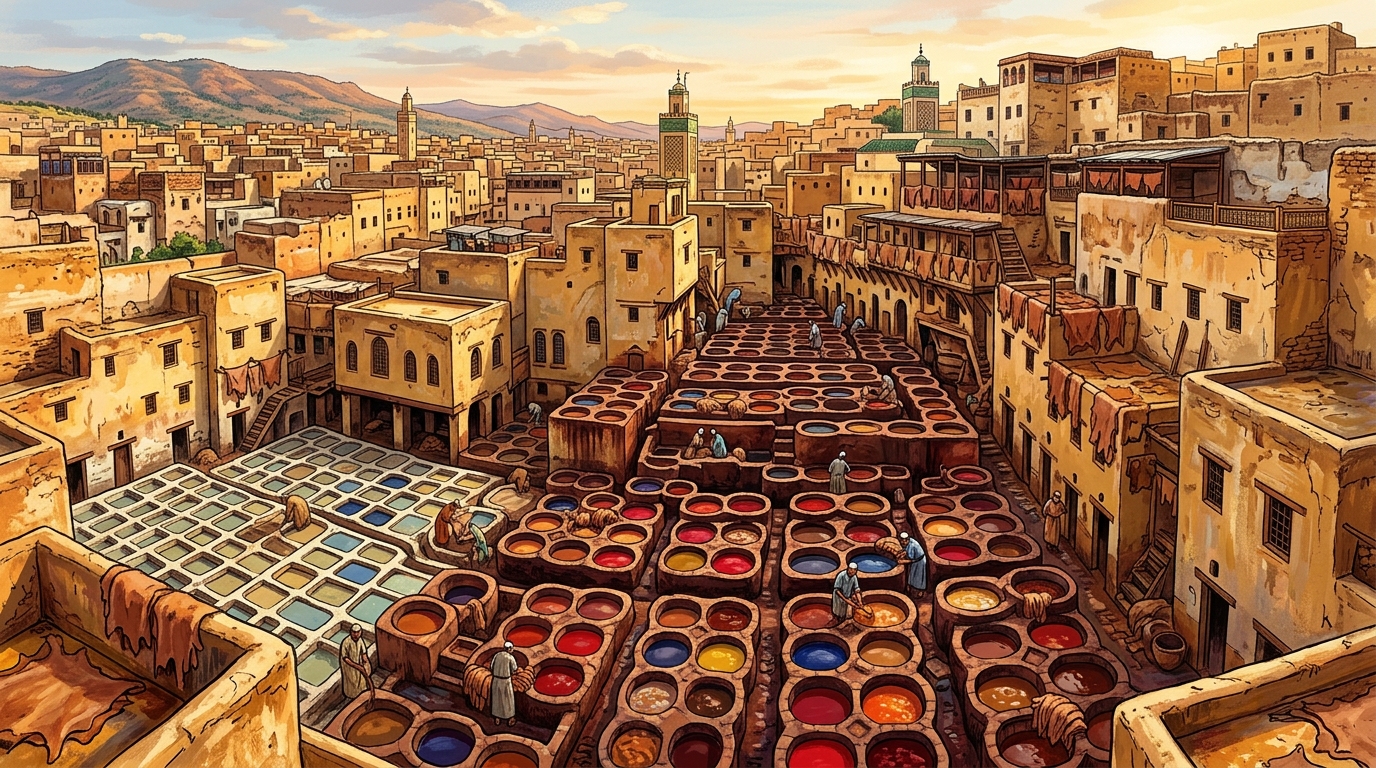
Chouara itself sits in the oldest quarter of the medina, Fes el Bali, near the historic Saffarin Madrasa and along the Oued Fes river that the tanning process has always depended on for water. That location, inside a UNESCO World Heritage Site protected since 1981 specifically for its preserved pre-modern urban fabric, is a large part of why Chouara looks today almost exactly as it does in photographs from decades earlier — the same honeycomb of stone dye pits, cut directly into the ground, that generations of tanners have worked in.
Fes el Bali was itself founded as the Idrisid capital between 789 and 808 AD, when Idris ibn Abdallah built a new settlement on the right bank of the Fez River, populated in large part by refugees fleeing political upheaval in Cordoba, in what is now Spain. That founding population brought Andalusian craft traditions with them, and tanning — alongside textile dyeing, metalwork and ceramics — became one of the trades that anchored the new city's economy from its earliest years, long before Chouara's specific pits took the shape visitors see today.

The process: pigeon droppings, quicklime and a lot of patience
The Chouara process begins with raw hides from cows, sheep, goats and camels, which arrive at the tannery still requiring hair and flesh removal before any dyeing can begin. The hides are first soaked for two to three days in a series of white, foul-smelling vats containing a mixture of cow urine, pigeon droppings, quicklime, salt and water. This is not decoration for tourists to gawk at; it is the actual chemistry of the trade. The quicklime helps loosen and remove hair from the hide, while the mild acidity in the pigeon droppings softens the leather and prepares its fibers to properly absorb dye in the next stage.
Once softened, hides move into a second set of pits filled with natural dye baths. Poppy flowers produce red, indigo produces blue, and henna produces orange and yellow-brown tones — the same category of plant-based dyes used historically in Moroccan leatherwork more broadly, including in the production of babouche slippers. Workers, almost always men, stand and move through the pits by hand and foot, treading and turning hides to ensure even color absorption, a physically demanding job performed in direct exposure to the dye mixtures for hours at a stretch.
After dyeing, the leather is pulled from the pits and laid out to dry directly in the sun on the surrounding rooftops and open surfaces of the tannery complex — the source of the colorful patchwork of drying hides visible from the viewing terraces that ring Chouara today. Only once fully dried and finished is the leather sold on to Fez's separate community of leather craftsmen, who cut and stitch it into bags, jackets, babouches and the wide range of other goods for which Moroccan leather is internationally known.
The distinctive circular arrangement of the dye pits is itself functional rather than decorative: grouping vats of a similar size and depth together let workers move efficiently between stages of the process, and the honeycomb pattern that photographs so well from above is simply the most space-efficient way to pack dozens of individual stone pits into a confined medina courtyard. What tourists now frame as an almost abstract, painterly pattern of color was designed, centuries ago, purely around workflow.

A trade passed down, not taught in a classroom
Like zellige tilework and babouche production, tanning in Fez has historically operated as a guild-based, family-transmitted trade rather than a formally schooled profession. Workers typically enter the trade through family or community ties to the tannery rather than external hiring, learning the specific sequence of soaking times, mixture ratios and dye handling through direct apprenticeship inside the pits themselves — knowledge that, like a maalem's zellige patterns, does not translate well onto a written instruction sheet.
That continuity is precisely what tourism promoters mean when they market Chouara as one of the oldest continuously operating tanneries of its kind still functioning in the world: not just an old building, but an old, essentially unautomated production process still being carried out by hand, using largely the same raw materials, in largely the same physical space, generation after generation. Visitors are typically guided up onto surrounding leather-shop terraces for an elevated view over the pits — partly for photographs, and partly, as any guide will tell you while handing over a sprig of mint, for the wind.
Chouara is not the only tannery quarter in Fez, and the wider leather district also includes the Sidi Moussa and Ain Azliten tanneries, each with its own workforce and specific product specialties, though Chouara remains the largest and by far the most visited by outsiders. Finished leather moves from the pits into an entire secondary economy of tailors, bag-makers and babouche cobblers working in surrounding medina workshops, meaning the tannery is really the first, most photogenic stage of a much longer, equally hand-driven supply chain.
The unresolved cost: chromium, health and a rehabilitation debate
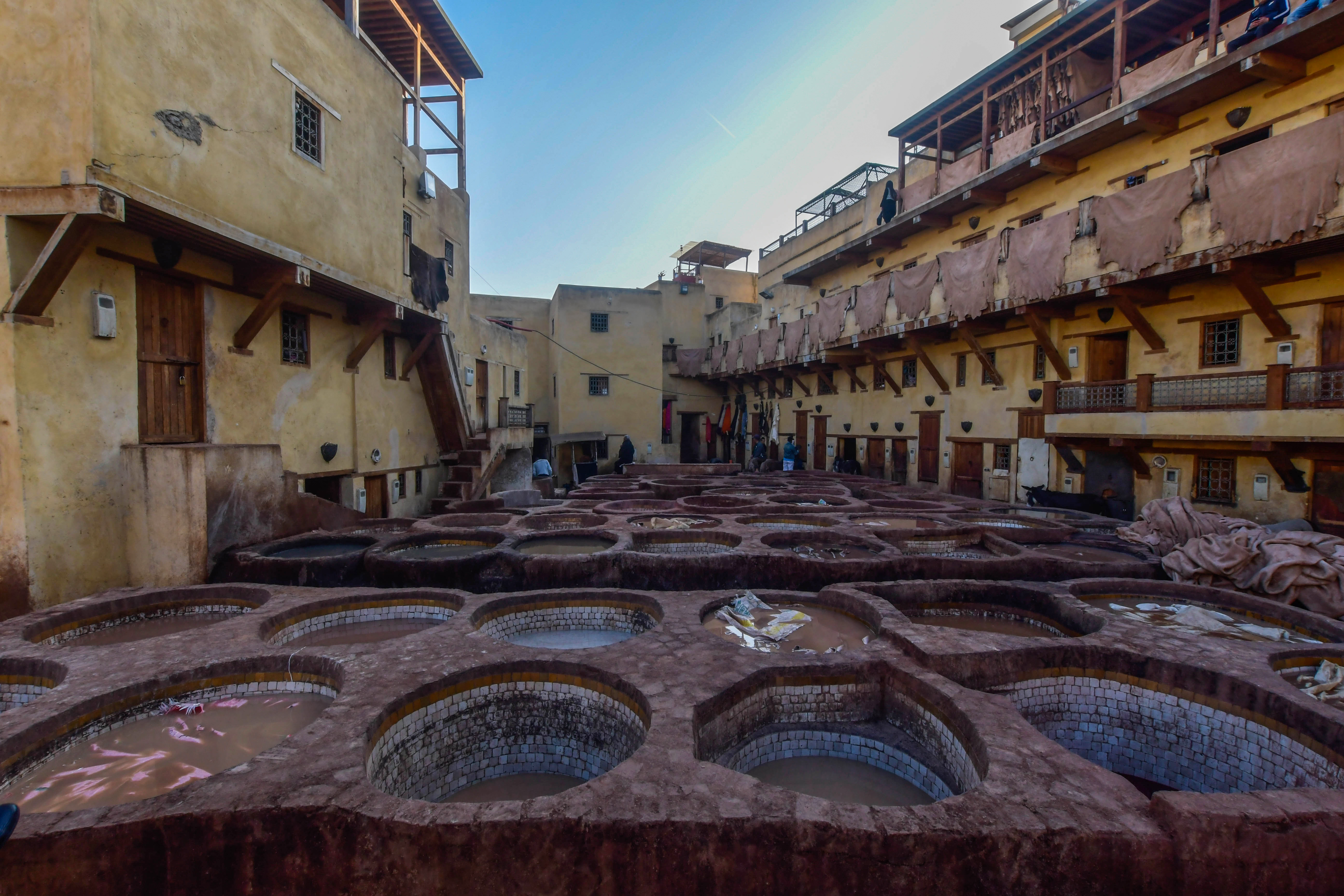
Chouara's romanticized image sits alongside a genuinely serious modern problem. Since the 19th century, chromium-based tanning agents have become widespread additions to the traditional process, and tannery workers and other residents living near the site have long reported adverse health effects tied to sustained chemical exposure, with the most serious documented cases linked to cancer and premature death. That reality complicates any simple, purely nostalgic reading of Chouara as an unchanged medieval craft; the human cost of keeping the process manual and largely unregulated has been real and ongoing.
In the 21st century that tension produced an actual public debate over the tannery's future. Moroccan-Canadian architect Aziza Chaouni led a rehabilitation project that, at various points, considered relocating tanning operations away from the historic site entirely, weighing preservation of the medina's built heritage against the health and working conditions of the people who actually work there. In the end, the tanneries were restored rather than relocated, and Chouara continues to operate on its original site — a resolution that keeps the tourist-facing history intact while leaving the underlying occupational health questions only partially addressed.
That unresolved tension is worth knowing before you buy a leather bag off a Fez terrace: the object you are holding is the product of a genuinely ancient, skilled and largely undocumented craft tradition, and also the product of a working environment that remains, for the people inside the pits, a serious and long-running occupational hazard. Both things are true of Chouara at the same time, which is part of why it remains one of the most written-about — and most misunderstood — sites in Morocco.
It is also why Chouara resists being flattened into a single tidy narrative. It is simultaneously a UNESCO-adjacent heritage site, a working industrial facility, a livelihood passed down through specific families, a serious public-health case study, and one of the most Instagrammed views in North Africa — and all five of those descriptions are accurate at once, which is a genuinely unusual thing for any single courtyard in any single city to be.
Frequently asked
How old is the Chouara Tannery?
Local tradition traces tanning in Fez back to the city's founding by Idris II around the start of the 9th century, though solid documentary evidence for Chouara specifically is thinner than for some nearby tanneries. Large-scale tanning in Fez is well documented from at least the late 12th to 13th century Almohad period.
What is used to soften the hides at Chouara?
Hides are soaked for two to three days in a mixture of cow urine, pigeon droppings, quicklime, salt and water. The quicklime removes hair, while the mild acidity in the pigeon droppings softens the leather and helps it absorb dye.
What natural dyes are used at the Fez tanneries?
Poppy flowers produce red, indigo produces blue, and henna produces orange and yellow-brown tones, the same category of plant-based dyes historically used in Moroccan leatherwork more broadly.
Is the Chouara Tannery the oldest tannery in the world?
It is widely reputed to be among the oldest continuously operating tanneries in the world, though precise founding-date evidence is limited. What is well documented is that Fez had dozens of active tanning workshops by the Almohad and Marinid periods, roughly 700 to 800 years ago.
Why is there a UNESCO connection to the Fez tanneries?
Chouara sits inside Fes el Bali, part of the Medina of Fez, which UNESCO inscribed as a World Heritage Site in 1981 for its preserved pre-modern urban layout and historic monuments, including its traditional craft districts.
Why do visitors get handed mint leaves at the tannery?
The tanning process, involving cow urine, pigeon droppings and animal hides, produces a very strong smell. Guides hand visitors sprigs of mint to hold near their nose while viewing the pits from the surrounding terraces.
Are there health risks associated with the Fez tanneries?
Yes. Since the 19th century, chromium-based tanning agents have been widely used alongside traditional methods, and tannery workers and nearby residents have long reported serious health effects from prolonged chemical exposure, including cancer.
Was the Chouara Tannery ever going to be relocated?
A 21st-century rehabilitation project led by architect Aziza Chaouni considered relocating tanning operations away from the historic site to address health and working conditions, but ultimately the tanneries were restored and left in place.
How many tanneries are there in Fez?
Chouara is one of three tanneries in Fez and is the largest of them.
What happens to the leather after it is dyed at Chouara?
After dyeing, hides are dried in the sun on the tannery's rooftops and open surfaces, then sold to Fez's leather craftsmen working in separate medina workshops, who turn it into bags, jackets, babouches and the wider range of leather goods Morocco exports internationally.
- Wikipedia — Chouara Tannery ↗
- Wikipedia — Fes el Bali ↗
- Morocco World News — Chouara, Birthplace of Morocco's Tannery Industry ↗
- Ancient Origins — The Ancient and Vibrant Leather Tanneries of Fez, Morocco ↗
- Moroccan Corridor — The Leather Tradition of Fez ↗
Video via official YouTube embeds; photos via Wikimedia Commons under their stated licenses. All rights belong to the respective owners; 212 Daily claims no ownership.