Fes vs Marrakech vs the Sahara: Why Morocco's Regional Cuisines Taste So Different
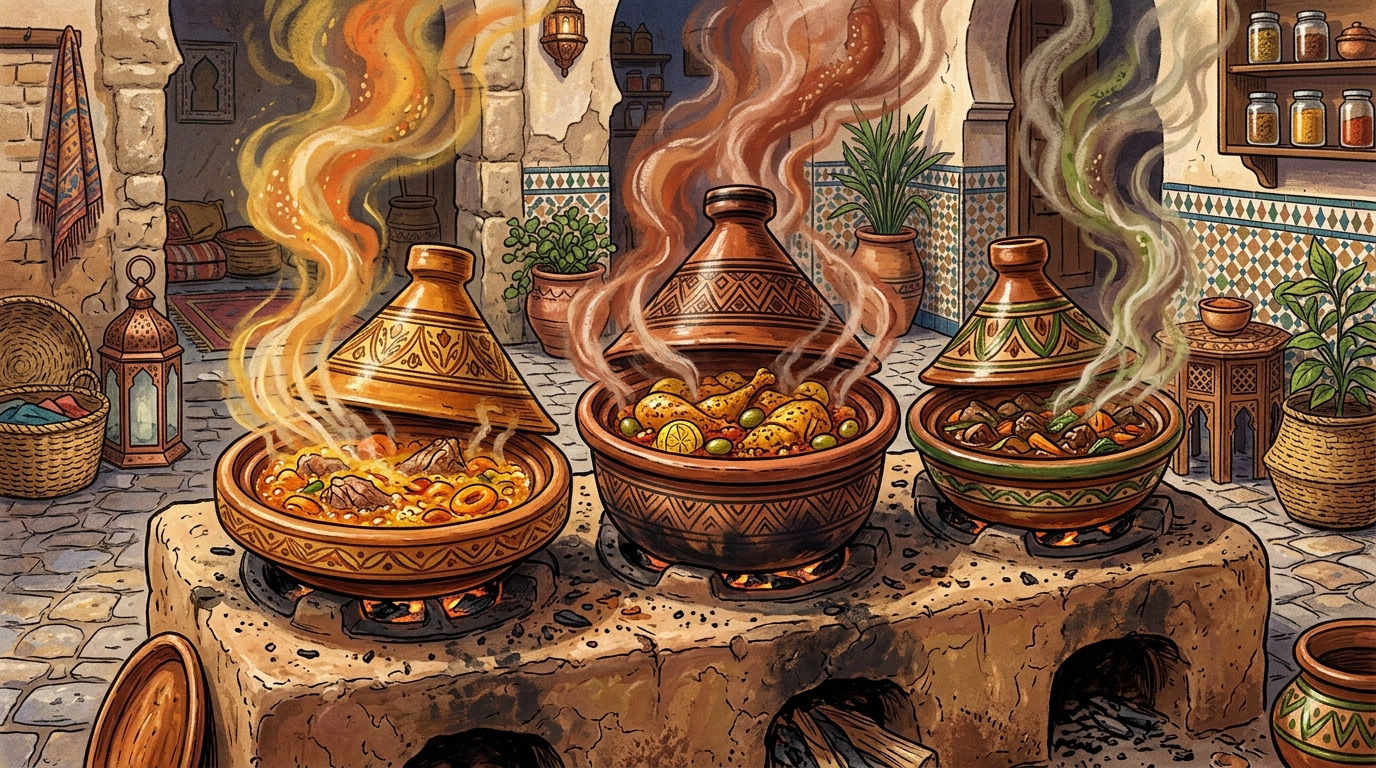
One country, three culinary worlds
Moroccan cuisine is often flattened abroad into a single idea: tagine, couscous, mint tea, repeat. In Morocco itself, cooks would find that framing strange. A meal in Fes, the old imperial capital of the north, does not taste like a meal in Marrakech, the Berber gateway city of the south-central plains, and neither resembles what is eaten in the oasis towns and pre-Saharan villages further south, around Zagora, Rissani and the Tafilalt. The same base ingredients — semolina, lamb, olive oil, saffron, preserved lemon, dates, mint — get assembled into entirely different food cultures depending on where you are standing.
The shared vocabulary is real: couscous on Fridays, some form of tagine most days, bread with every meal, mint tea poured from height at the end. But within that shared vocabulary sits enormous regional variation in technique, spicing, ceremony and what counts as an everyday dish versus a special-occasion one. Fes cooking leans toward sweet-savory complexity and formal presentation. Marrakech cooking leans toward smoky, communal, market-driven abundance. Southern and Saharan cooking leans toward practicality, preservation and ingredients that survive heat and distance.
None of this is accidental. Each region's food developed the way it did because of who settled there, what routes passed through it, and what the land and climate allowed. The rest of this piece looks at each region in turn, then traces the historical threads — Andalusian refugees, Amazigh tribal tradition, trans-Saharan trade, and later French colonial contact — that explain why a plate of food in Fes, Marrakech and the Sahara can look so different while still being unmistakably Moroccan.
Fes: the imperial city's Andalusian refinement
Fes was founded in the 8th century and grew into Morocco's great intellectual and spiritual capital, and its food carries that imperial weight. The single biggest reason Fes cuisine reads as refined rather than rustic is a wave of migration: Muslims and Jews expelled from Al-Andalus by Christian rulers over several centuries settled in cities like Fes and Tetouan, and they brought advanced agricultural knowledge, formal table etiquette, and intricate recipes with them. Fes did not just inherit dishes from Muslim Spain — it inherited an entire cooking philosophy built around layering, patience and presentation.
The clearest expression of that inheritance is pastilla (also spelled bastila or bstila), the dish most associated with Fassi cooking anywhere in the world. Sheets of impossibly thin warqa pastry are layered around a filling traditionally made with pigeon or chicken, spiced scrambled eggs and ground almonds, then baked and finished with a dusting of powdered sugar and cinnamon on top of the savory pie. That sweet-over-savory finish traces back to classical Arab cuisine that traveled from Damascus to Al-Andalus under the Umayyads and then crossed the strait into Morocco with the Andalusian arrivals — a direct culinary line running from the eighth century to a Fassi dinner table today.
Beyond pastilla, Fes cooking is defined by a lighter, more precise hand with spice than its southern counterparts: dishes built around preserved lemon and olives, delicate use of saffron and ras el hanout, and slow, formal tagines rather than smoky open-fire cooking. Food writers and chefs regularly call Fes the culinary capital of Morocco for exactly this reason — it is where Moroccan cooking became a court cuisine, refined over centuries inside the kitchens of an imperial city rather than developed for the road or the herd.

Marrakech: Berber roots and the theatre of the souk
Marrakech tells a different origin story. Founded in the 11th century by the Almoravids, an Amazigh (Berber) dynasty that rose out of the Sahara and the High Atlas, the city grew as the great meeting point between the mountains, the plains and the caravan routes heading south into the desert. Its food reflects that: Marrakech cuisine is built on Amazigh foundations first, with Arab and later Andalusian influences layered on top rather than dominating outright, and it has always been shaped by what a market city needs — variety, volume and dishes that can feed crowds.
The tagine itself, the conical earthenware pot that has become shorthand for Moroccan food worldwide, is widely understood as a Berber invention, designed to slow-cook meat and vegetables gently over embers with almost no water in a landscape where fuel and water were both precious. Marrakech is also the historic home of tangia, a dish invented not in kitchens but by working men: bachelor laborers would pack a clay urn with meat, preserved lemon, garlic and spices in the morning, drop it off at the neighborhood hammam furnace on their way to work, and collect it that evening, slow-cooked all day by the embers of the bathhouse fire — a men's communal dish born of the rhythms of city labor.
That communal, market-driven spirit reaches its fullest expression after dark in Jemaa el-Fnaa, the square at the heart of Marrakech's medina, where food culture has played out for centuries — Spanish traveler Luis del Mármol Carvajal described the square's bustle as far back as 1573, and UNESCO recognized it as a Masterpiece of the Oral and Intangible Heritage of Humanity in 2001. Along Mechoui Alley, whole lambs are lowered into clay pit ovens dug into the ground and left to cook for hours until they fall apart, a technique some family stalls, like the long-running Chez Lamine Hadj Mustapha, have practiced since the 1960s. As evening falls, dozens of stalls fill the square with grilled meats, snail soup and harira, turning Marrakech's cuisine into something closer to street theater than a fixed menu.

The Sahara and the south: nomadic and oasis cooking
South of the High Atlas, the food logic changes again, dictated less by imperial courts or bustling souks than by the oasis and the caravan. Towns like Zagora, Rissani and Merzouga sit in the Tafilalt and the pre-Saharan valleys, where date-palm groves and underground irrigation channels have supported Amazigh communities for over a thousand years. Nearby Sijilmasa, founded in the 8th century close to present-day Rissani, was for centuries the northern terminus of the trans-Saharan caravan trade — the point where gold, salt and goods crossing the desert from West Africa met the routes running north to Fes and the Mediterranean. That history left southern cuisine oriented around what travels well and what the oasis itself produces: dates above all, along with barley, dried vegetables and preserved meat.
The signature dish of this region is medfouna, popularly nicknamed "Berber pizza" — a stuffed flatbread whose name comes from the Arabic word for "buried," describing how it was traditionally cooked. Unlike an open flatbread, medfouna is completely sealed, with a filling of spiced meat, onions, nuts and herbs enclosed inside the dough before it is buried under hot embers or desert sand and left to bake, creating a moist, steam-cooked pocket with no pots or pans required. It began as a practical dish for Amazigh travelers and traders on long desert journeys and remains strongly associated with the Zagora and Rissani area today, prepared for celebrations as well as everyday meals.
Elsewhere, the same pastoral logic holds: dates function as a staple food and a natural sweetener rather than an occasional treat, couscous in the south is often made with barley or simpler vegetable combinations depending on what an oasis harvest allows, and mint tea is poured constantly, both as hospitality and as a practical, high-energy drink suited to a harsh desert climate. Where Fes cooking shows off and Marrakech cooking performs, southern and Saharan cooking conserves — built around ingredients that keep, techniques that need no equipment, and a rhythm set by the oasis and the caravan rather than the palace kitchen.

Why the food differs: geography, trade and history
Line the three regions up and the causes behind the differences become clear. Fes's refinement comes from a specific historical injection: waves of Andalusian Muslims and Jews, expelled from Iberia over several centuries, settling in an existing imperial capital and bringing a sophisticated, literate food culture with them. Marrakech's character comes from continuity and position — an Amazigh-founded city sitting exactly where the Atlas Mountains, the agricultural plains and the Saharan caravan routes meet, absorbing goods and influences from every direction without any single wave of migration overwriting what was already there. The south's simplicity comes from geography doing the deciding: an oasis economy, a caravan-trade history running through Sijilmasa, and Amazigh tribal traditions that stayed comparatively continuous, less disrupted by the large-scale foreign settlement that reshaped the northern imperial cities.
A later, more uneven layer sits on top of all three: the French protectorate, which governed Morocco from 1912 to 1956. Its culinary fingerprints — café culture, patisserie techniques, the ubiquitous baguette alongside traditional khobz — are visible across Moroccan cities generally, including Fes and Marrakech, blended into rather than replacing existing food traditions. That influence thins out the further south and the further from colonial-era administrative centers you go, leaving Saharan and rural Amazigh cooking comparatively closer to its pre-colonial form.
One ritual, though, cuts across all three regions and tells its own trade story: mint tea. The green tea at its base did not originate in Morocco at all — it arrived with British and Dutch merchants navigating new trade routes in the 18th century, and its use exploded after 1854, when the Crimean War shut British merchants out of their usual Baltic markets and left warehouses full of Chinese gunpowder green tea with nowhere to go. Traders redirected it to Moroccan ports like Essaouira and Tangier, selling it cheaply, while imported sugar — increasingly affordable through the same trade networks — completed the recipe. What began as an imported luxury for wealthy households spread into the shared daily ritual that unites a Fassi salon, a Marrakech riad and a desert tent alike, even as the food surrounding it stays defiantly regional.

Tasting the difference for yourself
If you only remember one shorthand, make it this: Fes for the dish that took centuries of court cooking to perfect, Marrakech for the dish that was built to feed a crowd in a square, and the Sahara for the dish that had to survive a journey across sand with no kitchen at all. Order pastilla in a Fes medina restaurant and you are eating an eight-hundred-year-old Andalusian recipe reworked into an art form. Watch a whole lamb come out of a clay pit on Mechoui Alley and you are watching a Berber market tradition that predates the modern city around it. Split open a medfouna near Zagora and you are eating a dish invented for people who could not stop moving.
None of these regional identities are sealed off from each other — tagines are cooked everywhere, couscous is eaten everywhere, and Fassi families make mechoui just as Marrakchi families make pastilla for special occasions. The differences are of emphasis and origin, not exclusivity, and that overlap is itself part of the story: centuries of trade and movement meant no Moroccan region ever cooked in total isolation.
That is, in the end, the real answer to why Fes, Marrakech and the Sahara taste different: not three separate cuisines invented from nothing, but one country's food history, recorded in three regional accents — imperial court, market crossroads, and desert caravan — each still audible on the plate today.
Frequently asked
What is the main difference between Fes and Marrakech cuisine?
Fes cuisine is generally more refined and formal, shaped by Andalusian refugees who brought sophisticated pastry work and delicate spicing, with signature dishes like pastilla built around preserved lemon and precise sweet-savory layering. Marrakech cuisine is more market- and street-driven, rooted in Amazigh (Berber) tradition, built around communal dishes like tagine, mechoui and tanjia that reflect the city's role as a crossroads between the mountains, the plains and the Sahara.
What is pastilla and why is it associated with Fes?
Pastilla (also spelled bastila or bstila) is a savory-sweet pie made from layers of thin warqa pastry, traditionally filled with pigeon or chicken, spiced eggs and almonds, and topped with powdered sugar and cinnamon. It is associated with Fes because its origins trace to Andalusian cooks who settled there, bringing a classical Arab-Andalusian tradition of layering sweet and savory flavors that Fassi kitchens refined over centuries.
Why is Fes cuisine influenced by Andalusian cooking?
Muslims and Jews fleeing a series of expulsions from Al-Andalus (Muslim Spain) settled in Moroccan cities including Fes and Tetouan over several centuries. They brought advanced agricultural knowledge, refined table customs and intricate pastry and spice techniques, which became embedded in Fes's cuisine and helped establish its reputation as Morocco's most refined culinary tradition.
What is mechoui and where can you find it?
Mechoui is whole lamb (or mutton) that is marinated and slow-roasted, traditionally in a clay pit oven dug into the ground and cooked for hours until the meat falls apart. It is closely associated with Marrakech, particularly Mechoui Alley near Jemaa el-Fnaa, where family-run stalls have prepared it this way for generations.
What is tanjia and how did it originate?
Tanjia is a slow-cooked meat dish, seasoned with preserved lemon, garlic and spices, sealed in a clay urn. It originated in Marrakech among bachelor laborers, who would pack the urn in the morning, leave it at the neighborhood hammam furnace to cook all day in the embers, and collect it in the evening for a shared meal.
What is madfouna (Berber pizza)?
Madfouna, also spelled medfouna, is a stuffed flatbread from Morocco's southern oasis regions, particularly around Zagora and Rissani. Its name means 'buried,' referring to how the sealed, filled dough is traditionally cooked under hot embers or desert sand rather than in an oven. It developed as a practical dish for Amazigh travelers who needed a filling meal without pots, pans or a fixed kitchen.
Why is Saharan and southern Moroccan cuisine simpler than food in Fes or Marrakech?
Southern and Saharan cooking developed around oasis agriculture and nomadic or caravan life rather than an imperial court or a major trading city. Dates, barley, preserved meats and dishes that require no cooking equipment reflect a food culture shaped by practicality, scarce resources and the demands of desert travel rather than courtly refinement.
Did the French protectorate influence Moroccan cuisine?
Yes, though unevenly. French colonial rule from 1912 to 1956 introduced patisserie techniques, cafe culture and the baguette, which blended into existing Moroccan food traditions in cities like Fes, Marrakech, Casablanca and Rabat. That influence is generally less pronounced in rural Amazigh and southern Saharan communities, where pre-colonial food traditions remained more continuous.
Why is mint tea common across all of Morocco despite regional food differences?
Mint tea's base ingredient, green tea, arrived in Morocco through European trade in the 18th and 19th centuries, becoming especially widespread after the Crimean War in 1854 flooded Moroccan ports like Essaouira with cheap Chinese green tea. As sugar became more affordable through the same trade routes, the drink spread from a wealthy luxury into a shared daily ritual practiced in Fes, Marrakech and the Sahara alike, even as the surrounding food culture stayed regional.
Is couscous prepared differently in different regions of Morocco?
Yes. While couscous is eaten across the country, typically on Fridays, the vegetables, meats and grains used vary by region and by what local agriculture or oasis harvests provide, so a couscous in Fes, a couscous in Marrakech and a couscous in a southern oasis town can differ noticeably in ingredients even when the basic semolina base and steaming technique are the same.
- Wikipedia — Pastilla ↗
- Wikipedia — Medfouna ↗
- Wikipedia — Maghrebi mint tea ↗
- Wikipedia — Trans-Saharan trade ↗
- Wikipedia — French protectorate in Morocco ↗
- National Geographic — Where to eat in Fez, Morocco ↗
Video via official YouTube embeds; photos via Wikimedia Commons under their stated licenses. All rights belong to the respective owners; 212 Daily claims no ownership.