Tbourida: Inside Morocco's Thunderous Fantasia Horse Tradition
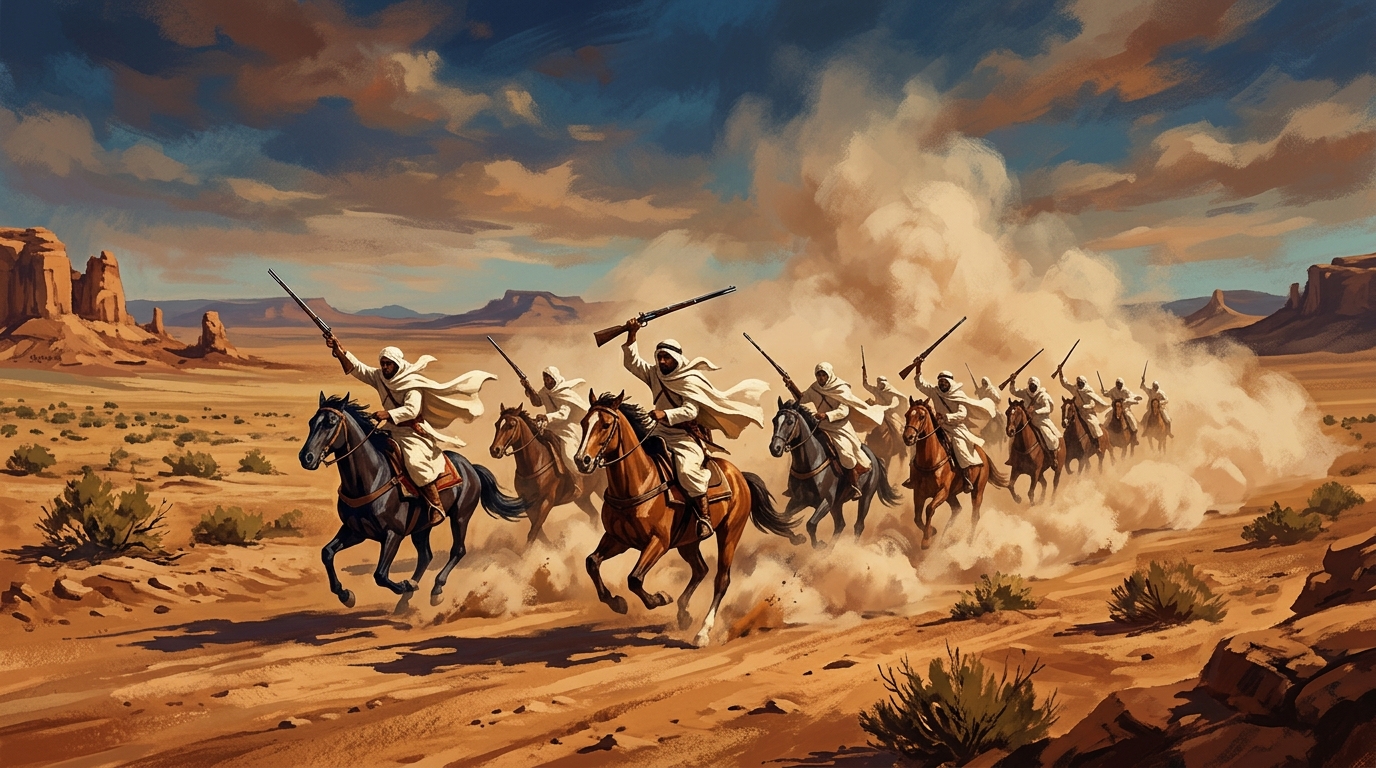
A cavalry charge frozen into performance
Tbourida's name comes from baroud, the Arabic word for gunpowder — a direct linguistic pointer to what the performance actually simulates. It is also widely known as lab al-baroud, literally 'the gunpowder game,' and internationally as Fantasia, a term of Latin-derived origin meaning something closer to spectacle or display, adopted by European observers rather than by Moroccans themselves. The tradition is generally dated to at least the 15th century in its current Moroccan form, though some historians trace the deeper roots of the underlying cavalry technique much further back, to the mounted charges of Numidian cavalry in ancient North Africa, with later development attributed to Arab and Amazigh tribal horsemanship from around the 17th century onward.
The performance directly reenacts a specific moment from real historical warfare: the charge of an army's mounted vanguard immediately before contact with the enemy, along with the raiding charges historically used between rival tribes and the celebratory volleys fired to mark victories or major tribal and religious occasions. What was once a genuine battlefield maneuver has been preserved, almost intact in choreography, as a purely ceremonial performance — Morocco's answer to the way other cultures have turned obsolete martial arts into modern demonstration sport, except here the 'sport' still uses real horses, real black-powder rifles, and a real, physically demanding cavalry charge rather than a stylized simulation.
Tbourida-style equestrian performance is not unique to Morocco; related traditions are documented across Algeria, Tunisia, Libya, Mauritania, Mali and Niger, reflecting a shared North African and Saharan cavalry culture that long predates the modern national borders separating those countries today. Morocco's specific version, however, has developed the clearest formal structure, the strongest institutional backing, and — as of 2021 — the only UNESCO Intangible Cultural Heritage listing among them.
The word Fantasia itself is worth pausing on, because it is almost entirely a foreign import into how the tradition is described. Moroccans overwhelmingly use tbourida or lab al-baroud; 'Fantasia' is the term that spread through European travel writing and later international tourism marketing, drawn from a Latin-rooted word for imaginative spectacle rather than from any Arabic or Amazigh source. That naming gap is a useful reminder that much of what outsiders call 'Fantasia' is, to the people actually performing it, understood first and foremost as a martial art and a competitive discipline, not a piece of exotic theater staged for visitors.

The sorba: an odd number of riders, one chief
A tbourida troupe is called a sorba, and its structure is precise rather than casual. Each sorba fields an odd number of horsemen — traditionally between fifteen and twenty-five — lined up in a single row, with a designated leader, the muqaddam (also transliterated mokaddem), positioned in the center of the line on his own mount. The muqaddam is typically the most experienced rider in the group, responsible for coordinating the timing of the charge, the halt, and above all the simultaneous firing of every rifle in the troupe at the climax of the run.
That timing is the entire technical challenge of the discipline. Riders must accelerate together, hold a dead-straight line at speed across roughly two hundred meters, then stop together and raise their rifles to fire in the same fraction of a second, so that dozens of individual gunshots merge into what should sound, to an audience, like a single unified report. A ragged, staggered volley is considered a visible failure of the performance, regardless of how impressive the galloping formation looked moments earlier — the discharge is the whole point, and it either lands as one sound or it does not.
The horses themselves are bred specifically for this work, drawn from Barb stock — a hardy North African breed prized historically for cavalry use — or increasingly from Arab-Barb crosses that combine the Barb's toughness with additional speed and refinement from Arabian bloodlines. Training a horse and rider pair to hold a straight line at a full gallop immediately next to twenty-odd other galloping horses, then stop cleanly on cue, represents years of paired practice rather than a skill picked up casually.
That horse-and-rider bond is treated, within the tradition, as inseparable from the performance's meaning. A rider does not rotate between different horses the way a modern equestrian competitor might; a serious tbourida horse and its rider train together, often for years, learning each other's specific rhythm and response before ever competing as part of a full sorba. Losing formation discipline at speed is not just embarrassing for a rider — with that many horses running flank to flank at a full gallop, it is a genuine safety risk, which is precisely why the pairing and training investment behind each individual horse-rider unit is taken so seriously by competitive troupes.

The costume and the rifle
Riders compete in full traditional dress, not modern equestrian gear: a kaftan or djellaba, loose serwal trousers, a selham cape, a wound turban called a rezza, and traditional leather riding boots known as tmagh. Most riders also carry a small Quran booklet and a khanjar dagger, and some troupes add a curved nimcha saber worn across the back — a costume that is, in effect, the same formal dress vocabulary found in other Moroccan ceremonial contexts, repurposed for a mounted, martial performance rather than a wedding or a religious procession.
The rifle itself has a specific name and history: the moukahla, a traditional long-barreled, muzzle-loading black powder gun, often inherited within families and, for serious troupes, maintained and sometimes hand-decorated as a valued heirloom rather than treated as disposable equipment. Loading and firing a moukahla safely from a moving, then abruptly halted, horse, in close proximity to dozens of other riders doing the same thing at the same instant, is itself a skill that takes real practice to execute without incident — tbourida troupes train specifically around the safety choreography of the simultaneous discharge, not just the galloping formation.
Beyond the individual rider's kit, tbourida performances are historically tied to specific cultural occasions rather than staged as standalone entertainment: moussems (regional religious and cultural festivals), agricultural festivals, weddings, and major national celebrations have traditionally provided the occasions for a sorba to perform, embedding the tradition within Morocco's broader festival calendar rather than treating it as an isolated tourist spectacle, even though modern tourism has also created a market for standalone tbourida demonstrations.

UNESCO recognition and the modern competitive circuit
On December 15, 2021, UNESCO formally inscribed tbourida on its Representative List of the Intangible Cultural Heritage of Humanity, following a nomination submitted by Morocco's Ministry of Culture together with SOREC (the Société Royale d'Encouragement du Cheval, Morocco's royal horse-breeding and equestrian development body) and four local tbourida associations. The listing formally recognized the tradition's centuries-old military origins, its living transmission across generations of riders and horse breeders, and its ongoing role in Moroccan festival culture — the same category of protective international recognition Morocco has since pursued for other traditions including the caftan and zellige.
Alongside that heritage status, tbourida has developed a genuine modern competitive structure. Morocco's Hassan II National Tbourida Trophy is held annually, most prominently in the coastal city of El Jadida, drawing on the order of 330 competing troupes from across the country to be judged on the precision of their charge, the straightness of their line, their formation discipline and, decisively, the unity of their simultaneous rifle discharge. That competition sits alongside SOREC's broader mandate to support horse breeding and equestrian sport nationally, giving tbourida an institutional backbone — funding, judging standards, a national ranking circuit — that few other traditional Moroccan performing arts currently have.
The combination of UNESCO protection and an active national competitive calendar has helped keep tbourida a living, evolving tradition rather than a museum piece revived only for tourists. Troupes still train year-round, horses are still bred specifically for the discipline, and families still pass moukahla rifles and riding skill down across generations — meaning that whatever a visitor sees at a moussem or a national trophy event today is not a costumed reenactment staged for cameras, but the current, still-competitive edge of a genuinely unbroken equestrian tradition.
SOREC's involvement also connects tbourida to the wider structure of Moroccan horse breeding and equestrian sport, positioning the tradition alongside more internationally familiar disciplines like show jumping and endurance racing within the country's official equestrian development strategy, rather than treating it as a separate folkloric category disconnected from modern sporting infrastructure. That institutional integration is a large part of why tbourida has managed to modernize its organization and safety standards while keeping its core choreography — the charge, the halt, the single unified shot — essentially unchanged from the cavalry maneuver it was always meant to reenact.

Frequently asked
What is tbourida?
Tbourida is a traditional Moroccan equestrian performance in which a line of horsemen gallops in synchronized formation before halting and firing antique rifles into the air simultaneously, reenacting a historical cavalry charge. It is internationally known as Fantasia.
Where does the word 'tbourida' come from?
It derives from baroud, the Arabic word for gunpowder. The tradition is also called lab al-baroud, 'the gunpowder game,' referring to the black-powder rifle volley at its climax.
How old is tbourida?
The tradition in its current Moroccan form is generally dated to at least the 15th century, though the underlying cavalry charge technique is sometimes traced further back to ancient Numidian cavalry, with tribal Arab-Amazigh horsemanship developments noted from around the 17th century.
What is a sorba?
A sorba is a tbourida troupe, made up of an odd number of riders, traditionally between fifteen and twenty-five, lined up together and led from the center by a muqaddam, or troupe chief.
What rifle is used in tbourida?
A traditional muzzle-loading black powder gun called the moukahla, often a family heirloom, fired by all riders simultaneously at the end of the charge to produce a single unified shot.
What horses are used for tbourida?
Primarily Barb horses, a hardy North African breed historically used for cavalry, or Arab-Barb crosses combining Barb toughness with Arabian bloodline speed and refinement.
What do tbourida riders wear?
Traditional dress including a kaftan or djellaba, serwal trousers, a selham cape, a turban called a rezza, leather boots called tmagh, and often a khanjar dagger and sometimes a nimcha saber.
Is tbourida recognized by UNESCO?
Yes. On December 15, 2021, UNESCO inscribed tbourida on its Representative List of the Intangible Cultural Heritage of Humanity, following a nomination from Morocco's Ministry of Culture, SOREC and four local tbourida associations.
Is there a national tbourida competition in Morocco?
Yes, the Hassan II National Tbourida Trophy, held annually and most prominently in El Jadida, drawing around 330 competing troupes judged on formation precision, line discipline and the unity of their simultaneous rifle discharge.
Is tbourida unique to Morocco?
No, related traditions exist across Algeria, Tunisia, Libya, Mauritania, Mali and Niger, reflecting a shared North African and Saharan cavalry heritage, though Morocco's version has the clearest formal structure and, as of 2021, the only UNESCO heritage listing among them.
- Wikipedia — Tbourida ↗
- Visit Morocco — Tbourida: Moroccan Equestrian Art ↗
- SOREC — Tbourida ↗
- Yabiladi — Tbourida: Inside Morocco's Equestrian War Legacy ↗
- National Geographic — Pictures of Fantasia Horse Riders in Morocco ↗
Video via official YouTube embeds; photos via Wikimedia Commons under their stated licenses. All rights belong to the respective owners; 212 Daily claims no ownership.