Elder Respect in Morocco: The Customs Behind One of Its Deepest Values
Where the value comes from
Respect for elders in Morocco draws heavily on Islamic teaching, which places caring for and honoring parents and older relatives among the most emphasized obligations in the faith, described in the Quran alongside the command to worship God alone. A frequently cited passage instructs believers that if their parents reach old age in their care, they must not speak to them with even a word of disrespect, but address them in terms of honor — language many Moroccans learn early and treat as a genuine behavioral standard rather than abstract scripture.
Beyond religious grounding, Moroccan family structure has historically reinforced the same value through simple proximity: multigenerational households, where grandparents, parents, children, and sometimes aunts, uncles, and cousins live together or nearby, remain common, particularly outside the largest cities. That closeness creates ongoing daily contact between generations rather than the periodic visits more typical of societies where elders and adult children live separately, and daily contact tends to reinforce, rather than erode, the expectation of visible deference and care.
Respect in this context is described by many Moroccans as something closer to the organizing value of family and social life altogether — not narrowly about elders, but extending to parents, teachers, employers, and community more broadly, with respect for elders sitting at the most emphasized end of that wider spectrum.

The specific customs: greetings and gestures
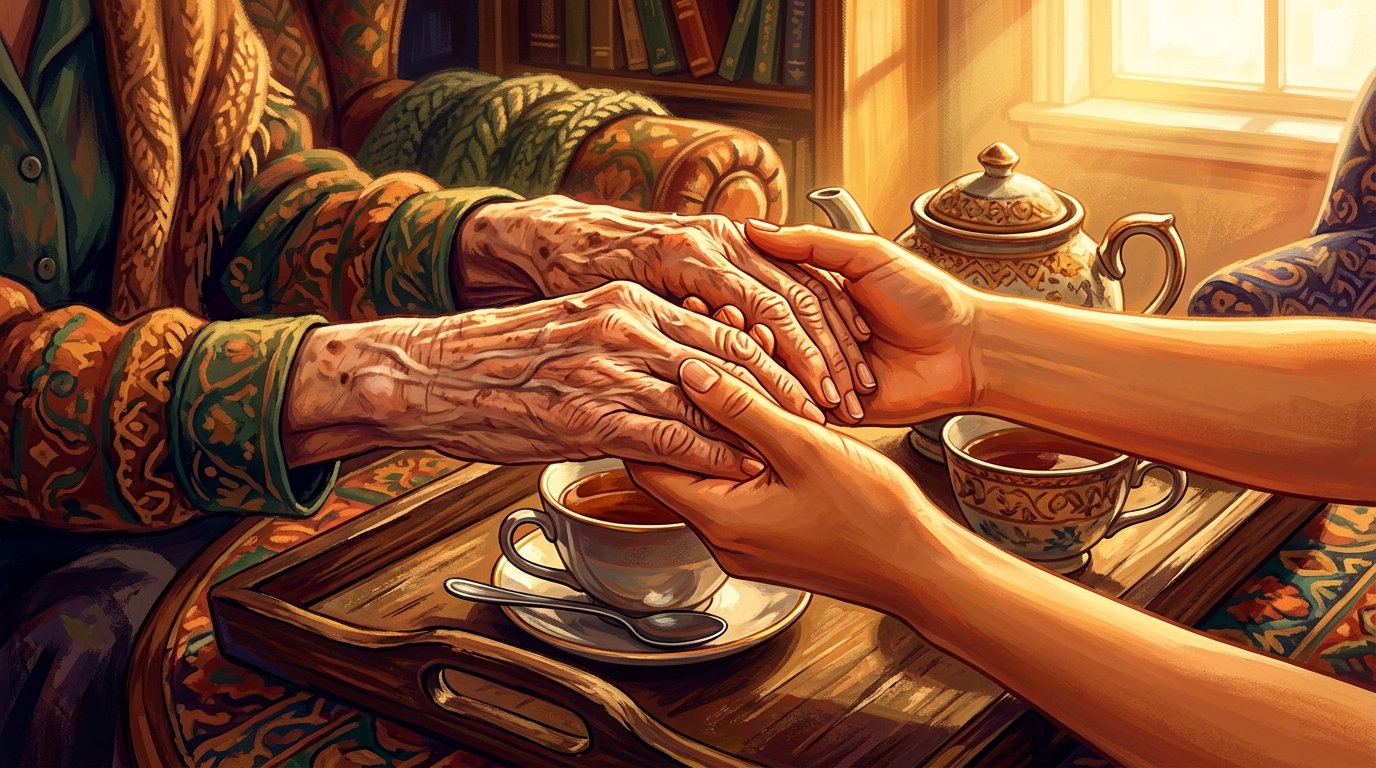
The most visible marker of elder respect in Morocco is hand-kissing. It's common practice for a younger person to kiss the hand of a grandparent, or another elder considered deserving of special respect, as part of a greeting — a custom seen far more consistently with grandparents than, say, with a relatively young father, suggesting the gesture is tied more to age and generational seniority than to the parent-child relationship alone. Often, when an elder extends a hand toward a child, the child moves to kiss it, and the elder pulls the hand back partway in a small gesture of humility, a tiny back-and-forth exchange of respect and modesty repeated constantly across Moroccan households.
Standing when an elder enters a room is another widely observed norm — remaining seated while an older relative or guest is still standing is generally considered a small breach of manners. Speech patterns shift too: Moroccans are generally taught to address elders in a gentler, more deferential tone than they might use with peers, avoiding interruption, argument, or a raised voice, particularly in front of others.
Children are also taught specific respectful terms of address for adults generally, not only direct family: adult men are commonly addressed as ami ("my uncle") and adult women as khalti ("my aunt"), even by children entirely unrelated to them, extending family-style respect language into the wider community rather than reserving it strictly for blood relatives.

Everyday deference: seating, serving, and speaking order
Respect for elders also shapes smaller, less obviously ceremonial moments of daily life. At a family meal, elders are commonly served first or offered the best portion of a shared dish, and seating arrangements at gatherings often informally reflect generational hierarchy, with elders given the most comfortable or prominent position in the room. During tea service, the youngest person present often takes on the job of pouring and serving, a small but consistent way that age hierarchy gets expressed even in a purely social, relaxed setting.
In conversation and decision-making, elders are typically given deference as well: younger family members are generally expected to let an elder speak first or finish uninterrupted, and major family decisions — from a wedding date to a large purchase — are frequently discussed with, or deferred to, the input of grandparents or the family's eldest members, even in households where those elders no longer hold direct financial authority over the decision.
None of this is treated in Morocco as a special, occasional performance of politeness — it functions as background, near-automatic behavior, absorbed by children through repetition and correction long before they could explain the religious or cultural reasoning behind it, in much the same way children elsewhere absorb table manners or basic greetings.
Caring for aging parents: obligation, not option
The respect shown to elders in daily interaction is closely tied to a broader expectation around practical care as parents age. In Islamic teaching that shapes much of Moroccan family culture, caring for aging parents is treated as a serious duty shared between adult children — sons and daughters alike are generally expected to contribute to a parent's care and well-being in old age, whether through direct caregiving, financial support, or coordinating shared responsibility among siblings.
In practice, this has translated into a strong cultural preference for elderly parents living with or very near their adult children rather than in separate elder-care facilities, and research on aging Moroccan populations has found that a large share of elderly Moroccans live with their children and rely on them as the primary source of both informal caregiving and financial support, rather than on institutional care or state-provided services.
That said, this pattern is not static. Social changes — including more women working outside the home, a group that has traditionally shouldered much of the informal caregiving burden within Moroccan families, along with urbanization and smaller living spaces in major cities — have put real pressure on the multigenerational-household model in recent decades. A modest but growing number of residential elder-care homes, most run by nonprofit or charitable organizations rather than as a fully developed for-profit sector, have emerged to fill some of the resulting gap, even as living with family remains the strongly preferred default for most Moroccan families able to manage it.

Elders as a source of authority, not just affection
It's worth distinguishing Moroccan elder respect from a purely sentimental or affectionate framing, since it also carries real functional weight within the family. Grandparents and other senior relatives are frequently treated as informal arbiters in family disputes, sought out to mediate disagreements between siblings, in-laws, or even neighbors, precisely because their age and accumulated experience are understood to carry a kind of earned authority that a younger relative's opinion would not automatically command.
This authority extends into practical household matters as well. Even in families where an elder no longer works or manages the household finances directly, their blessing or approval is often still sought for significant steps — a child's choice of spouse, a major move, a business decision — less as a formality and more as a genuine expectation that failing to consult an elder on something consequential would itself be seen as a lapse in respect, independent of whether the elder's advice is ultimately followed.
This blend of emotional warmth and practical authority is part of what distinguishes Moroccan elder respect from a purely symbolic courtesy: it functions as an active, ongoing role within the family system rather than a status elders hold passively once they reach a certain age.
Why the value has proven durable
Elder respect in Morocco has persisted through significant social change — urbanization, migration, smaller nuclear households in cities, and shifting gender roles in the workforce — in a way that some other traditional customs have not, and researchers and cultural writers generally attribute that durability to the fact that the value is reinforced from multiple directions simultaneously: religious teaching, family structure, language and etiquette taught from early childhood, and simple ongoing daily contact between generations, rather than any single institution or rule.
For visitors and newcomers to Morocco, understanding this framework helps explain behavior that might otherwise seem puzzling: why a family gathering pauses when a grandparent walks in, why younger relatives speak carefully around older ones, or why a Moroccan colleague might structure a major life decision around a parent's or grandparent's opinion well into their own adulthood. None of it is unusual within Moroccan cultural logic — it is simply what respect is understood to look like in practice, and recognizing it as a coherent, widely shared framework rather than a collection of unrelated customs makes it far easier to understand Moroccan family life on its own terms.
Frequently asked
Why do Moroccans kiss the hands of elders?
Hand-kissing is a common greeting gesture of respect shown especially to grandparents and other elders considered deserving of special honor. It's part of a broader Moroccan cultural and Islamic emphasis on visibly honoring older family members, and it's seen more consistently with grandparents than with younger parents.
Is respecting elders a religious obligation in Morocco?
It draws heavily on Islamic teaching, which places honoring and caring for parents among the most emphasized duties in the faith, including specific Quranic instruction against speaking disrespectfully to aging parents. This religious grounding reinforces broader Moroccan cultural norms around elder respect.
Do Moroccan families typically live with grandparents?
Multigenerational households, where grandparents, parents, and children live together or very nearby, remain common in Morocco, especially outside major cities, though urbanization and social change have made this less universal than in the past.
What are 'ami' and 'khalti' in Moroccan culture?
Ami ("my uncle") and khalti ("my aunt") are respectful terms Moroccan children are taught to use when addressing adult men and women generally, even those outside their family, extending family-style respectful address into the wider community.
Are elderly parents typically cared for at home in Morocco, or in nursing homes?
The strong cultural and religious preference is for elderly parents to live with or near their adult children, who are expected to share responsibility for their care. Residential elder-care homes exist, mostly run by nonprofit organizations, but institutional care remains far less common than family-based care.
What happens when an elder enters a room in a Moroccan home?
It's customary for those seated to stand as a sign of respect, and conversation and tone often shift to be more deferential, reflecting the broader expectation that elders receive visible acknowledgment and courtesy in everyday interactions.
Who serves tea or food at Moroccan family gatherings?
The youngest person present often takes on the task of pouring tea or serving food, while elders are frequently served first or given the best portion, reflecting age-based hierarchy expressed through small, everyday gestures rather than only formal occasions.
Do both sons and daughters share responsibility for caring for aging parents in Morocco?
Yes, generally. Islamic teaching underpinning much of Moroccan family culture treats the duty to care for aging parents as shared among adult children, whether through direct caregiving, financial support, or coordinated responsibility among siblings, rather than falling to one child alone.
How has elder respect in Morocco changed with urbanization?
Urban migration, smaller city households, and more women working outside the home have put pressure on the traditional multigenerational living model, contributing to a modest rise in residential elder care, even though living with or near family remains the strongly preferred default for most families.
Is respect for elders unique to Morocco?
No, similar values are found across much of the Muslim world and the wider Middle East and North Africa region, rooted in shared Islamic teachings on honoring parents, though the specific customs — such as particular greeting gestures or terms of address — reflect Morocco's own cultural traditions.
- Road to Desert — The Role of Family in Moroccan Culture: What Tourists Should Know ↗
- Life in Morocco — It's (Above All) a Question of Respect ↗
- About Islam — Caring for the Elderly in Islam ↗
- PMC (National Institutes of Health) — Design of a Typical Residence for the Elderly in Morocco ↗
- Remitly — How Do People Greet Each Other in Morocco? ↗
- Suqoon — Caring for Elderly Parents in Islam: Faith, Duty & Practical Guidance ↗
Video via official YouTube embeds; photos via Wikimedia Commons under their stated licenses. All rights belong to the respective owners; 212 Daily claims no ownership.