Djellaba vs Kaftan vs Takchita: The Real Differences Between Morocco's Three Traditional Garments
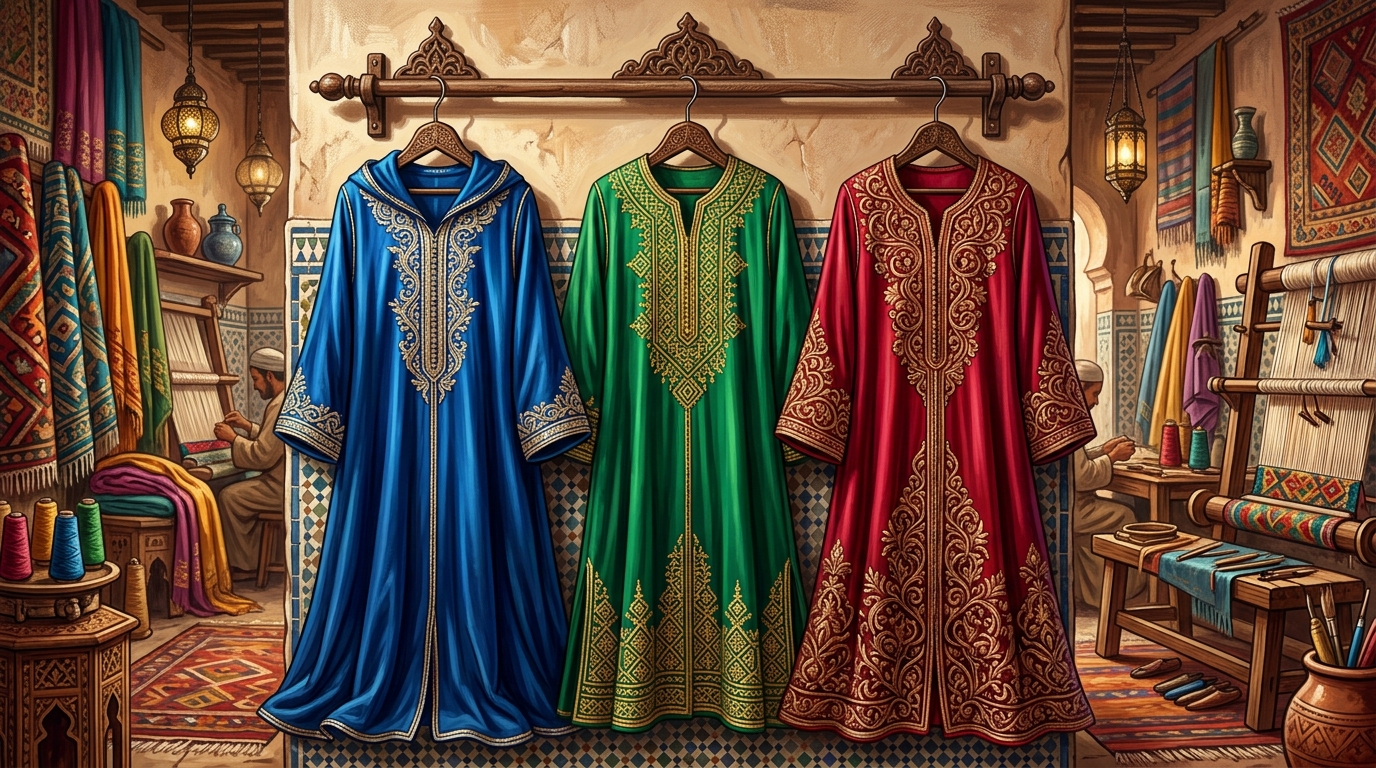
The djellaba: Morocco's everyday, hooded uniform
The djellaba is the garment most visitors to Morocco actually see, because it is worn every day, by ordinary people, for ordinary reasons. It is a long, loose-fitting robe with wide sleeves and, crucially, a pointed hood called a qob sewn onto the back of the neckline. The hood is not decorative. In the Atlas mountains it functions like a built-in winter hat, trapping heat and shielding the face from snow and rain. In the desert and along the coast it protects against sun glare and blowing sand. Historically it doubled as an improvised pocket or even a basket for carrying small goods.
The garment's roots trace back to the Amazigh (Berber) peoples of the Maghreb, long before the Arab conquests of the 7th and 8th centuries introduced their own tailoring traditions and Islamic modesty norms, which blended with existing Amazigh dress to produce the djellaba as it is recognized today. Regional variants persist: in the Moroccan mountains it is sometimes called by the Berber term tadjellabit, while in central and eastern Algeria a related garment is known as qeššaba or qeššabiya. The word 'djellaba' itself is French-transliterated Arabic, from jallaba, ultimately linked to a root meaning 'to bring' or 'to import' — a nod to the garment's association with traders.
Both men and women wear djellabas, but the fabric and cut signal the difference instantly. Men's djellabas are typically wool in winter and light cotton in summer, often in muted earth tones, and are commonly paired with a red fez and yellow babouche slippers for Friday prayers or festive occasions. Women's djellabas tend to be more colorful and can carry decorative stitching around the collar and cuffs, but the silhouette — loose, hooded, unfitted — stays the same. During the French protectorate era (1912-1956), Moroccan women also adopted the djellaba as a quiet marker of national identity, wearing it publicly as an assertion of Moroccan culture under colonial rule.

Djellaba materials and its modern reinvention
Buttons for traditional djellabas are still hand-produced in the town of Bhalil, near Fez, where artisans braid silk cord into the small, intricate closures called aqad — the same button style used on the far more elaborate kaftan. That shared detail is a useful reminder that these three garments are not unrelated costumes; they are branches of the same tailoring tradition, distinguished by formality rather than invented from scratch.
Fabric choice still tracks the seasons the way it always has. A winter djellaba is usually heavy wool, sometimes woven from undyed sheep's wool in mountain regions, while a summer djellaba is thin cotton or a cotton-synthetic blend, often in white or pale colors to reflect heat. Contemporary Moroccan designers have also pushed the djellaba upmarket, producing lightweight, tailored versions in linen and fine cotton for city wear, proof that a centuries-old, function-first garment can still be reinterpreted for modern life without losing its hood, its silhouette or its name.
The kaftan: a one-piece ceremonial robe with royal roots
The kaftan is a different animal entirely. Where the djellaba is functional and hooded, the kaftan is a single, hoodless, long-sleeved robe made to be seen: rich brocade, velvet or silk, with an open or buttoned front, elaborate hand-embroidery, and the same fine silk-cord buttons (aqad) and decorative edge-band (sfifa) found on formal djellabas, but taken to a much higher level of craftsmanship. It is not everyday wear. It is Morocco's formal dress, worn to weddings, engagement ceremonies, religious festivals and state occasions.
According to Moroccan art historian Rachida Alaoui, the kaftan in Morocco dates back to at least the end of the 15th century, with roots connected to the Moorish heritage of Al-Andalus, though the earliest confirmed written references to the garment appear in the 16th century. One historical theory holds that the Saadi sultan Abd al-Malik, who had lived in Algiers and Istanbul before taking the Moroccan throne, brought Ottoman-style kaftans back with him and encouraged their adoption at court. For centuries the garment was restricted to palace dignitaries and noblewomen; it only spread to Morocco's wider middle classes from the late 17th century onward, and today it is worn across all social groups as the default 'dressed-up' garment for major life events.

The kaftan's UNESCO recognition and global reach
The kaftan's cultural weight was formally recognized in December 2025, when UNESCO inscribed 'Moroccan Caftan: art, traditions and skills' on its Representative List of the Intangible Cultural Heritage of Humanity, at the 20th session of the Intergovernmental Committee held in New Delhi. The listing credits the garment's more than eight centuries of history and singles out the specialized craftspeople behind it: the weavers who produce the brocade, velvet and silk; the tailors who cut and assemble the robe; and the artisans who hand-braid the sfifa trim and the aqad button closures. It is one of the clearest official confirmations that the kaftan is treated in Morocco not as a costume but as a living craft tradition.
The kaftan has also traveled well beyond Morocco's borders as a diplomatic and fashion statement. Hillary Clinton famously wore a Moroccan-style kaftan at a 2000 White House state dinner honoring Morocco's king, an early signal of the garment's international profile. Since then, Morocco's annual Caftan fashion shows — glamorous, televised events held in cities including Marrakech and Casablanca — have become a showcase where established designers and newcomers reinterpret the silhouette every season, pairing century-old embroidery techniques with modern cuts and colors while keeping the essential one-piece, hoodless form intact.
The takchita: the kaftan's two-piece bridal form
If the kaftan is Morocco's formal robe, the takchita is its most celebrated version — the outfit almost every Moroccan bride wears at some point during her wedding. Structurally, the takchita splits the kaftan into two garments worn together: an inner dress called the tahtiya, made from a fine but relatively understated fabric, and an outer overdress called the dfina (or foukia), which is open at the front and carries the heaviest embroidery, beading and sequin work of the whole ensemble. The two layers are cinched together at the waist with a wide decorative belt known as the mdamma, which is often coordinated in color and ornamentation with the dfina.
Historically, the earliest form of what became the takchita is generally traced to around the 13th century, during the Marinid dynasty, when the caftan itself was still restricted to Morocco's ruling and upper classes. Over the following centuries the garment absorbed Andalusian, Amazigh and Jewish sartorial influences as artisans, weavers and tailors moved between Morocco's imperial cities, giving the modern takchita its layered, ornamented character. A widely cited photograph from 1939 documenting Moroccan women wearing early takchita styles shows how established the two-piece form already was by the early 20th century.

How to tell the three garments apart
Today the takchita's role is unambiguous: it is the standard choice for Moroccan weddings, where a bride will typically change through several takchitas of different colors during a single ceremony, each change marking a different stage of the celebration. It also appears at other major family and religious milestones, including engagement parties and the two Eid holidays. Modern designers showcase new takchita and kaftan collections every year at Morocco's annual Caftan fashion shows, keeping a centuries-old garment in constant, visible evolution rather than freezing it as a museum piece.
The scale of embroidery on a takchita's dfina is itself a marker of the occasion's importance: everyday formal wear might carry modest thread-work along the collar and cuffs, while a top-tier wedding takchita can take skilled embroiderers weeks to finish, with dense metallic thread patterns covering almost the entire overdress. Because the tahtiya underneath is comparatively plain, the visual weight of the whole outfit is deliberately concentrated in the outer layer and the belt, so that even a first-time observer can immediately identify the takchita as the more elaborate, two-piece relative of the everyday kaftan.
The distinction is easy to remember once you strip away the embroidery: djellaba equals hood plus daily life; kaftan equals one piece plus formality; takchita equals two pieces plus a wedding. All three descend from the same Moroccan tailoring lineage, and all three are still worn, unselfconsciously, by millions of people every week — not as folklore, but as clothes.
Frequently asked
What is the main difference between a djellaba and a kaftan?
The djellaba has a hood (qob) and is worn as everyday clothing by both men and women. The kaftan has no hood, is a single ceremonial piece made from richer fabrics like brocade or silk, and is reserved for formal occasions such as weddings and religious festivals.
What is the difference between a kaftan and a takchita?
A kaftan is a one-piece ceremonial robe. A takchita is essentially a two-piece version of the kaftan: an inner dress (tahtiya) worn under a more elaborately embroidered open overdress (dfina), fastened with a decorative belt (mdamma).
Which garment is worn at Moroccan weddings?
The takchita is the standard bridal and wedding-guest garment in Morocco. Brides typically wear several different takchitas of varying colors throughout a single wedding celebration, changing outfits between different ceremonial stages.
Do men wear djellabas, kaftans or takchitas?
Men wear djellabas regularly, in wool or cotton, often with a fez and babouche slippers for Friday prayers or festivals. Men also have their own hoodless ceremonial robe traditions, but the kaftan and takchita in their most elaborate embroidered forms are primarily women's formal garments.
How old is the Moroccan kaftan?
According to art historian Rachida Alaoui, the kaftan in Morocco dates to at least the end of the 15th century, with the earliest confirmed written references appearing in the 16th century. Some accounts trace related garment forms back more than eight centuries.
Has the Moroccan caftan received any official cultural recognition?
Yes. On December 10, 2025, UNESCO inscribed 'Moroccan Caftan: art, traditions and skills' on its Representative List of the Intangible Cultural Heritage of Humanity, at the 20th session of the Intergovernmental Committee in New Delhi, recognizing the weavers, tailors and embroiderers behind the garment.
What is the hood on a djellaba called and what is it for?
It is called the qob. It protects the wearer from sun, wind and blown sand in hot regions, and functions like a winter hat in colder mountain climates, in addition to occasionally serving as an improvised pocket.
What is the belt worn with a takchita called?
It is called the mdamma, a wide decorative belt that cinches the inner tahtiya and outer dfina together at the waist and is usually coordinated in color and ornamentation with the rest of the outfit.
Where does the word 'djellaba' come from?
It is a French transliteration of the Arabic jallaba, itself a variant of jallabiya, originally meaning a garment worn by traders, tracing back to a root verb meaning to bring, fetch or import.
Are the djellaba, kaftan and takchita only worn in Morocco?
Related garments exist across the wider Maghreb and Middle East, with regional names like qeššaba in Algeria, but the specific djellaba, kaftan and takchita traditions described here, including their construction details like the sfifa trim and aqad buttons, are distinctly Moroccan.
- Wikipedia — Djellaba ↗
- Wikipedia — Kaftan ↗
- Wikipedia — Takchita ↗
- UNESCO — Moroccan Caftan: art, traditions and skills (Intangible Cultural Heritage) ↗
- Morocco Ministry of Foreign Affairs — Moroccan Caftan inscribed on UNESCO Intangible Cultural Heritage list ↗
- BeldiWear — Moroccan Clothing Glossary: Caftan, Djellaba, Takchita ↗
Video via official YouTube embeds; photos via Wikimedia Commons under their stated licenses. All rights belong to the respective owners; 212 Daily claims no ownership.