30 Darija Phrases Every Visitor to Morocco Should Know
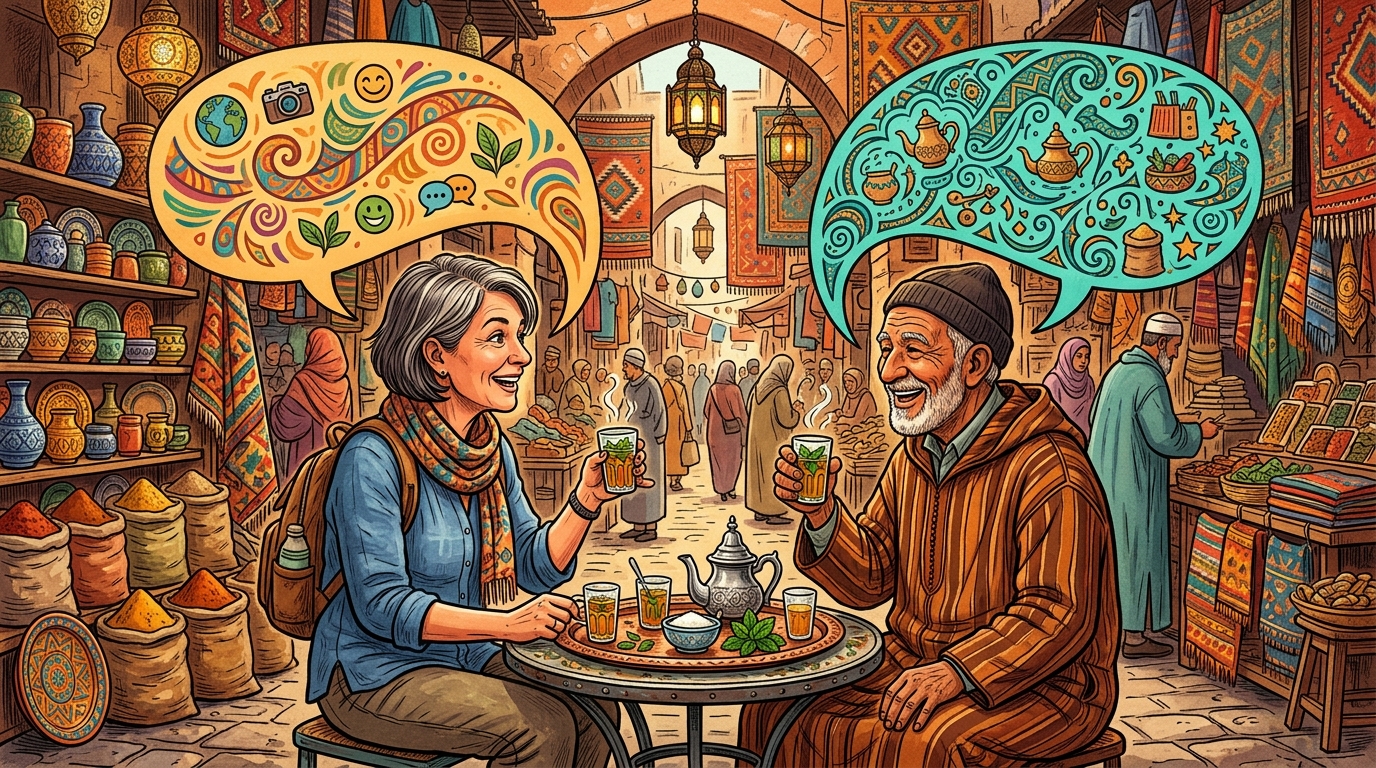
Greetings and Politeness
Start every interaction with a greeting; it is the social glue of Moroccan life. Say 'salam' (sa-LAM) for a casual hello, or the fuller 'salam ou3alikoum' (sa-LAM oo- a-lay-koom) for 'peace be upon you'. To ask how someone is, use 'labas?' (la-BESS), which doubles as 'are you well?' and 'all good?'.
Politeness opens doors. 'Choukran' (SHOOK-ran) means thank you, 'afak' or 'aafak' (a-FAK) means please, and 'smahli' (smah-LEE) means excuse me or sorry. To say goodbye, 'bslama' (b-sla-MA) works everywhere. Sprinkle these in and watch the warmth of the response.
The Everyday Power Words
A few short words do an astonishing amount of heavy lifting in Darija. 'Wakha' (WA-kha) means 'okay' or 'fine, agreed'. 'Safi' (SA-fee) means 'enough', 'done' or 'that's it'. 'Bezzaf' (be-ZZEF) means 'a lot' or 'too much', perfect for haggling. 'Yallah' (ya-LLAH) means 'let's go' or 'come on'.
Add 'inshallah' (in-sha-LLAH, 'God willing', used for anything future), 'hamdullah' (ham-doo-LLAH, 'thank God / I'm well'), 'meskin' (mes-KEEN, 'poor thing'), and the all-purpose 'mzyan' (m-ZYAN, 'good / nice'). Master these eight and you can navigate a surprising share of daily exchanges.
Shopping and Haggling
The souk runs on Darija. Ask the price with 'bch7al?' (b-SH-hal, 'how much?'). If it is too steep, say 'ghali bezzaf' (GHA-lee be-ZZEF, 'too expensive') and counter. 'Naqes shwiya' (NA-qes sh-WEE-ya) means 'lower it a little', and a smile makes it land better.
When you want to walk away politely, 'la, choukran' (la, SHOOK-ran, 'no, thank you') is your shield against pushy vendors. To confirm a deal, 'wakha, safi' ('okay, done') seals it. Remember that haggling is expected and good-natured, so keep it light and never lose the smile.
Numbers, Food and Getting Around
Useful basics: 'l-ma' (l-MA) is water, vital in the heat; 'atay' (a-TAY) is mint tea, the national drink; 'khobz' (KHOBZ) is bread; and 'l-hsab' (l-HSAB) is the bill. To ask where something is, use 'fin?' (FEEN, 'where?'), as in 'fin l-hammam?' for the bathroom.
A handful of numbers helps: 'wahed' (WA-hed) one, 'jouj' (JOOJ) two, 'tlata' (t-LA-ta) three, 'rebaa' (re-BAA) four, 'khamsa' (KHAM-sa) five. And two more crowd-pleasers for World Cup summer: 'Dima Maghrib' (DEE-ma MAGH-rib, 'Always Morocco') and 'mabrouk' (mab-ROOK, 'congratulations'). Drop those and you are practically a local.
Frequently asked
What language do Moroccans speak?
Most Moroccans speak Darija, a Moroccan Arabic dialect, along with Tamazight (Berber). French is widely used in business, and English is increasingly common in tourist areas.
What is the most useful Darija phrase for tourists?
'Choukran' (thank you) and 'salam' (hello) go furthest, but 'bch7al?' (how much?) and 'la, choukran' (no, thank you) are invaluable in the souks.
How do you say thank you in Moroccan Darija?
You say 'choukran' (pronounced SHOOK-ran). For 'please' use 'afak', and for 'you're welcome' you can say 'la choukran 3la wajib'.