Couscous in Morocco: The Friday Tradition, UNESCO Heritage, and the Seven-Vegetable Classic
What Couscous Actually Is (Hint: Not a Grain)
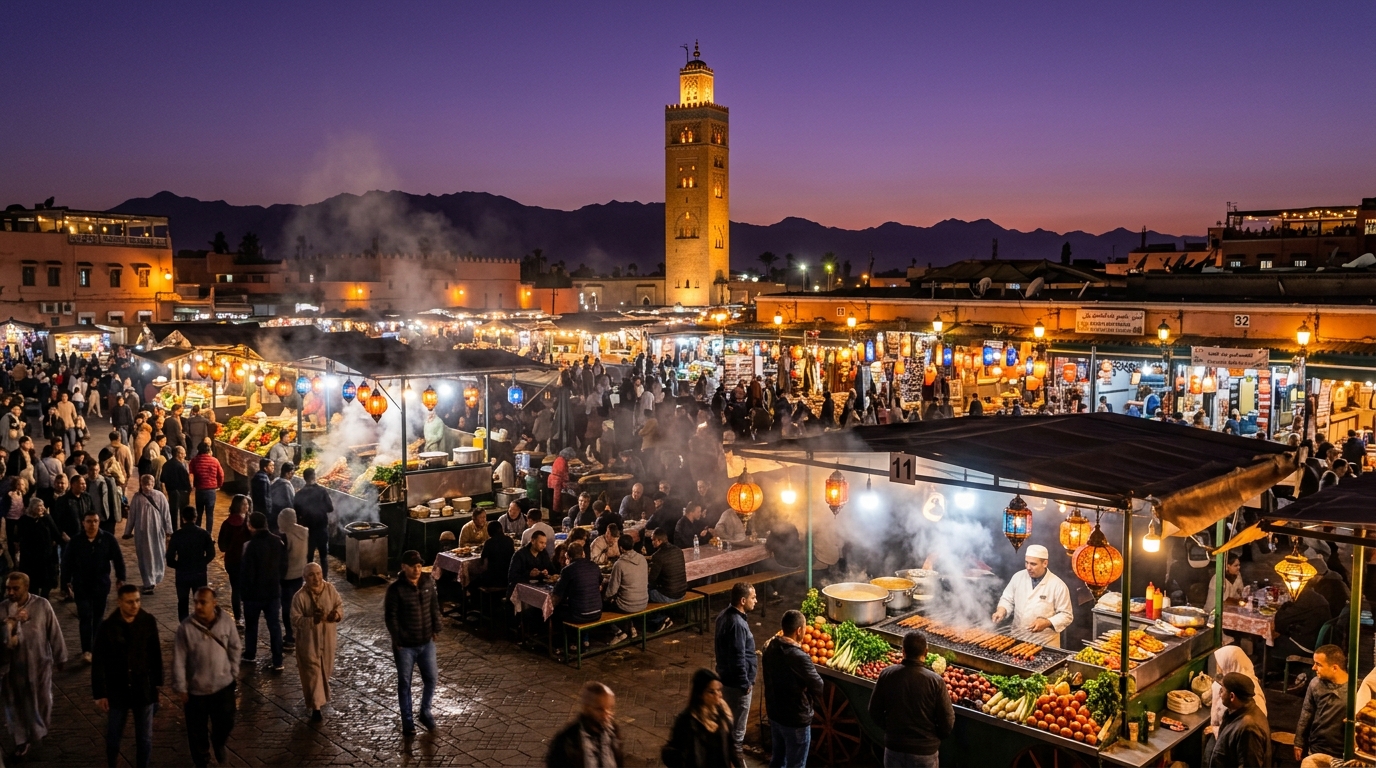
Start with the most common misconception: couscous is not a grain that grows in a field. It is a made food, tiny pellets produced by moistening coarse durum wheat semolina and rolling it by hand until fine granules form, each one coated in a whisper of flour. In that sense couscous is closer kin to pasta than to rice, though its texture and preparation belong to a world of their own.
The name itself is generally traced to the Amazigh (Berber) word seksu, meaning well-rolled or well-formed, and in Moroccan homes you will hear seksu or kseksu alongside the Arabic-derived kuskus. Whatever the pronunciation, the thing being named is the same: semolina transformed by skilled hands and steam.
Real couscous is steamed, never boiled. The granules cook suspended over a simmering stew in a perforated steamer, absorbing aromatic vapor rather than water, in two or three rounds interrupted by fluffing, oiling, and gentle re-rolling. Done properly, each granule stays separate, swollen, and feather-light, capable of absorbing ladles of broth without turning to porridge.
This is also where the instant couscous sold in Western supermarkets parts company with the Moroccan original. Instant couscous is pre-steamed and dried, needing only hot water; it is convenient and respectable for a quick side, but Moroccans regard it roughly the way Italians regard instant noodles. The Friday dish is another animal entirely.
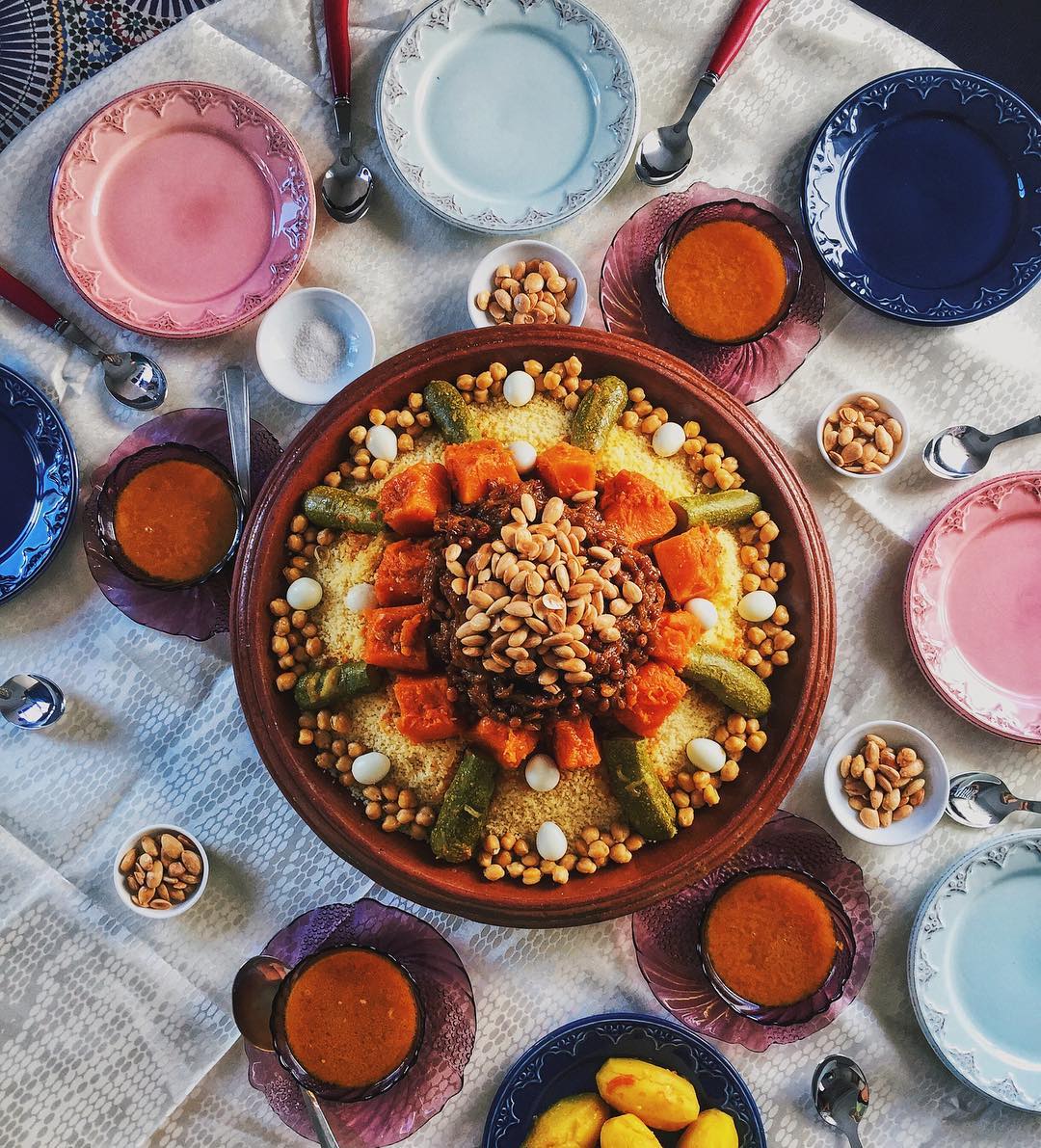
The finished platter follows a fixed architecture: a broad mound of grains, a well or crown of slow-cooked meat and vegetables, and broth ladled over, with extra broth served alongside. Around that simple template, Morocco has built an entire culture, one important enough that four nations went to UNESCO together to protect it.
An Amazigh Invention with a Thousand-Year Paper Trail
Couscous is one of the oldest continuously eaten dishes in the world, and its origins belong to the Amazigh peoples of North Africa. Archaeological finds of couscous-style cooking utensils in the region have been dated by researchers as far back as the medieval period, with some scholars arguing for even earlier roots, and the dish was well established across the Maghreb by the time written cookbooks appear.
The documentary record is unusually good for a humble food. A thirteenth-century Andalusi cookbook, the famous anonymous compilation from the era of Almohad rule, includes couscous preparations, showing the dish circulating between North Africa and Islamic Spain seven centuries ago. Medieval travelers and chroniclers across the Maghreb mention it as everyday and festive food alike.
From its Amazigh cradle, couscous traveled everywhere North Africans went: west to Mauritania and the Sahel, east to Libya and beyond, north into Sicily, where the port town of San Vito Lo Capo still holds an annual couscous festival rooted in centuries of Arab-Sicilian history, and across the Mediterranean with Maghrebi migration, making it one of France's favorite dishes today.
Within Morocco, couscous absorbed regional character over the centuries: barley and corn versions in the mountains, fish couscous on the coasts, sweet presentations in the imperial cities. What never changed was the fundamental technology, hand-rolling and multiple steamings, passed down within families, overwhelmingly from mother to daughter.
That unbroken transmission is precisely what earned couscous its place on the world stage. When UNESCO evaluates intangible heritage, it looks for living traditions carried by communities across generations, and few foods on Earth can match couscous's combination of antiquity, vitality, and shared regional identity.
Friday Couscous: A Weekly National Ritual
In Morocco, Friday and couscous are effectively synonyms. Friday, yawm al-jumu'a, is the holiest day of the Muslim week, anchored by the midday congregational prayer, and the grand family lunch that follows is almost universally couscous. Ask a Moroccan what Friday smells like and the answer will involve steam, saffron broth, and slow-cooked vegetables.
The timing is woven into the ritual. Cooking begins in the morning: the stew building in the bottom of the steamer, the semolina getting its first steamings and rubbings. When the men return from the mosque and children from school, the household converges on a single giant platter, and the week's most important shared meal begins.
Couscous on Friday is also charity food. A long-standing tradition sends plates of couscous from home kitchens to mosques, neighbors, and the poor on Fridays, and many mosques and zawiyas serve communal couscous to anyone who comes. The dish's abundance, one huge platter feeding many, makes it naturally suited to the Islamic emphasis on Friday almsgiving.
The eating itself has its own etiquette. Traditionally, diners gather around the communal platter and eat from the section in front of them with a spoon, or, in the older style still alive in many regions, by deftly rolling a bite of couscous into a compact ball with the right hand. The meat, buried at the center under the vegetables, is portioned out by the household's matriarch or host near the end of the meal.
Restaurants across Morocco honor the rhythm: many serve couscous only on Fridays, when workers who cannot reach home crowd in for the weekly plate. Even Moroccans abroad keep the clock; in Paris, Brussels, Montreal, and Madrid, Friday couscous remains one of the diaspora's most durable rituals, a weekly appointment with home.
None of this is nostalgia; it is current, living practice. Surveys of Moroccan food habits and the testimony gathered for the UNESCO nomination all point the same way: whatever else modernity has changed, the Friday couscous holds, in villages and in high-rise Casablanca apartments alike.
UNESCO Heritage: The 2020 Inscription That United the Maghreb
On 16 December 2020, UNESCO's Intergovernmental Committee for the Safeguarding of the Intangible Cultural Heritage inscribed 'Knowledge, know-how and practices pertaining to the production and consumption of couscous' on the Representative List of the Intangible Cultural Heritage of Humanity. The nomination was jointly submitted by Algeria, Mauritania, Morocco, and Tunisia.
The joint bid was itself historic. Algeria and Morocco, neighbors with famously strained relations, had earlier edged toward competing claims; an Algerian move to nominate couscous alone in 2016 stirred protest in Morocco. Diplomats and culture ministries eventually chose cooperation, filing the four-country dossier in 2019, and UNESCO officials publicly praised the inscription as a model of international cooperation around shared heritage.
Importantly, the listing does not protect a recipe, and it does not declare couscous the property of any one nation. Intangible heritage inscriptions safeguard practices and transmission: the hand-rolling of the semolina, the craft of the steaming vessels, the ceremonies and social meanings surrounding the dish, and the passing of all this knowledge between generations, especially from mothers to daughters.
The UNESCO dossier emphasizes exactly what any Maghrebi grandmother would: that couscous is present at life's every landmark, births, weddings, funerals, religious feasts, and harvest celebrations, and that it functions as a symbol of living together. The committee highlighted the consensus displayed by the four countries as much as the dish itself.
For Morocco, the inscription slotted alongside its other food-related recognitions, including participation in the UNESCO-listed Mediterranean Diet, and it supercharged national pride in a dish Moroccans already considered theirs by birthright. The friendly cross-border argument over who makes couscous best, of course, remains gloriously unresolved.
The Types: From Seven Vegetables to Sweet Seffa
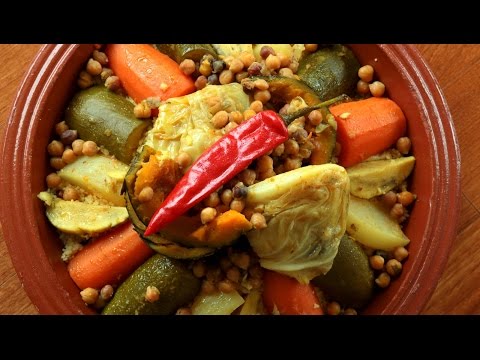
The undisputed monarch of Moroccan couscous is couscous bidaoui, the seven-vegetable couscous associated with Casablanca and eaten nationwide on Fridays. Beef, lamb, or chicken simmers in a spiced broth while the vegetables go in by cooking time; the platter arrives with the vegetables arranged in a pyramid over the mound of grain.
Which seven vegetables is a matter of season, region, and family. The usual candidates include turnip, carrot, zucchini, pumpkin or squash, cabbage, onion, tomato, and chickpeas, with fava beans and sweet potato making appearances. Seven is favored as a number of good fortune in Moroccan tradition, though nobody stops a cook who uses six or nine.
Couscous tfaya is the sweet-savory showpiece: chicken or lamb couscous crowned with tfaya, a jammy confit of caramelized onions and raisins scented with cinnamon and often honey, usually finished with fried almonds and sometimes hard-boiled eggs. It is a beloved dish for guests and celebrations, balancing the broth's saltiness against the topping's sweetness.
Belboula is barley couscous, nuttier and heartier than wheat, with deep roots in Amazigh mountain cooking, and corn-based baddaz plays a similar role in some regions. On the coasts, couscous comes with fish and pumpkin. And at the sweet end sits seffa: fine couscous or vermicelli steamed and dressed with butter, powdered sugar, cinnamon, and almonds, sometimes hiding chicken within (seffa medfouna), sometimes served with a glass of buttermilk.
Two humbler preparations complete the family. Couscous with buttermilk or milk, saykouk or variations thereof, is summer refreshment food. And couscous with dried fava beans, herbs, or just smen and buttermilk recalls the dish's frugal origins, proof that couscous never needed meat to be a meal.
How Real Moroccan Couscous Is Made
The essential tool is the couscoussier, known in Moroccan Arabic as a barma and keskas: a two-part steamer whose bottom pot holds the simmering stew and whose perforated upper basket holds the grain, so that every wisp of steam that cooks the couscous is already fragrant with the meal it will join. Traditional versions are clay; most modern kitchens use aluminum or stainless steel.
The process is a rhythm of steamings and rests, classically three rounds. The moistened semolina steams uncovered until vapor rises through the whole mass; it is then turned out, sprinkled with salted water, rubbed and raked between the palms to break every lump, rested, and returned to the steam. Oil or butter enters along the way, and each cycle leaves the granules lighter and more distinct.
Hand-rolling couscous from raw semolina, the ancestral craft the UNESCO listing specifically honors, goes a step further back: dry semolina is spread in a wide gsaa (wooden or earthenware basin), sprinkled with water and flour, and rolled under the flat of the hand in circular motions until pellets form, then sieved to size. Rural families and artisan cooperatives, many of them women-run, still produce hand-rolled couscous, and connoisseurs swear by it.
Meanwhile the broth develops below: meat browned with onion, tomato, and spices, gentle spicing of ginger, turmeric or saffron, pepper, and a bouquet of cilantro, then water, then vegetables in careful sequence so that nothing dissolves and nothing stays hard. The cook's judgment, when to add the zucchini, how much broth to hold back for serving, is precisely the kind of embodied knowledge heritage listings try to keep alive.
Assembly is architecture: grains mounded and shaped, a crater formed, meat placed at the heart and covered, vegetables leaned in ordered ranks down the slopes, broth ladled over until the mound glistens. Extra broth circulates at the table, along with, in many homes, a bowl of buttermilk and a dish of tfaya. Nobody measures anything, and it comes out right every Friday.


A Country of Couscous: Regional Styles Across Morocco
Casablanca and the Atlantic plains own the reference version, the beefy seven-vegetable bidaoui, but travel the country and the platter changes with the landscape. In the Fez-Meknes orbit, couscous grows more aristocratic: finer grains, more saffron, tfaya appearing readily, and chicken sharing the crown with lamb. Fassi families famous for their pastilla bring the same perfectionism to their Friday grain.
The Rif and the Mediterranean north cook couscous with the sea and the garden. Fish couscous appears in ports like Al Hoceima and Nador, and the region's small farms feed versions heavy on fava beans, herbs, and olive oil that would look at home across the water in Andalusia. In the northwest, some families keep the old tradition of couscous with wild greens gathered in spring.
The Atlas mountains are belboula country. Barley thrives where wheat struggles, and the nutty, gray-gold barley couscous of Amazigh villages, often served simply with buttermilk, pulses, or a modest vegetable broth, is the closest living link to the dish's ancient origins. Corn-based baddaz plays the same role in parts of the south, and both are increasingly prized in the cities as health foods.
The Souss and the pre-Sahara add their signatures: argan oil drizzled at the table, couscous crowned with caramelized pumpkin, and in the oases, versions sweetened with dates and raisins that blur into dessert. In Saharan communities, couscous shares the festive stage with camel meat and follows the region's own rhythms of hospitality, where the dish may appear at the end of a long sequence of tea rounds.
Then there are the calendar couscoushes, dishes tied to specific days. Couscous with dried fava beans or with seven herbs marks certain regional observances; sweet couscous appears for Achoura; and in many areas a special couscous is cooked for Yennayer, the Amazigh new year in January, loaded with dried pulses and good-luck symbolism. One dish, a full national calendar.
Couscous Etiquette: How to Eat from the Shared Platter
Couscous arrives as a single monumental platter set at the center of the table or, traditionally, on a low round table with the family seated on cushions around it. The first rule is territorial and unspoken: you eat the wedge of the platter directly in front of you, never reaching across into a neighbor's sector. The pile shrinks evenly, like a cake eaten from all sides at once.
Hands or spoons are both legitimate. The elegant old-school technique, rolling a portion of grains and vegetables into a neat ball with the fingers of the right hand and popping it into the mouth without touching the lips, is a genuine skill, admired when done well and quietly disastrous when attempted by beginners. Guests are handed spoons without judgment, and most urban families eat with spoons today.
The meat at the summit is common property under the host's administration. It is considered poor form to grab at it; instead, the host or eldest woman breaks it up at the proper moment and distributes pieces, pushing the best morsels toward guests. Declining seconds is a recognized ritual struggle: the host insists, the guest resists, and the host usually wins at least one more serving.
A few final courtesies complete the picture: say bismillah before starting, keep bread on hand even though couscous needs none, expect a glass of lben offered alongside, and never, ever rush. Fridays are structured so that nobody has anywhere better to be, and lingering at the platter is not a failure of efficiency but the entire point of the exercise.
More Than Food: What Couscous Means
Couscous appears at every hinge point of Maghrebi life. It is served at weddings and at funerals, at naming ceremonies and religious festivals, offered to guests as the highest form of welcome and distributed to the needy as the standard vehicle of charity. The UNESCO nomination text makes the point plainly: the dish accompanies life's collective moments from birth to death.
It is also a technology of togetherness. A couscous platter cannot really be made for one; the format assumes a circle of eaters, and the labor of proper preparation, hours of steaming, rolling, and tending, assumes it is worth doing for people you love. Sociologists of food regularly cite Maghrebi couscous as a textbook case of cuisine structuring social life rather than merely feeding it.
The dish carries gendered heritage in a specific way: the knowledge has passed overwhelmingly through women, from grandmothers and mothers to daughters, in the kitchen sessions where girls learned to judge the semolina by touch. Modern Morocco complicates and enriches this picture, with celebrity chefs of both sexes, YouTube tutorials, and cooperatives professionalizing women's couscous craft into income.
Couscous is likewise a diaspora anchor. For millions of Maghrebi-origin families in Europe and North America, Friday or Sunday couscous is the meal at which language, memory, and belonging are re-transmitted; in France it perennially ranks among the country's favorite dishes altogether. Few foods double as heritage infrastructure so effectively.
And it is a shared regional identity in a region short on shared symbols. The 2020 four-nation UNESCO bid succeeded precisely because couscous belongs to Amazigh and Arab, to Morocco and Algeria and Tunisia and Mauritania, to mountain village and capital city alike. As the diplomats discovered, it is easier to argue about borders than about couscous.
From Wheat Field to Friday Table: The Couscous Economy
Behind the ritual stands an industry. Durum wheat, the hard, high-protein species whose semolina makes couscous possible, is a staple crop across the Maghreb, though Morocco's variable rainfall means the country supplements its own harvests with substantial imports in dry years. The grain's journey from field to Friday platter supports millers, semolina factories, market vendors, and a growing industrial couscous sector that exports Moroccan brands worldwide.
Hand-rolled couscous has meanwhile become a development story. Across rural Morocco, women's cooperatives produce artisanal couscous, classic wheat, barley belboula, corn, and newer whole-grain and herb-enriched varieties, for city boutiques and export markets, converting a domestic skill into wages and, in the process, keeping the UNESCO-honored craft economically alive rather than museum-bound.
The tools sustain their own artisans too: the metal-workers and potters who make couscoussiers, the woodturners who carve the gsaa rolling basins, the weavers of the conical straw lids that cover finished platters. When UNESCO inscribed couscous, its dossier explicitly embraced this whole ecosystem of makers, not just the cooks, recognizing that a dish survives only as long as its material culture does.
None of this is abstract for Moroccan households. The Friday platter routinely feeds an extended family for less than the cost of a fast-food meal abroad, which is part of the dish's staying power: it is simultaneously the most ceremonial and among the most economical meals in the national repertoire. Abundance without extravagance is the couscous business model, and it has worked for roughly a thousand years.
Making Moroccan-Style Couscous at Home Abroad
You do not need a Moroccan grandmother to eat far better couscous than the instant packet delivers, though it helps to borrow her method. The minimum equipment is a pot and a snug-fitting steamer basket or colander lined so grains cannot fall through; a proper couscoussier costs little and lasts decades. Buy medium-caliber couscous from a Maghrebi or Mediterranean grocer rather than the smallest instant grade if you can.
The abbreviated home method keeps the soul of the technique: moisten the dry couscous lightly with salted water and a spoonful of oil, rake out every lump, and steam it uncovered over your simmering stew until steam rises through the grain, about 15 to 20 minutes. Turn it out, sprinkle with more water, fluff thoroughly as it cools enough to handle, and steam once or twice more. Even two rounds transform the texture beyond anything soaked in a bowl.
Meanwhile the broth carries the flavor: brown meat or chicken with plenty of onion, tomato, ginger, turmeric or saffron, pepper, and a tied bunch of cilantro; add water and simmer until half done; then stage in the vegetables, hardest first, tender ones last, so that everything reaches doneness together. Chickpeas, soaked overnight, go in with the meat. Taste the broth boldly; it seasons everything above it.
Even the fully instant shortcut can be honorable if you treat the packet grain to a steam over the finished broth for ten minutes and finish it with butter or olive oil. The unforgivable sins are serving couscous dry, undersalting the broth, and stinginess with vegetables. Generosity, not precision, is the tradition being reproduced.
Serve it the Moroccan way regardless of your kitchen's passport: one large platter, grains mounded, meat hidden at the center, vegetables arranged down the slopes, broth over the top and more in a pitcher, buttermilk for the adventurous. Then call more people than the food seems to justify. It will stretch; it always does. That, more than any technique, is the recipe.
Couscous Today: From Friday Tables to World Menus
Globally, couscous has never been bigger. Industrial production makes instant couscous a supermarket staple on five continents, health-conscious eaters embrace it as a fast whole-ish grain, and international chefs fold it into salads, bowls, and fusion menus. Morocco, Algeria, and Tunisia all export couscous, and world couscous demand keeps growing.
Purists should relax: globalization has not flattened the original. If anything, recognition has flowed backward, with food travelers seeking out the real steamed article in Moroccan homes and restaurants, cooking schools in Marrakesh and Fez teaching the full three-steam method, and hand-rolled artisanal couscous commanding premium prices at home and abroad.
For visitors to Morocco, the practical advice is simple. Plan to be somewhere good on a Friday: a family table if you are lucky enough to be invited, a restaurant that honors the tradition otherwise. Expect the meal early in the afternoon, expect it to be enormous, and expect the buttermilk chaser to make more sense than it sounds.
However you meet it, remember what is on the platter: an Amazigh invention older than most nations, a craft UNESCO now lists among humanity's treasures, and the standing Friday appointment of an entire people. Couscous is Morocco's weekly argument that food can be heritage, ritual, and dinner all at once.
And if you take a single habit home from Morocco, let it be the appointment itself. Pick a day, cook one generous dish, and put it in the middle of a table with no phones and no hurry, the same people every week. The grain matters less than the geometry of the circle around it, kept faithfully week after week, year after year. That, Moroccans would tell you, is the real recipe UNESCO was protecting all along.
Frequently asked
Why do Moroccans eat couscous on Fridays?
Friday is the holiest day of the Muslim week, centered on the midday congregational prayer, and the big family lunch that follows is traditionally couscous. The dish's communal format suits the day's spirit of gathering and charity; plates are also traditionally shared with neighbors, mosques, and the poor on Fridays.
Is couscous on the UNESCO heritage list?
Yes. On 16 December 2020, UNESCO inscribed 'Knowledge, know-how and practices pertaining to the production and consumption of couscous' on the Representative List of the Intangible Cultural Heritage of Humanity, following a joint nomination by Algeria, Mauritania, Morocco, and Tunisia, the four countries' first shared cultural dossier.
Is couscous a grain?
No. Couscous is a made food: tiny pellets hand-rolled (or industrially formed) from moistened durum wheat semolina, making it closer to pasta than to a cereal grain. Traditional versions also exist made from barley (belboula) and corn.
Where does couscous originally come from?
Couscous originates with the Amazigh (Berber) peoples of North Africa. Archaeological evidence of couscous-making utensils in the region dates back to the medieval era, and the dish appears in a thirteenth-century Andalusi cookbook, showing it was already circulating widely across the western Islamic world centuries ago.
What is seven-vegetable couscous?
Couscous bidaoui, associated with Casablanca, is Morocco's classic Friday dish: steamed couscous topped with meat and roughly seven vegetables, commonly turnip, carrot, zucchini, pumpkin, cabbage, onion, tomato, and chickpeas, simmered in a spiced broth. Seven is considered an auspicious number, though the exact lineup varies by season and family.
What is the proper way to cook couscous?
Authentic Moroccan couscous is steamed, never boiled, in a couscoussier (barma/keskas): a pot of simmering stew below and a perforated basket of grain above. The semolina is steamed two or three times, with fluffing, salted water, and oil worked in between rounds, until the granules are light, separate, and infused with the stew's aroma.
What is couscous tfaya?
Tfaya is a sweet-savory topping of onions slowly caramelized with raisins, cinnamon, and often honey. Spooned over chicken or lamb couscous and typically finished with fried almonds, it creates Morocco's beloved sweet-and-salty celebration couscous, a fixture at gatherings and guest meals.
What is seffa?
Seffa is Morocco's sweet couscous family: fine steamed couscous or vermicelli dressed with butter, powdered sugar, cinnamon, and almonds. In seffa medfouna, the sweetened grain conceals saffron chicken buried at the center. It is served as a festive course, often toward the end of celebration meals.
How is Moroccan couscous different from the instant couscous in supermarkets?
Instant couscous is pre-steamed and dried industrially, ready after a soak in hot water; it is convenient but comparatively flat in texture. Traditional Moroccan couscous is steamed multiple times over a simmering stew, absorbing its aromas and becoming far lighter and fluffier. The hand-rolled artisanal version is the craft UNESCO's listing honors.
Do other countries eat couscous too?
Yes, couscous is the shared staple of the Maghreb: Morocco, Algeria, Tunisia, Mauritania, and Libya all have deep traditions, which is why four of those countries filed the UNESCO bid together. It also has centuries-old footholds in Sicily and the Sahel, and through Maghrebi migration it has become one of France's most popular dishes.
What do Moroccans drink or serve with couscous?
The classic companion is lben (buttermilk), poured into a glass alongside or even over the grain, its tang cutting the richness. Extra broth is always served for moistening the couscous, mint tea follows the meal, and seasonal fruit commonly closes the Friday table.
Is couscous healthy?
Traditional Moroccan couscous is a reasonably balanced one-dish meal: durum semolina for carbohydrates, seven or so vegetables, legumes like chickpeas, and moderate meat, with steaming rather than frying as the core technique. Whole-wheat and barley versions add fiber. As with any dish, portion size and added butter or smen decide the calorie math.
- UNESCO Intangible Cultural Heritage — Knowledge, know-how and practices pertaining to the production and consumption of couscous ↗
- UNESCO — Couscous inscription as an example of international cultural cooperation ↗
- Al Jazeera — UNESCO adds couscous to list of intangible world heritage (Dec 16, 2020) ↗
- Middle East Eye — North Africa's favourite dish added to UNESCO list ↗
- Wikipedia — Couscous ↗
- Forbes — UNESCO Announces Couscous Now Inscribed On Intangible Cultural Heritage Of Humanity List ↗
Video via official YouTube embeds; photos via Wikimedia Commons under their stated licenses. All rights belong to the respective owners; 212 Daily claims no ownership.