Casablanca Complete City Guide 2026: Things to Do, Where to Stay & Food
Understanding Casablanca
Casablanca, known to locals simply as Casa, is Morocco's commercial heart and biggest city. With a metropolitan population of roughly 3.7 million, it dwarfs every other Moroccan city and functions as the country's financial, industrial and business hub. The port is one of the largest in Africa, and the city's skyline mixes glass towers with elegant early-20th-century Art Deco facades, a legacy of the French protectorate era.
First-time visitors sometimes arrive expecting the romance of Marrakech or Fez and feel briefly disoriented: Casablanca is modern, sprawling and unapologetically urban. But this is precisely its appeal. It offers a window into contemporary Morocco, a city of ambitious young professionals, fashionable cafes, oceanfront nightlife and a cosmopolitan energy you will not find in the imperial cities.
The city earned global mystique from the 1942 film that bears its name, though the movie was shot entirely in Hollywood. Today the reality is grittier and more rewarding than any film set: a working metropolis with genuine character, superb food, striking architecture and an Atlantic coastline that gives it a breezy, open feel quite distinct from the inland medinas.
The Hassan II Mosque and Top Sights
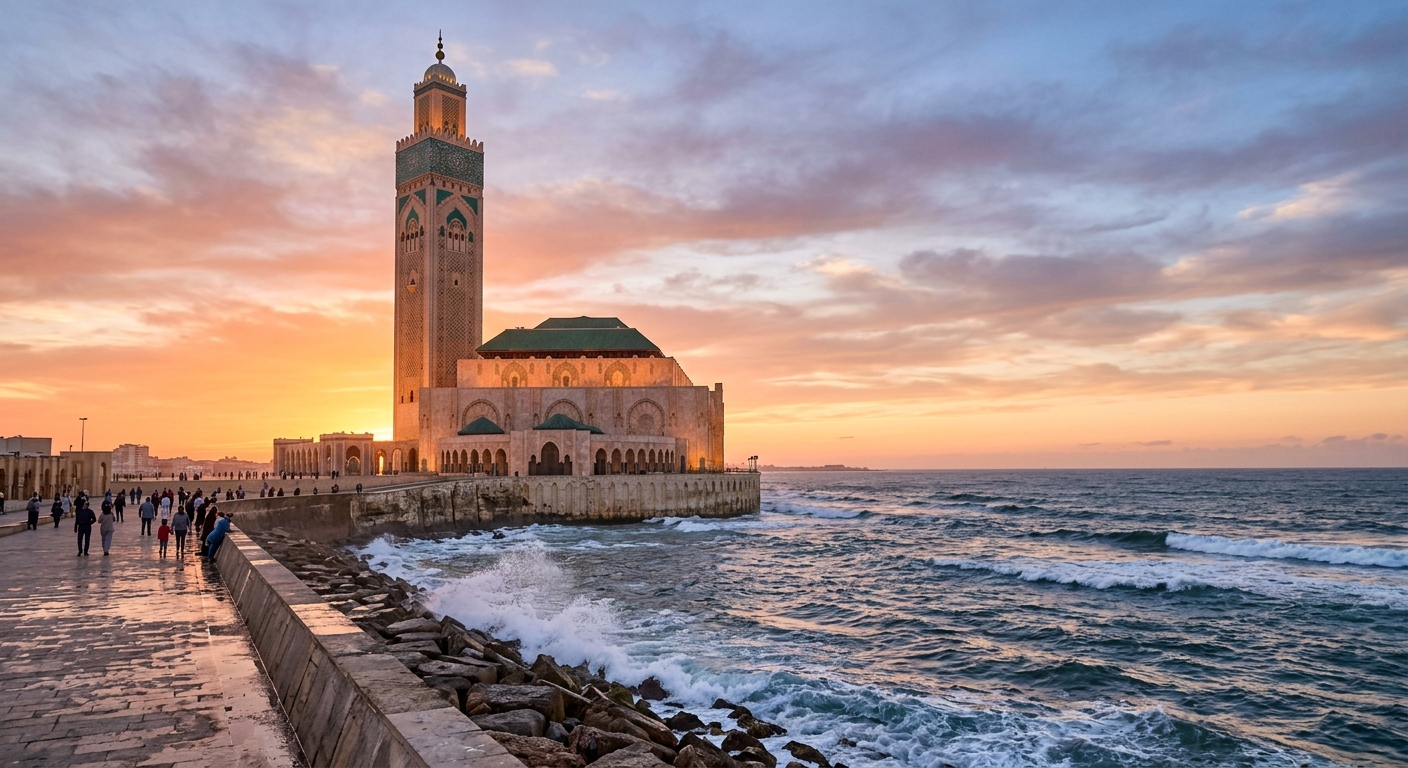
The undisputed highlight is the Hassan II Mosque, one of the largest mosques in the world and an architectural masterpiece. Built partly over the Atlantic, with a minaret soaring over 200 metres, it is the only major mosque in Morocco that non-Muslims can enter, via guided tours. The craftsmanship, from hand-carved cedar ceilings to vast marble floors and intricate zellige tilework, is breathtaking, and the seaside setting at sunset is unforgettable.
Beyond the mosque, explore the Art Deco and Mauresque architecture concentrated around the city centre and the old Quartier des Habous, a French-built new medina that blends traditional Moroccan design with colonial planning. The central market, Marche Central, is a lively spot for fresh seafood and produce. The smaller old medina, while less grand than those of Fez or Marrakech, offers an authentic, untouristy stroll.
The Corniche along the Ain Diab coast is where Casablanca relaxes: a long oceanfront promenade lined with restaurants, beach clubs, cafes and nightlife. Morocco Mall, one of Africa's largest shopping centres, sits at its western end. For culture, the Villa des Arts and various galleries reflect Casa's role as the country's contemporary art scene, while the cathedral and various colonial-era buildings reward architecture enthusiasts.
Best Neighbourhoods and Where to Stay
Choosing the right base shapes your experience. The city centre and the area around the Marche Central and the United Nations Square put you within walking distance of Art Deco landmarks and transport links, ideal for first-time visitors who want to explore on foot and use the tram. It is convenient, central and well connected.
For a more upscale, relaxed stay, the Ain Diab and Corniche district along the ocean offers beachfront hotels, sea views and easy access to the city's best dining and nightlife. It is slightly removed from the historic centre but a short taxi or tram ride away, and the ocean breeze is a welcome contrast to the inland heat.
Gauthier and the Maarif district are fashionable, leafy neighbourhoods popular with younger residents and remote workers, full of trendy cafes, boutiques and restaurants. They offer a comfortable, modern slice of Casablanca life. Whichever area you choose, the city has accommodation across every budget, from international five-star hotels near the business district to characterful boutique guesthouses.
Food and Dining in Casablanca
As an Atlantic port city, Casablanca is one of the best places in Morocco to eat seafood. Grilled fish, fried calamari, prawns and the daily catch appear on menus from humble market stalls to upscale waterfront restaurants. The seafood stalls inside the Marche Central are a local institution: buy fresh fish and have it cooked on the spot.
The city also has Morocco's most cosmopolitan dining scene. Alongside excellent traditional tagines, couscous and pastilla, you will find French bistros, Italian trattorias, sushi, Lebanese mezze and modern fusion restaurants reflecting Casa's international outlook. The Gauthier and Maarif districts in particular are packed with stylish cafes and contemporary eateries.
Do not miss the street-food and cafe culture. Casablancais take their coffee seriously, and pavement cafes are central to daily life. Sample Moroccan classics like harira soup, msemen pancakes, fresh orange juice and mint tea, and seek out a traditional patisserie for almond pastries and chebakia. For an authentic experience, eat where locals do rather than only in tourist zones.
Getting Around and Practical Tips
Casablanca has the best transport links in Morocco. Mohammed V International Airport is the country's busiest, connecting Casa to destinations across Europe, Africa, the Middle East and North America. A convenient train links the airport directly to the city centre. The high-speed Al Boraq train, Africa's first, connects Casablanca to Rabat and Tangier in remarkable comfort and speed.
Within the city, a modern tramway network is the easiest and cheapest way to move around, covering many key areas and avoiding the city's notorious traffic. Petit taxis (small red taxis) are abundant and cheap for short hops; insist on the meter or agree a price first. Ride-hailing apps also operate. Driving yourself is best avoided unless you are comfortable with assertive, chaotic urban traffic.
Practical notes: Casablanca is generally safe, with the usual big-city precautions against pickpocketing in crowds and on transport. It is more liberal and Westernised than rural Morocco, but modest dress is still appreciated, especially away from the Corniche. Carry cash for taxis and small purchases, and as a port city the weather is milder and more humid than the interior, with cooler Atlantic breezes year-round.
Day Trips and When to Visit
Casablanca's central location and excellent rail links make it a superb base for day trips. Rabat, the elegant capital, is barely an hour away by high-speed train and offers a relaxed contrast with its kasbah, royal landmarks and coastal setting. El Jadida, a UNESCO-listed former Portuguese fortified town, lies a short drive down the coast and rewards visitors with its atmospheric cistern and sea ramparts.
Slightly further afield, the high-speed train whisks you to Tangier in the north, while Marrakech is reachable by train in around three hours, making an ambitious day trip or a comfortable overnight excursion. For nature, the beaches along the Atlantic coast and the cooler towns inland provide variety within easy reach.
The best times to visit are spring (April to June) and autumn (September to November), when the weather is warm but not oppressive and the Atlantic breeze keeps things comfortable. Summer is hot and humid but tempered by the ocean, while winters are mild and occasionally rainy. Whenever you come, give Casablanca at least two full days to move past first impressions and discover the modern, dynamic Morocco it represents.
| Topic | Detail |
|---|---|
| Population | Around 3.7 million (largest in Morocco) |
| Must-see | Hassan II Mosque (open to non-Muslims via tour) |
| Best transport | Tramway in city, Al Boraq high-speed train between cities |
| Food specialty | Atlantic seafood, cosmopolitan dining |
| Best areas to stay | City centre, Ain Diab/Corniche, Gauthier/Maarif |
| Best time to visit | Spring (Apr-Jun) and autumn (Sep-Nov) |
Casablanca quick reference
FAQ
Can non-Muslims enter the Hassan II Mosque?
Yes. The Hassan II Mosque is the only major mosque in Morocco that non-Muslims can enter, and they do so on guided tours that run several times a day. It is one of the largest mosques in the world, built partly over the Atlantic, with stunning craftsmanship and a minaret over 200 metres tall.
Is Casablanca worth visiting or just a business city?
Casablanca is more of a working metropolis than a tourist postcard, but it is well worth a couple of days. Its Art Deco architecture, the Hassan II Mosque, excellent seafood, the oceanfront Corniche and its modern, cosmopolitan energy offer a genuine window into contemporary Morocco that the imperial cities do not.
How do I get from Casablanca to Marrakech or Rabat?
Trains are the best option. Rabat is about an hour away, and the high-speed Al Boraq line connects Casablanca to Rabat and Tangier quickly and comfortably. Marrakech is roughly three hours by train, making it feasible as a long day trip or an easy overnight excursion.
Is Casablanca safe for tourists?
Casablanca is generally safe, with the main risk being petty crime such as pickpocketing in crowded areas and on public transport. It is more liberal and Westernised than rural Morocco, though modest dress is still appreciated away from the beachfront. Standard big-city precautions are sufficient.
What is the best way to get around Casablanca?
The modern tramway is the cheapest and easiest way to navigate the city while avoiding heavy traffic. Petit taxis (small red taxis) are abundant for short trips, but insist on the meter or agree a fare first. Ride-hailing apps also operate, and trains link the airport directly to the centre.
Loved this? Useful? React below — your feedback helps other readers.