Botola Pro: Morocco's Football League Explained
What Is the Botola Pro?
The Botola Pro is the highest tier of professional men's football in Morocco, sitting at the summit of a pyramid governed by the Fédération Royale Marocaine de Football (FRMF). The word "Botola" is the Arabic-derived Moroccan term for "championship," and over the decades it has become shorthand for the country's first division in everyday conversation across cafés in Casablanca, Rabat, Fès and beyond.
In its current shape the league features 16 clubs that play each other twice — once at home and once away — across a season that typically runs from late August or September through to spring. The competition has carried various sponsor names over the years; in recent seasons it has been branded the Botola Pro Inwi after its telecommunications title sponsor, a commercial arrangement that reflects the league's steady professionalisation.
Below the Botola Pro sits the Botola 2, the second professional division, and beneath that a network of amateur and regional leagues. Promotion and relegation link the tiers, so the bottom clubs of the Botola Pro face the drop while the strongest second-division sides earn the right to test themselves against Raja, Wydad and AS FAR.
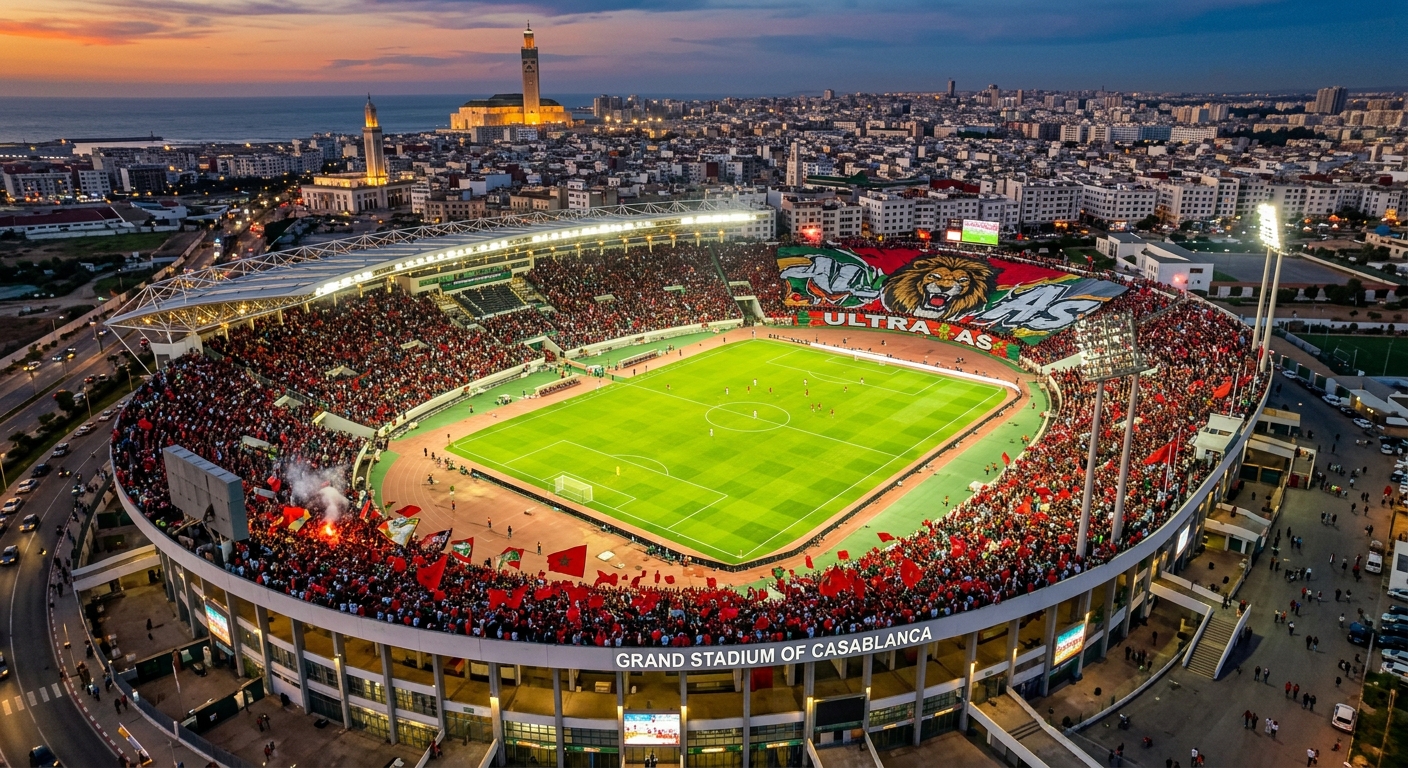
For Moroccan fans, the Botola is more than a sporting calendar. It is a social institution, a weekly ritual that fills stadiums in Casablanca and Rabat, fuels furious debate on radio phone-ins, and provides the cultural backbone for the ultras movements whose choreographed displays have become famous across Africa and beyond.
A Brief History of the League
Organised league football in Morocco predates independence, with colonial-era competitions running under the French protectorate. The modern national championship, however, is traced to 1956, the year Morocco regained its sovereignty. The newly independent nation quickly set about building its own football institutions, and the first championship of the independent era crowned a Moroccan champion rather than a colonial one.
The early decades were shaped by the rise of clubs that fused sport with national identity. Wydad Athletic Club, founded in 1937 during the protectorate, had already become a symbol of Moroccan resistance and pride. Raja Club Athletic followed in 1949, born in the working-class neighbourhoods of Casablanca and quickly establishing itself as a club of the people. Together these two would come to define the league's competitive heart.
From the 1960s onward AS FAR Rabat, the army club, emerged as a powerhouse, leveraging its institutional backing to assemble strong squads and dominate several seasons. The geographic spread of titles widened over time, with clubs from Fès, Khouribga, Agadir, Marrakech and elsewhere occasionally breaking the Casablanca-Rabat duopoly.
In 2011 the league took a decisive step toward modernity by adopting professional status, restructuring its governance and finances to align with continental standards. The professionalisation drive aimed to improve infrastructure, contracts and competitiveness, and it coincided with a broader investment in Moroccan football that would later bear fruit on the world stage.
How the League Format Works
The Botola Pro operates on the classic double round-robin system used across most of the footballing world. With 16 teams, each club plays 30 matches per season — 15 at home and 15 away. Three points are awarded for a win, one for a draw and none for a defeat, with goal difference and goals scored used as the primary tie-breakers when clubs finish level on points.
The team topping the table at the end of the campaign is crowned national champion and earns Morocco's primary berth in the CAF Champions League, Africa's premier club competition. Additional continental places are distributed to the runner-up and to the winner of the Moroccan Throne Cup, the country's principal knockout competition, who typically enters the CAF Confederation Cup.
At the foot of the table, the lowest-placed clubs are relegated to the Botola 2, swapping divisions with the second tier's promoted sides. The exact number of relegation places has varied as the FRMF has periodically adjusted the league's size, but the principle of sporting merit determining survival remains constant.
Scheduling in Morocco must account for the climate and the religious calendar. The hot summer months are generally avoided for the start of fixtures, and the league pauses or adjusts around Ramadan, with matches sometimes shifted to evening kick-offs after the fast is broken. International breaks for the Atlas Lions further punctuate the calendar.
The Dominant Clubs
No conversation about the Botola Pro can avoid the gravitational pull of the two Casablanca clubs. Raja Club Athletic and Wydad Athletic Club have between them won the bulk of the league's titles and contest the Casablanca Derby, one of Africa's most intense and atmospheric fixtures. Their rivalry shapes the league's narrative every single season.
AS FAR Rabat completes the historic trinity of Moroccan giants. As the army's club, AS FAR built a formidable tradition particularly through the 1960s and beyond, and it remains a regular contender for honours both domestically and on the continent, having pioneered Moroccan success in African competition.
Beyond the big three, a cluster of provincial clubs provide the league's depth and its romance. RS Berkane has risen dramatically in recent years to become a continental force; Maghreb de Fès carries the proud history of the imperial city; and clubs such as Olympique Khouribga, Hassania Agadir, Kawkab Marrakech and FUS Rabat have all enjoyed periods of success.
This competitive layering means that while the title race often comes down to Raja, Wydad and AS FAR, the battle for continental places, cup glory and survival keeps the rest of the division fiercely contested. A surprise champion is rare but not unheard of, which is part of the Botola's enduring appeal.
The Ultras Culture
Morocco's stadiums are defined as much by what happens in the stands as on the pitch. The ultras movement, which took root in the early 2000s, has transformed match days into spectacles of organised support featuring giant tifo displays, synchronised chanting, pyrotechnics and choreographies that rival anything seen in South America or southern Europe.
The Casablanca clubs lead the way. Raja's Green Boys and Ultras Eagles, and Wydad's Winners, are among the most famous supporter groups on the African continent. Their displays during the Casablanca Derby have produced images that circulate globally, and their songs have spilled beyond football into wider Moroccan social commentary.
This passion has a serious cultural weight. Ultras songs have at times become anthems addressing social and economic concerns, demonstrating how deeply football is woven into the fabric of Moroccan urban life. The energy these groups generate is a major reason the Botola has such a distinctive identity.
The intensity also brings challenges. Authorities have at times restricted away fans or imposed closed-door matches to manage crowd safety and disorder, and balancing the spectacular atmosphere with security remains an ongoing concern for the league and the federation.
Broadcast, Commerce and Sponsorship
The Botola Pro is broadcast domestically through Morocco's national television channels and dedicated sports platforms, bringing the league into homes and cafés across the country. Match coverage, highlights and analysis programmes form a substantial part of the Moroccan sports media diet, and demand for the Casablanca Derby in particular is enormous.
Title sponsorship has become central to the league's commercial model, with the Inwi branding a visible example of how telecommunications and consumer brands attach themselves to the competition. Club shirt sponsorship, stadium advertising and merchandising add further revenue streams, though Moroccan club football remains modestly resourced compared with Europe's wealthiest leagues.
Player transfers also form part of the economic picture. The Botola has historically been a selling league, developing talent that moves on to the Gulf, North Africa, France and occasionally the bigger European leagues. The financial reality of these transfers helps sustain club budgets.
Investment in the game accelerated as Morocco positioned itself as a footballing nation of ambition. Improved stadiums, training facilities and youth structures, partly driven by national-team success and major-tournament hosting plans, have begun to lift the commercial ceiling of the domestic game.
The League and the National Team
The Botola Pro functions as a crucial talent identification and development pipeline for the Atlas Lions, Morocco's national team. While many of Morocco's stars now play in Europe — and a significant proportion of the squad is drawn from the Moroccan diaspora born abroad — the domestic league continues to produce players who progress to the international stage.
Morocco's historic run to the semi-finals of the 2022 World Cup, the first African and Arab nation to reach that stage, shone a spotlight on the entire Moroccan football ecosystem. Much of that squad was Europe-based, but the success raised the profile and ambition of the domestic game and inspired a generation of young players in the Botola.
The league also supplies the backbone of Morocco's representation in continental club competitions, where strong Botola sides keep the country among Africa's elite. Performances by Raja, Wydad, AS FAR and Berkane in CAF tournaments enhance Morocco's coefficient and continental standing.
Crucially, the federation's investment in academies and youth football is increasingly feeding the Botola with home-grown talent. The Mohammed VI Football Academy, in particular, has become a renowned production line, and many of its graduates pass through Botola clubs on their way to bigger things.
Stadiums and Infrastructure
The Botola is played in a range of venues, from large national stadiums to compact club grounds. The Stade Mohammed V in Casablanca is the spiritual home of the city's football, hosting both Raja and Wydad and, on derby days, packing in a fervent crowd that generates a cauldron-like atmosphere.
Rabat's Prince Moulay Abdellah Stadium serves as a major venue and has undergone significant modernisation, while other cities including Tangier, Marrakech, Agadir and Fès boast substantial stadiums that host top-flight football and national-team fixtures.
Morocco's stadium infrastructure has received heavy investment tied to the country's tournament-hosting ambitions, including the Africa Cup of Nations and Morocco's role as co-host of the 2030 World Cup. New builds and major renovations across multiple cities are reshaping the matchday experience for Botola fans.
This wave of infrastructure spending benefits the domestic league directly, providing clubs with improved facilities and giving the Botola a stage worthy of its passionate following. The trajectory points toward a more modern, better-equipped competition over the coming years.
Challenges Facing the Botola
For all its passion, the Botola Pro faces structural challenges familiar to many emerging football economies. Club finances can be precarious, with reliance on local sponsorship, public support and player sales rather than the broadcast riches that sustain Europe's elite. Wage disputes and administrative instability have surfaced at various clubs over the years.
Talent retention is a persistent issue. The league's best young players are frequently sold abroad to balance the books, which strengthens individual clubs financially but can weaken the overall quality and continuity of the domestic competition season to season.
Refereeing standards, fixture congestion caused by continental commitments, and crowd-management concerns linked to the ultras phenomenon all feature among the issues the FRMF must navigate. Periodic closed-door matches and away-fan bans illustrate the tension between atmosphere and order.
Yet the direction of travel is broadly positive. Professionalisation, infrastructure investment and the halo effect of national-team success have created momentum. The challenge for Moroccan football's administrators is to convert that momentum into a more financially sustainable and consistently high-quality league.
The Future of Moroccan League Football
Morocco's footballing stock has never been higher. The 2022 World Cup semi-final, hosting rights for the 2025 Africa Cup of Nations and co-hosting of the 2030 World Cup alongside Spain and Portugal have positioned the country as a continental and increasingly global football hub. The Botola Pro stands to benefit from this elevated profile.
The pipeline of talent through academies such as Mohammed VI, combined with a growing pool of diaspora players who choose to represent Morocco, gives the broader ecosystem unusual depth. The challenge and opportunity for the domestic league is to capture more of this value rather than simply exporting it.
Commercially, rising sponsorship interest, improved stadiums and the global attention on Moroccan football create the conditions for the Botola to grow its revenues and its reach. There is genuine appetite, both at home and across the Arab and African football markets, for high-quality Moroccan club football.
If the league can address its financial fragilities and retain more of its best players, the Botola Pro is well placed to become one of Africa's flagship competitions. With the Casablanca Derby as its centrepiece and a wave of investment behind it, Moroccan league football is entering one of the most promising periods in its history.
| Attribute | Detail |
|---|---|
| Founded | 1956 (independence era) |
| Number of clubs | 16 |
| Matches per club | 30 (double round-robin) |
| Governing body | Royal Moroccan Football Federation (FRMF) |
| Most successful clubs | Wydad AC, Raja CA, AS FAR Rabat |
| Second tier | Botola 2 |
| Continental prize | CAF Champions League qualification |
| Title sponsor (recent) | Inwi (Botola Pro Inwi) |
Botola Pro at a glance
FAQ
What does "Botola" mean?
Botola is the Moroccan Arabic term for "championship" or "league." It is used colloquially to refer to Morocco's professional football divisions, with Botola Pro being the top tier and Botola 2 the second.
How many teams play in the Botola Pro?
The Botola Pro features 16 clubs who each play 30 matches in a home-and-away double round-robin format across a season running roughly from late summer to spring.
Which club has won the most Botola titles?
Wydad Athletic Club and Raja Club Athletic of Casablanca, along with AS FAR Rabat, are the most successful clubs in the league's history, with the two Casablanca giants leading the all-time honours roll.
Does the Botola feed into African competitions?
Yes. The league champion qualifies for the CAF Champions League, while the runner-up and the Throne Cup winner typically enter continental tournaments such as the CAF Confederation Cup.
How does the Botola relate to Morocco's World Cup success?
The Botola is part of Morocco's wider football ecosystem and serves as a domestic talent pipeline. While much of the 2022 World Cup semi-final squad was Europe-based, the success boosted the profile, ambition and investment in Moroccan football at every level, including the domestic league.
Loved this? Useful? React below — your feedback helps other readers.