Berber Carpets Decoded: What the Symbols on Beni Ourain and Boucherouite Rugs Actually Mean
A weaving tradition older than the word 'Morocco'
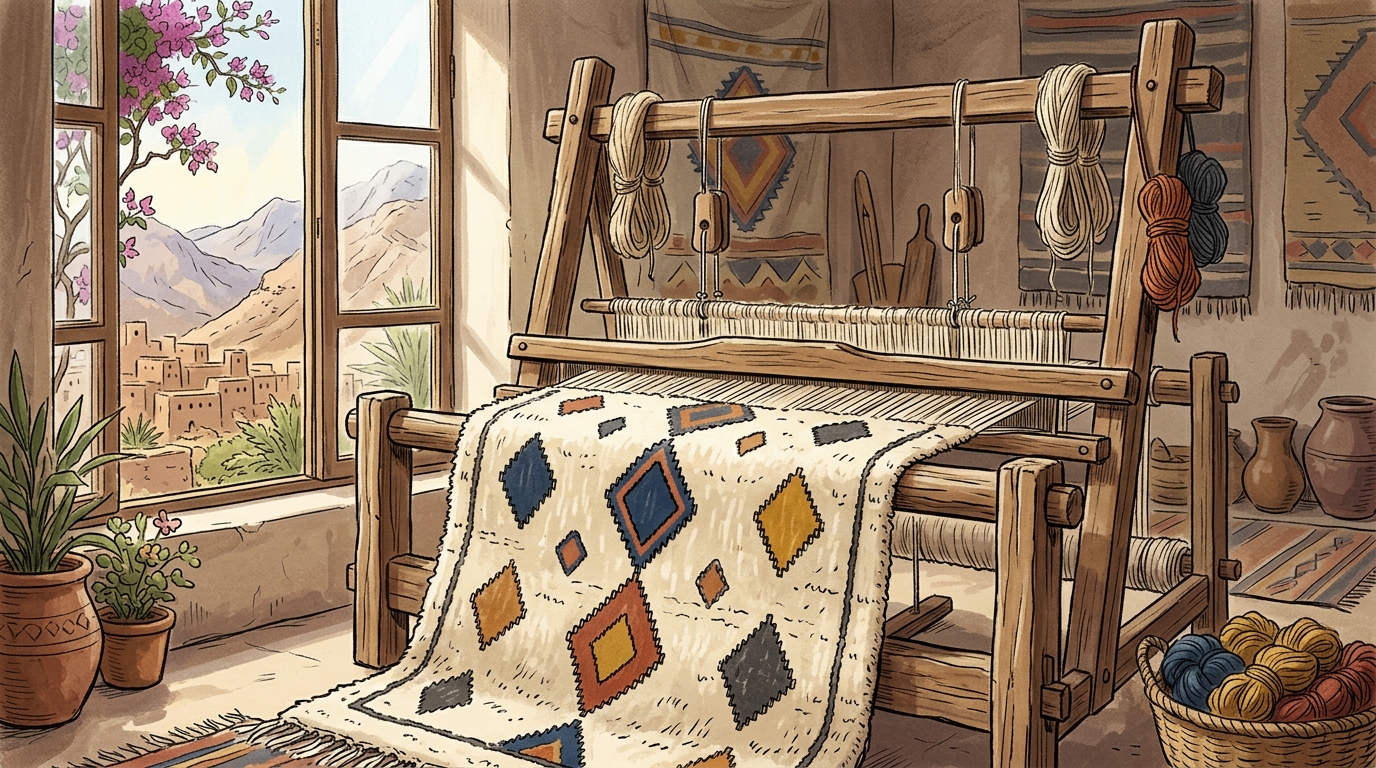
Amazigh rug weaving in the Atlas Mountains predates the Arab presence in North Africa by a wide margin, with the craft's roots in the region generally traced to well before the common era. What is better documented is the medieval flowering of the craft: Fez became the most important carpet-producing city in Morocco under the Marinid dynasty in the 13th century, supporting, according to historical accounts, over a hundred dye workers and thousands of artisan embroidery studios at the trade's peak. The oldest well-documented surviving Moroccan carpet, known as the Chiadma carpet, is dated to 1787.
Crucially, most Berber rugs were never made to be sold. They were made to be used: as bedding, insulation and flooring in homes and tents that could sit well below freezing at altitude in the High and Middle Atlas winters. A single carpet could take a woman more than a year of labor, worked in around childcare, herding and household duties, using wool sheared, washed, spun and dyed entirely by hand before a single knot was tied. Weaving knowledge passed down maternal lines, mother to daughter, inside specific tribal and village communities, which is precisely why different regions developed such distinct visual dialects — each tribe was, in effect, weaving in its own separate script.
It was only in the 19th century that Moroccan carpets became a significant export product, appearing at the French universal exhibitions of 1867, 1878 and 1889 and drawing sustained European interest for the first time. That exposure eventually fed into the 20th-century modernist design world — architects and designers including Le Corbusier began pairing thick-piled Berber rugs with minimalist furniture, drawn to what design writers of the era described as the rugs' 'primitivism,' a stark contrast to the dense, symmetrical patterns of classical Persian and Oriental carpets that had dominated Western taste until then.

Reading the symbols: diamonds, zigzags and eyes
The visual vocabulary of Amazigh weaving is built almost entirely from abstracted geometric shapes rather than figurative imagery, and certain motifs recur across regions with broadly consistent meanings. Diamond shapes are among the most common, frequently interpreted as protective symbols connected to the eye — a guard against the evil eye — and, in many contexts, as a symbol of female strength and fertility, sometimes read as an abstracted representation of the female form. Triangles carry a closely related meaning, widely associated with femininity, fertility and the protective, watchful eye.
Zigzag lines are commonly read as water, rivers or a person's life journey — the ups and downs of an individual or family's path — while crosses, sometimes called the 'Berber cross,' are associated with balance, harmony within the household, and architectural or spatial connection. Branch- and tree-like motifs point toward a 'tree of life' reading, or more literally toward the hardship and growth of daily life, while comb-shaped motifs are tied directly to the craft of weaving itself, and teapot motifs — a distinctly Moroccan touch — reference hospitality and community bonds, the ritual of serving mint tea to a guest.
Animal symbols appear less often but carry sharp, specific meanings: scorpions and jackals, somewhat counterintuitively, function as protective figures rather than threats, warding off the very dangers they represent. Fish motifs are tied to water, rain and the fertility of the land, while birds — referenced in the Quran as messengers between heaven and earth — are read as symbols of destiny or fate. None of these readings were standardized the way a written alphabet is; a specific diamond pattern could carry a slightly different inflection in the Middle Atlas than in the High Atlas, because each weaving community developed its own regional 'dialect' of the same underlying symbolic language.
Beni Ourain: the minimalist white-and-black classic
The Beni Ourain rug takes its name not from one weaver or one village but from a confederation of roughly seventeen Amazigh tribes settled in the northeastern Middle Atlas, an area historians link back to the wider Zenata tribal grouping. These communities have long made their living primarily from sheep farming, and it is that pastoral economy that produced the rug's defining material: exceptionally soft, high-loft, undyed wool from mountain sheep bred for exactly this kind of cold-weather insulation.
Visually, Beni Ourain rugs are instantly recognizable and comparatively restrained next to other Amazigh styles: an off-white or cream background, thick pile, and sparse, asymmetric patterns worked in black or dark brown, usually diamonds, lines and triangles rather than dense all-over ornamentation. That restraint was practical, not aesthetic minimalism for its own sake — these were originally sleeping mats and winter bedding for households living at real altitude, where warmth mattered more than density of decoration, and undyed wool was simply what the local sheep provided.
The style's modern global popularity, especially in Scandinavian-influenced and mid-century interior design, is a relatively recent chapter layered onto a much older functional object. What decorators now prize as a design statement began, and in many Middle Atlas households still functions, as the practical, handmade answer to a genuinely cold winter.
Boucherouite: rags, scarcity and a second life
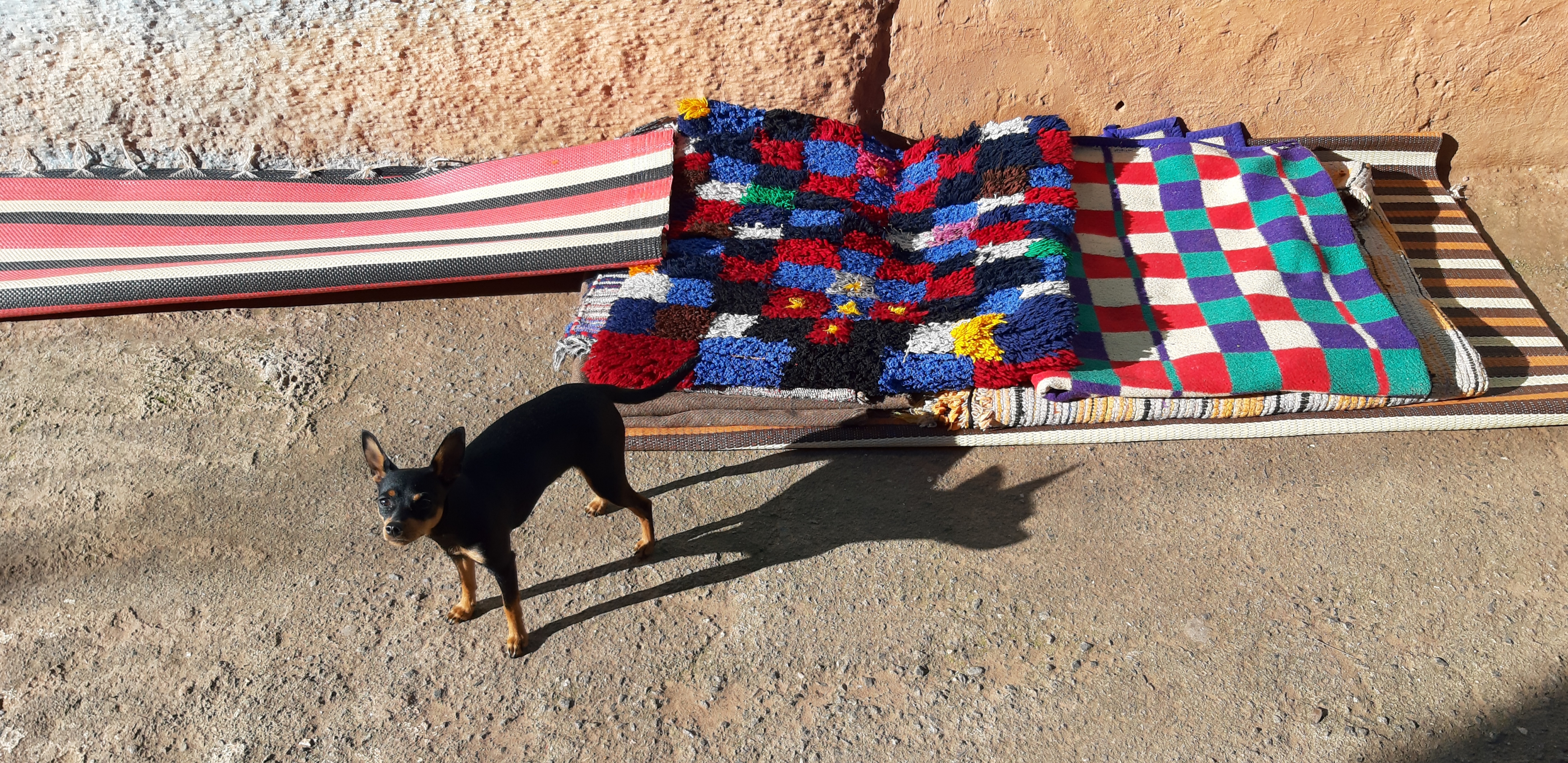
If the Beni Ourain represents the ancient end of the tradition, the Boucherouite rug represents its newest and, in some ways, most radical chapter. The word boucherouite comes from Moroccan Arabic and translates roughly to 'a piece torn from used clothing' or 'a scrap of rags.' The style itself only emerged in the mid-20th century, when Atlas weavers — many facing rising wool costs and reduced access to traditional raw material — began substituting recycled textiles: cotton and synthetic fabric offcuts, worn-out clothing, factory scraps, even plastic strips, whatever was available in a given household or village at a given time.
The results are, by design, unpredictable and free-form. Where Beni Ourain and other classical Amazigh styles follow relatively strict, inherited geometric grammars, Boucherouite rugs are spontaneous, improvisational and frequently asymmetrical, built from whatever colors the available scraps happened to be — hot pink beside lime green beside electric blue, with no two rugs ever exactly alike, because no two households' rag piles were ever exactly alike.
That makes Boucherouite less a break from the older symbolic tradition than an adaptation of its underlying logic — resourceful, women-led, home-based textile production — to mid-20th-century economic reality. It is now recognized internationally as a genuine art form in its own right, prized specifically for the same improvisational quality that originally came from necessity rather than artistic intention, and it remains, alongside Beni Ourain, one of the two Moroccan rug styles most recognized by name outside Morocco.

Azilal, Boujad and the rest of Morocco's rug map
Beni Ourain and Boucherouite are the two names most familiar internationally, but they are only part of a much larger regional map. Azilal rugs, from the northern Atlas region of the same name, are known for colorful, asymmetrical geometric and abstract patterns worked onto light or white backgrounds, using a single-knot technique that allows for finer, more intricate detail than the thicker Beni Ourain pile. Boujad rugs, from the central plains around the town of Boujad, lean into deep reds, pinks, purples and oranges, made from soft, high-quality wool colored with natural dyes and often carrying bolder, more angular figurative elements than the purely geometric Beni Ourain style.
Each of these regional styles developed its own symbolic emphasis alongside its own color palette and knotting technique — Azilal weavers, for instance, are often associated with more overtly expressive, almost freehand mark-making within the geometric framework, while Beni M'guild rugs from further south typically commit to a single dominant color field, such as orange, pink or blue, rather than the mixed palettes seen elsewhere. None of these differences are arbitrary; each reflects the specific materials, dyes and symbolic priorities available to and important for that particular tribal community.
Taken together, the regional map of Moroccan rug styles amounts to a kind of atlas of the Atlas Mountains themselves: you can trace tribal geography, historical trade routes and even 20th-century economic pressure simply by reading which symbols, colors and materials show up where. That is the real argument for looking closely at a Berber carpet rather than treating it as a neutral floor covering — the geometry is not random, and in many cases, neither is the story behind why a particular rug ended up looking the way it does.
For buyers today, that regional literacy is also practical. A rug labeled simply 'Moroccan' or 'Berber' in an international furniture catalogue could be a Middle Atlas Beni Ourain, a Boujad, an Azilal or a Boucherouite, each with a different weight, weaving technique, price point and, if you know what to look for, a different symbolic vocabulary stitched into the wool or fabric itself.

Frequently asked
What do the diamond shapes on Berber rugs mean?
Diamonds are widely interpreted as protective symbols connected to guarding against the evil eye, and are also commonly read as a symbol of female strength and fertility, sometimes as an abstracted representation of the female form.
What does a zigzag pattern mean on a Moroccan rug?
Zigzag lines are typically interpreted as representing water, rivers, or a person's or family's life journey, including its ups and downs.
What is a Beni Ourain rug?
It is a style of Amazigh (Berber) rug from a confederation of roughly seventeen tribes in Morocco's northeastern Middle Atlas Mountains, known for thick, undyed cream wool with sparse black or brown geometric patterns, originally made as warm winter bedding.
What is a Boucherouite rug?
Boucherouite means 'a piece torn from used clothing' in Moroccan Arabic. It is a rug style that emerged in the mid-20th century, woven from recycled fabric scraps, old clothing and synthetic textile offcuts instead of wool, producing colorful, free-form patterns.
Why do Beni Ourain rugs use undyed wool?
The Beni Ourain tribes are primarily sheep-farming communities, and their rugs traditionally used the natural, undyed wool from local mountain sheep, prized for its softness and insulating quality, rather than dyed fiber.
Who weaves Berber carpets in Morocco?
Weaving is traditionally done by Amazigh women, with knowledge passed down from mother to daughter within specific tribal and village communities, historically for household use (bedding and insulation) rather than for sale.
How long does it take to make a Berber carpet?
A single hand-woven carpet can take well over a year of labor, fit around a weaver's other household and herding responsibilities, from shearing and spinning the wool through dyeing and final knotting.
Why did Berber rugs become popular in Western interior design?
In the 20th century, modernist architects and designers, including Le Corbusier, began pairing thick-piled Berber rugs with minimalist furniture, drawn to their geometric simplicity in contrast to dense, symmetrical Oriental and Persian carpets.
What is the difference between Azilal and Boujad rugs?
Azilal rugs, from the northern Atlas, are colorful and asymmetrical on light backgrounds using a fine single-knot technique. Boujad rugs, from Morocco's central plains, favor deep reds, pinks, purples and oranges on soft, naturally dyed wool.
Do all Berber rug symbols mean the same thing in every region?
No. While certain motifs like diamonds, zigzags and crosses recur across Morocco with broadly similar themes (protection, fertility, life's journey), each tribal region developed its own visual 'dialect,' so exact interpretations can vary between the Middle Atlas, High Atlas and other weaving areas.
- Wikipedia — Moroccan rugs ↗
- Morocco Guide — The Traditional Berber Carpet ↗
- Boucherouite Rug — From Fabric Scraps to Timeless Art: The History of Boucherouite Rugs ↗
- Rug & Kilim — A Guide to History and Significance of Moroccan Berber Azilal Rugs ↗
- Asala Living — The Beni Ouarain Tribe: A Living Amazigh Heritage of the Moroccan Atlas ↗
Video via official YouTube embeds; photos via Wikimedia Commons under their stated licenses. All rights belong to the respective owners; 212 Daily claims no ownership.