Bahia Palace Guide
Origins of the Bahia Palace
The Bahia Palace was built in Marrakech in the second half of the nineteenth century for influential figures at the Moroccan court. It is associated above all with Ba Ahmed (Ahmed ben Moussa), a powerful grand vizier who expanded and embellished the complex toward the end of the century.
The name Bahia is often translated as the beautiful or the brilliant, fitting for a palace intended to display the wealth and status of its owners. Unlike many older monuments, it represents a relatively late flowering of traditional Moroccan palatial architecture.
Layout and Scale
The palace sprawls across several acres, an assemblage of courtyards, gardens, salons, and private apartments rather than a single grand structure. It was expanded over time, which gives it a somewhat irregular, organic plan.
This sprawling layout reflects both the gradual growth of the complex and the needs of a large household, including multiple wives and concubines. Visitors move through a sequence of spaces that open onto courtyards and gardens, revealing new vistas at each turn.
Courtyards and Gardens
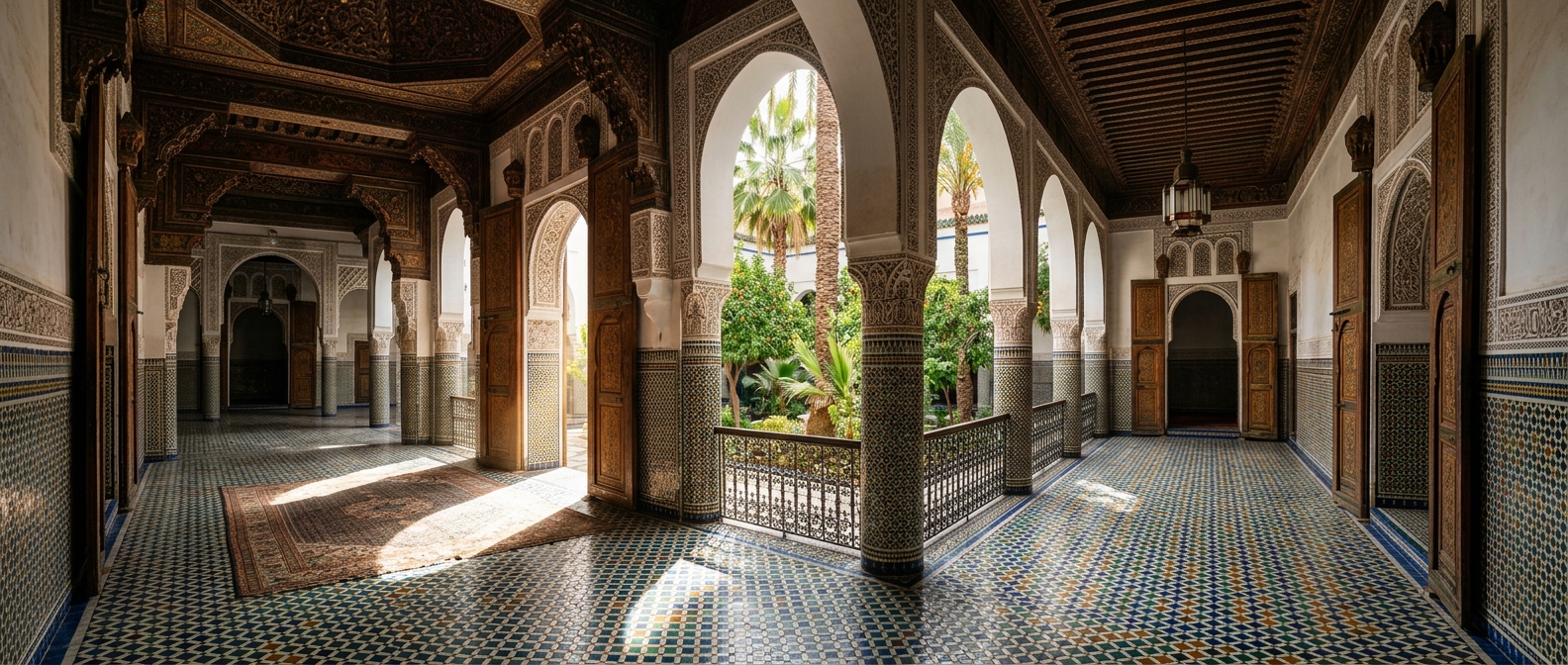
Central to the Bahia Palace are its courtyards, including a large marble-paved court and smaller intimate ones planted with citrus, cypress, and flowering shrubs. Fountains and channels of water bring coolness and movement to these spaces.
The gardens follow the Moroccan and Andalusian tradition of the enclosed paradise garden, providing tranquil retreats within the palace. Their greenery and the sound of water contrast with the ornate, enclosed interiors.
Decorative Craftsmanship
The Bahia Palace is celebrated for its decoration, which displays the full range of Moroccan crafts. Walls are sheathed in zellige mosaic, doorways framed by carved and sculpted plaster, and ceilings covered in painted and carved cedar.
The painted wooden ceilings, with their bright geometric and floral designs, are among the palace's most admired features. Together these elements demonstrate the skill of the artisans who worked on the complex and the wealth that funded their labor.
Historical Significance
The palace offers insight into the political world of late nineteenth-century Morocco, when powerful viziers wielded enormous influence. After Ba Ahmed's death, his property was reportedly seized, illustrating the precariousness of power even at the highest levels.
During the French protectorate, the palace was used by colonial authorities and visiting dignitaries. This later history adds another layer to the building's story, connecting it to the broader transformations of twentieth-century Morocco.
Visiting the Bahia Palace
The Bahia Palace is located in the medina of Marrakech, within walking distance of other major sites. It is open to visitors for an admission fee and is one of the most popular monuments in the city, so it can become crowded during peak hours.
Visiting early in the day helps avoid the largest crowds and the midday heat. Note that the palace is largely unfurnished, focusing attention on its architecture and decoration rather than on period furnishings.
Tips for Your Visit
Allow at least an hour to explore the courtyards, gardens, and rooms at a relaxed pace. Look upward frequently to appreciate the painted ceilings, and notice the variations in tilework and plaster from one room to the next.
Comfortable shoes, water, and sun protection are useful, as much of the visit is in open courtyards. Combining the Bahia with nearby attractions such as the Saadian Tombs or El Badi Palace makes for an efficient and rewarding day of sightseeing.
| Detail | Information |
|---|---|
| Location | Medina of Marrakech |
| Built | Late 19th century |
| Associated with | Grand vizier Ba Ahmed |
| Highlights | Painted ceilings, zellige, courtyards, gardens |
| Suggested visit | About one hour, early in the day |
Bahia Palace visitor information
FAQ
Who built the Bahia Palace?
It was built in the late nineteenth century for powerful court figures, most notably the grand vizier Ba Ahmed, who greatly expanded and decorated it.
What can you see at the Bahia Palace?
Visitors see courtyards, gardens, and lavishly decorated rooms featuring zellige tilework, carved plaster, and painted cedar ceilings, though it is largely unfurnished.
How long does a visit take?
Most visitors spend about an hour exploring the courtyards, gardens, and rooms. Arriving early helps avoid crowds and midday heat.
Loved this? Useful? React below — your feedback helps other readers.