Babouche: The History and Hidden Meaning of Morocco's Pointed Leather Slippers
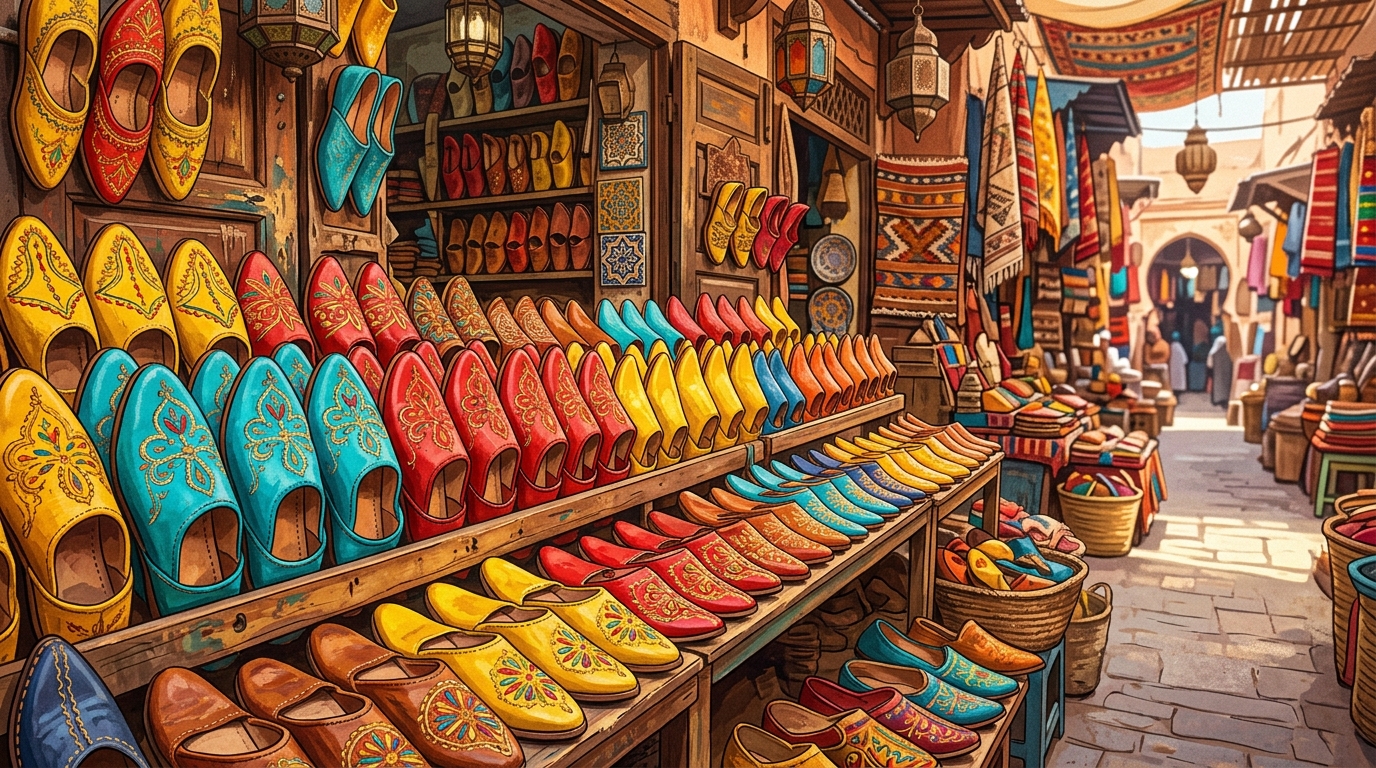
A Persian word, an Arabic bridge, a Moroccan craft
The word 'babouche' is itself a small history lesson. It entered French from the Arabic bābūj or bābūsh, which in turn descends from the Persian pāpūsh — a compound of pā ('foot') and pūsh ('cover'). That the French word for a quintessentially Moroccan object is actually Persian in origin, filtered through Arabic, says something important about how the babouche traveled: it is not a garment invented in isolation in Morocco, but the North African endpoint of a shoe style that moved across the Islamic world for well over a thousand years, with evidence of similar heelless leather footwear stretching back as far as the 2nd century BC in the wider region.
In Morocco the local Arabic term is balgha (also transliterated belgha or belga), and it is this word, not 'babouche,' that Moroccans themselves use day to day. Documented production in Morocco is generally dated to at least the 14th century, centered on Fez — a city that was already, by then, one of the great tanning and leatherworking capitals of the Islamic world. The craft has been passed down inside families, father to son, ever since, making the babouche one of the few Moroccan garment traditions with a nearly unbroken artisanal chain running from the Marinid era to the present day.
Structurally, the babouche is defined by what it lacks as much as by what it has: no heel, no laces, a soft folded-down or open back that lets the wearer slip in and out of it in one motion, ideal for a culture where shoes come off constantly — before prayer, before entering a home, before stepping onto a carpeted salon.

Fez tanneries: where the leather is actually made
You cannot separate the babouche from the Chouara tannery and its sister tanneries in Fez's old medina, which have supplied hides to Moroccan leatherworkers for centuries and still process cow, camel, sheep and goat skins using largely pre-industrial methods. Hides are cured and softened in vats, historically using natural fixatives including quicklime, salt, and even pigeon droppings to break down the leather before the tanning stage — a process still visible to tourists looking down from the surrounding rooftop terraces today.
Once tanned, the leather is dyed using traditional plant- and mineral-based pigments: saffron and pomegranate for yellows and golds, poppy for reds, indigo for blues, mint or henna-based mixtures for greens. Because these are natural dye baths rather than industrial chemical processes, colors can vary subtly between batches — a detail collectors of handmade babouches specifically look for as a mark of authenticity, as opposed to the flat, uniform color of a factory-dyed slipper.
From Fez, finished or partially finished leather is distributed to babouche workshops across Morocco, in cities including Marrakech, Meknes and Rabat, where cobblers cut, stitch and finish the slippers by hand, often adding embroidery, sequins or metallic thread for more decorative versions. The result is a genuinely national supply chain built around one city's tanning industry — which is part of why 'Fez leather' and 'Moroccan babouche' are so often mentioned in the same breath.
That supply chain also explains why babouche quality varies so widely between what tourists buy in a quick souk transaction and what a Moroccan family buys for a wedding. A cheap, mass-produced pair may use synthetic leather substitutes and machine stitching to hit a low price point for visitors. A genuine handmade balgha, by contrast, uses full-grain leather tanned in Fez, hand-cut soles, and stitching strong enough to be resoled and repaired for years, which is exactly how many Moroccan households treat them — as a durable, repairable object rather than a disposable souvenir.

Pointed toe or round toe: Arab style versus Amazigh style
Look closely at a wall of babouches in any medina and you will notice two distinct silhouettes. The pointed-toe babouche, with its elongated, sometimes upturned tip, is generally identified as the Arab-style shape, historically associated with urban centers and, in its more elaborate embroidered forms, with wealthier or more formal wear. The rounded-toe babouche is the Amazigh (Berber) style, native to Morocco's indigenous population and generally plainer, sturdier, and built for practical daily use in rural and mountain regions rather than display.
This two-shape split mirrors a pattern seen across Moroccan material culture more broadly, where an indigenous Amazigh form and a later Arab-influenced form coexist rather than one replacing the other — much as the djellaba absorbed both Amazigh and Arab tailoring traditions. Neither shape has fully displaced the other; both are manufactured today, often by the same workshops, sold side by side in the same souk stalls.
Gender also shapes the babouche in predictable ways. Men's babouches tend toward plainer leather, muted colors and the classic pointed or slightly rounded toe, often in the same yellow or brown associated with everyday and religious wear. Women's babouches are the primary canvas for decoration: embroidery, sequins, beadwork, metallic thread and bright dyed leathers in pinks, turquoises and golds, especially for versions meant to be worn with a kaftan or takchita at a wedding.
The 1689 decree: when a slipper's color was the law
The single most striking fact in babouche history has nothing to do with craftsmanship and everything to do with religion and power. In 1689, after capturing the northern port town of Larache from Spain, the Alaouite sultan Moulay Ismail issued a sumptuary decree banning the wearing of black shoes by Muslims, associating the color with the Spanish Christian rule he had just ended. Under the decree, black babouches were reserved specifically for Morocco's Jewish population, who were required to wear them, while Muslims were required to wear canary-yellow babouches. It was, in effect, a footwear-based dress code enforcing religious segregation at a glance, a striking historical example of how an everyday object can be conscripted into law.
That decree is the direct historical source of the strong association between yellow babouches and Moroccan Muslim identity that persists in the country's visual culture today — the same canary-yellow slippers commonly paired with a djellaba and fez for Friday prayers or religious festivals. The color rule as formal law has long since disappeared along with the legal discrimination it enforced, but the color itself never went away; it simply shifted from a compulsory marker into a traditional, voluntary choice, still visible in medinas across the country to this day.
It is worth being precise about what the historical record supports and what it does not: the 1689 decree is documented as an act of the Alaouite sultanate specifically tied to the recapture of Larache, not a general or continuous law throughout Moroccan history, and dress codes based on religion were abolished long ago. But the yellow babouche's specific cultural weight, distinct from any other color available, traces directly back to that one 17th-century edict.
From medina staple to bohemian icon
The babouche's reach beyond Morocco is not a recent phenomenon. Historical accounts describe versions of the slipper reaching the Ottoman court and, by the 17th century, the French royal court itself, carried along the same trade and diplomatic routes that moved textiles, spices and other goods between North Africa and Europe. European painters who traveled through Morocco and the wider Maghreb in the 19th and early 20th centuries, including artists working in the broader Orientalist tradition, frequently depicted babouches in their work, cementing the slipper as a visual shorthand for North African life in the European imagination.
The 20th century added a new chapter: the babouche became a fixture of bohemian and countercultural fashion in the 1960s and 1970s, worn by Western travelers and artists who passed through Marrakech and brought the slippers home as souvenirs and everyday footwear. That crossover has never fully faded — contemporary designers and lifestyle brands continue to reissue babouche-inspired slippers, and handmade Moroccan babouches remain a fixture of home-decor and fashion retail well outside North Africa.
More recently, the same slippers have become a recurring reference point in global interior design and loungewear marketing, sold internationally simply as 'Moroccan leather slippers' with little of the deeper history attached. That gap — between the object as a globally traded lifestyle accessory and the object as a seven-century-old regulated craft tied to a specific city's tanneries and, for a time, to a specific and discriminatory legal code — is exactly why the babouche rewards a closer look rather than a passing glance in a gift shop.
Inside Morocco itself, none of that external fame changes daily use. Babouches remain what they have been for seven centuries: the shoe you slip on to walk to the corner shop, the shoe you keep by the door for guests, the shoe that comes off automatically before you step onto a rug. Plain leather versions serve that everyday function, while heavily embroidered pairs are reserved for Eid, weddings and family celebrations — a simple, functional garment carrying, if you know where to look, a genuinely complicated history.
Frequently asked
Where does the word 'babouche' come from?
It comes from the Arabic bābūj or bābūsh, which descends from the Persian pāpūsh, a compound of pā (foot) and pūsh (cover). The French adopted 'babouche' from this Arabic-Persian lineage.
What is the Moroccan (Arabic) name for babouche?
In Morocco the slippers are called balgha (also spelled belgha or belga). 'Babouche' is the French-derived name more commonly used internationally.
How old is babouche production in Morocco?
Documented production in Morocco dates to at least the 14th century, centered in Fez, one of the historic capitals of Islamic-world leather tanning.
Why are babouches associated with Fez?
Fez is home to historic tanneries, including the Chouara tannery, that have supplied leather to Moroccan craftsmen for centuries using traditional, largely pre-industrial tanning and natural-dye methods.
What is the difference between pointed-toe and round-toe babouches?
The pointed-toe babouche is generally identified as the Arab-influenced style. The rounded-toe babouche is the native Amazigh (Berber) style. Both are still produced and sold today, often side by side.
Why are yellow babouches specifically associated with Morocco?
In 1689, after retaking the port of Larache, Sultan Moulay Ismail issued a decree banning black shoes for Muslims (associating black with Spanish Christian rule) and requiring canary-yellow babouches for Muslims, while black babouches were reserved for the Jewish population. The strong cultural association between yellow babouches and Moroccan Muslim dress traces back to that decree.
Are babouches still color-coded by religion today?
No. The legal dress-code distinctions from the 1689 decree were tied to that historical period's discriminatory sumptuary laws and have long since disappeared. Babouches today are worn in a wide range of colors by anyone, chosen for style rather than legally mandated identity.
What are babouches traditionally made from?
Cow, camel, sheep or goat hide, tanned largely by hand in cities like Fez and dyed using natural pigments such as saffron, pomegranate, poppy and indigo, though modern factory-produced versions also exist.
Do men and women wear different styles of babouche?
Yes. Men's babouches tend to be plainer leather in muted tones such as yellow or brown, often worn with a djellaba. Women's babouches are more often decorated with embroidery, sequins and bright dyed leather, especially for weddings and formal occasions.
How did babouches become known outside Morocco?
Historical trade and diplomatic exchange carried the slipper style to the Ottoman court and, by the 17th century, the French royal court. In the 20th century, babouches became a bohemian fashion staple after Western travelers and artists brought them home from Marrakech.
- Wikipedia — Balgha ↗
- Wikipedia — Mawlay Ismail (Moulay Ismail) ↗
- El Fenn — The Story of Babouche ↗
- Ocelot Market — What's the Difference Between Arabic and Berber Babouche? ↗
- Majestic Disorder Travels — Moroccan Slippers ↗
Video via official YouTube embeds; photos via Wikimedia Commons under their stated licenses. All rights belong to the respective owners; 212 Daily claims no ownership.