How Amazigh Women Built Morocco's Argan Oil Cooperatives
A tree that grows almost nowhere else
The argan tree, Argania spinosa, is a thorny, drought-hardy species endemic to the arid plains of southwestern Morocco. Its natural range is concentrated in the Souss-Massa region, spreading across the provinces around Agadir, Essaouira, Taroudant and Tiznit. Argan trees can live for centuries, sending roots deep into cracked, rocky soil where almost nothing else survives, which is why Moroccans have long called the arganeraie, the argan forest, a natural barrier against the encroaching Sahara and a foundation of the wider agro-sylvo-pastoral economy of the region, supporting grazing, beekeeping and cereal plots alongside the trees themselves.
On December 8, 1998, UNESCO designated the Arganeraie as a Biosphere Reserve under its Man and the Biosphere Programme, the first such reserve ever declared in Morocco. It covers roughly 2.5 million hectares stretching across the Souss-Massa and Marrakech-Safi regions, taking in the provinces of Agadir Ida-Outanane, Inezgane Ait Melloul, Chtouka Ait Baha, Taroudant, Tiznit and Essaouira. The designation was meant to balance strict ecological protection with the economic reality that hundreds of thousands of rural Moroccans depend on the tree for their livelihood.
Long before UNESCO arrived, Amazigh communities already managed the forest collectively through a customary system called the agdal, a word roughly meaning to close or to fence. Under this system, a village assembly, the jmaa or taqbilt, would agree each year on when a given stretch of forest or pasture would be closed to grazing and harvesting so the trees could rest, aligning the picking of fruit with the tree's own biological cycle. It is one of the oldest examples of community-based natural resource management in the region, and it long predates the cooperatives built on top of it.
That international recognition has continued to grow. In March 2021, the United Nations General Assembly adopted resolution 75/262, sponsored by Morocco and co-sponsored by 113 member states, proclaiming May 10 as the International Day of Argania. The measure explicitly ties the tree's ecological value to the role of the rural communities, and especially the women, who have sustained it for generations.

A craft passed down between women
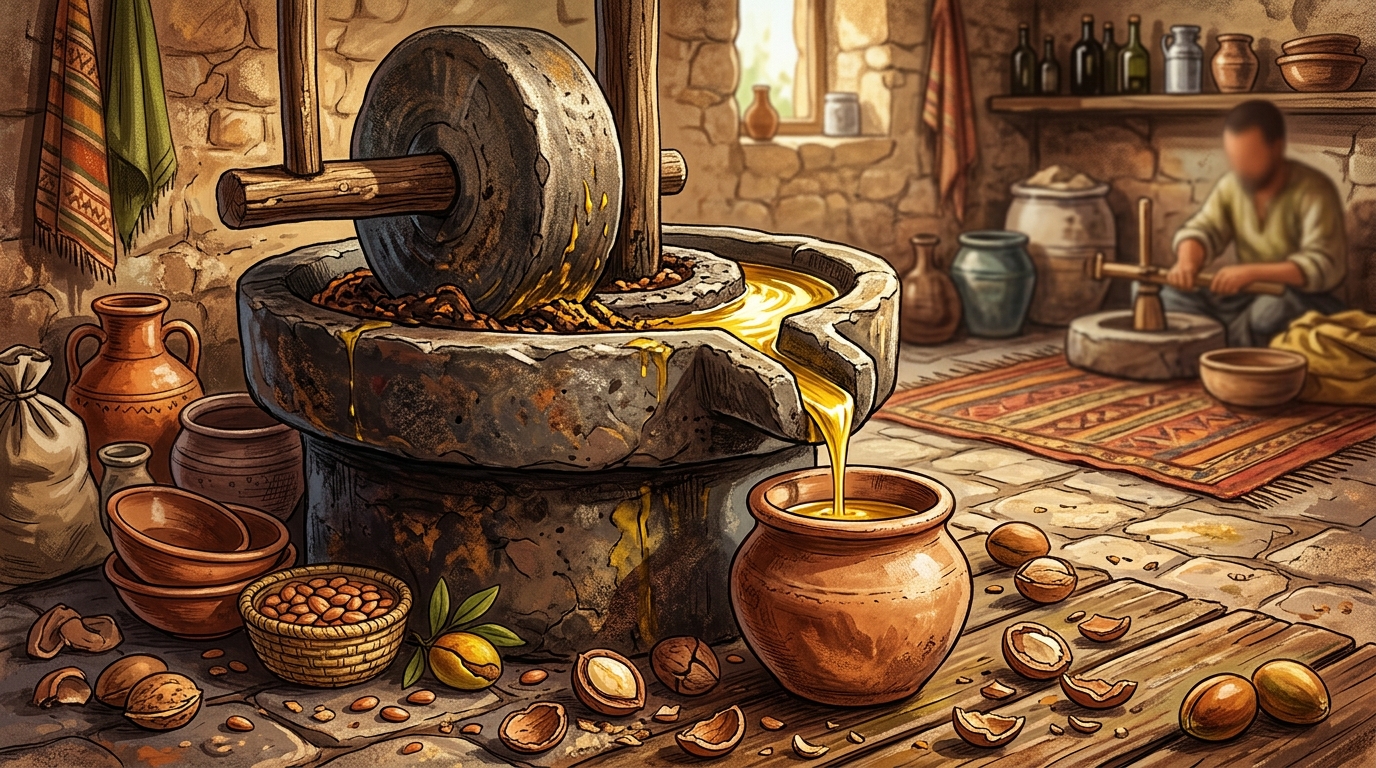
Long before cooperatives existed, extracting argan oil was slow, physically demanding work done almost entirely by women. Sun-dried argan fruit had to be de-pulped, and the walnut-hard shell inside cracked open by hand between two stones, one nut at a time, to reach the small kernels within. Producing a single liter of oil could take many hours of this repetitive cracking and grinding, traditionally finished on a stone quern and kneaded with warm water to separate the oil from the paste.
The kernels were roasted for the nuttier culinary oil used in cooking and in amlou, the honey-and-almond dip eaten with bread, while unroasted kernels produced the milder oil used for skin and hair care. This was domestic, communal work, done in courtyards and passed from mother to daughter, often as a social occasion where several women worked and talked together, and it carried real cultural weight even though it rarely generated much cash.
Because rural Amazigh women traditionally did not participate directly in public souk trade, the oil or raw nuts they produced were typically sold cheaply to middlemen who controlled access to buyers. Women did the labor, cracking, roasting and grinding for hours on end, but they saw little of the value it eventually created once it left the village and reached urban or foreign markets.
The 1990s: from household craft to cooperative
The shift began with a scientist. In the 1990s, Zoubida Charrouf, a professor at Mohammed V University in Rabat, carried out ethnobotanical doctoral research on the argan tree that scientifically documented, for the first time, the oil's exceptionally high levels of tocopherols and antioxidants and its links to reduced cardiovascular risk. Her research gave argan oil a credible case for real commercial and cosmetic value beyond its local reputation, at a moment when the forest itself was visibly shrinking from overuse.
Charrouf then encouraged rural women in the Agadir region to organize themselves into formal cooperatives rather than sell as scattered individuals to intermediaries. The first, Amal, meaning hope in Arabic, was founded in 1996 in Tamanar, a town roughly 70 kilometers south of Essaouira. Many of its founding members were widowed or divorced women with few other paths to economic independence, and the cooperative gave them a way to earn a living with dignity as recognized members of their communities, doing the same cracking and pressing work they already knew, but now for their own collective benefit.
The model spread quickly through the argan belt of southwestern Morocco. Within about a decade, roughly fifty women's cooperatives had formed, pooling equipment such as presses and roasting tools, sharing training in hygiene and organic standards, and giving members a collective, steadier income in place of informal, individual bartering. Development agencies, foreign NGOs and Moroccan government programs took notice, funding presses, storage facilities and organic certification for the growing network of cooperatives.

UCFA and the union of women's cooperatives
As individual cooperatives multiplied, many banded together into larger unions to gain negotiating power and export capacity. The best known is UCFA, the Union des Cooperatives des Femmes de l'Arganeraie, which grew into the largest such union in the region, bringing together dozens of member cooperatives with backing from Morocco's Social Development Agency, European Union funding, and, in parallel networks, German technical cooperation support for other cooperative groups. Together these unions gave individual, small, rural cooperatives a collective voice they could never have had negotiating alone with foreign buyers.
Formal cooperative and union status carried weight well beyond the paycheck. It gave women a recognized legal entity that could sign contracts, hold bank accounts, and own production equipment collectively, in a setting where women had rarely been able to represent themselves as economic actors. Many cooperatives added literacy classes and basic health services for members alongside the production work itself, and reporting on the movement has repeatedly described members earning several times more than rural women outside the cooperative system doing similar work informally.
The fair-trade and export side of the story matters just as much. Organic certification and fair-trade partnerships opened cooperative-made argan oil to buyers in Europe and North America, in both cosmetics and culinary markets. In April 2009, Moroccan argan oil received Protected Geographical Indication status, the first product from the African continent to earn that European designation, formally tying the oil's identity to its Moroccan origin and, by extension, to the cooperatives producing it. That designation, combined with the cooperatives' own organic certifications, is a large part of why argan oil now sells internationally at a premium far above ordinary vegetable oils.
A forest under pressure
The very success of argan oil now threatens the tree it comes from. The sight of goats balanced high in argan branches is a genuine, centuries-old part of rural life in the region, since goats naturally forage the tree's leaves and fruit. But the income argan oil brought to rural households let many families buy larger goat herds, and bigger herds mean more overgrazing, which strips ground cover, damages young trees, and accelerates soil erosion across the arganeraie.
Booming global demand adds further strain, and it is putting pressure on the old agdal system itself. Because the fruit is now so valuable, some harvesters no longer wait for the traditional closure period to end, picking fruit early and green rather than letting it fall naturally, which stresses the trees and undercuts the very rest system that kept the forest healthy for centuries. Wood collection for fuel also continues in parts of the forest despite its protected status.
Layered on top of that is climate change: reduced and less reliable rainfall in southwestern Morocco is slowing the natural regeneration of argan stands, with the most exposed and vulnerable trees disappearing first. There is also commercial pressure on the cooperative model itself, as large beauty and food companies buy argan oil in bulk and bigger private operators or intermediaries undercut small cooperatives on price. Reporting on the sector has documented cooperatives struggling or closing under this competition, squeezing the very women the fair-trade system was originally built to support, and leaving the movement's long-term future an open question even as the tree it depends on gains ever more international recognition.

Frequently asked
What is argan oil made from?
Argan oil is pressed from the kernels inside the fruit of the argan tree, Argania spinosa, a species native to southwestern Morocco. Roasted kernels produce the nuttier culinary oil, while unroasted kernels produce the milder oil used in skin and hair care. Both versions still start with the same slow, hand-cracked process women have used for generations.
Where does the argan tree grow?
The argan tree is endemic to the arid Souss-Massa region of southwestern Morocco, concentrated around Agadir, Essaouira, Taroudant and Tiznit. Its deep root system lets it survive in rocky, drought-prone soil where few other trees can grow, and its range broadly overlaps with the UNESCO-designated Arganeraie Biosphere Reserve.
When did UNESCO recognize the argan forest?
UNESCO designated the Arganeraie as a Biosphere Reserve on December 8, 1998, Morocco's first ever biosphere reserve. It covers about 2.5 million hectares across the Souss-Massa and Marrakech-Safi regions, balancing conservation with the livelihoods of local communities.
Who started the first women's argan oil cooperative?
The first women's argan oil cooperative, Amal, meaning hope in Arabic, was founded in 1996 in Tamanar, near Essaouira, after research by Professor Zoubida Charrouf of Mohammed V University scientifically confirmed the oil's exceptional antioxidant properties and commercial potential.
What is UCFA?
UCFA, the Union des Cooperatives des Femmes de l'Arganeraie, is the largest union of women's argan oil cooperatives in Morocco. It brings together dozens of cooperatives and has received support from Morocco's Social Development Agency and European Union funding to strengthen production, quality control and exports, giving small rural cooperatives combined bargaining power they would not have alone.
How did cooperatives change life for rural Amazigh women?
Formal cooperative membership gave women a recognized legal and economic identity, letting them sign contracts, hold bank accounts, and share equipment collectively. This was significant in communities where women had traditionally been excluded from public market trade, and many cooperatives added literacy and health programs alongside production work, giving members a source of steady income that did not exist a generation earlier.
What is Protected Geographical Indication status, and when did argan oil receive it?
Protected Geographical Indication, or PGI, is a European designation tying a product's identity to its specific region of origin, similar to protections given to products like Champagne or Parmesan cheese. Moroccan argan oil received PGI status in April 2009, becoming the first product from the African continent to earn the recognition.
Why do goats climb argan trees?
Goats naturally forage on the leaves and fruit of the argan tree, and the image of goats perched in its branches is a genuine, long-standing feature of rural life in the region, often used to illustrate the tree in photographs and travel writing. However, argan-driven income has let some families buy larger herds, and the resulting overgrazing now damages young trees and erodes soil across parts of the forest.
What other threats does the argan forest face today?
Beyond overgrazing, the arganeraie faces overharvesting of fruit before it falls naturally, which undermines the traditional agdal system of seasonal rest, along with ongoing wood collection for fuel and climate change, which is reducing rainfall and slowing the natural regeneration of the trees. Cooperatives also face commercial competition from larger operators that can undercut them on price.
Is there an International Day of Argania?
Yes. In March 2021 the United Nations General Assembly adopted resolution 75/262, sponsored by Morocco and co-sponsored by 113 member states, proclaiming May 10 as the International Day of Argania in recognition of the tree's ecological importance and the rural communities, especially women, who sustain it.
- UNESCO - Arganeraie Biosphere Reserve (Man and the Biosphere Programme) ↗
- UNESCO - The Agdal system sustaining landscapes and livelihoods in Arganeraie ↗
- United Nations - International Day of Argania ↗
- IDRC - 'Amal' as in 'Hope': An Argan Oil Cooperative is Changing Women's Lives ↗
- International Journal of Intangible Heritage - Berber Women and the Argan Oil Co-operatives in Morocco ↗
- Equal Times - Faced with competition from big business, Morocco's argan oil cooperatives are being forced to close ↗
Video via official YouTube embeds; photos via Wikimedia Commons under their stated licenses. All rights belong to the respective owners; 212 Daily claims no ownership.