How Andalusian Refugees Reshaped Morocco: The Lasting Legacy of Al-Andalus
Centuries of exodus: the waves that emptied Al-Andalus into Morocco
The migration was never a single event — it was a long, recurring rupture spread across more than seven hundred years. An early wave followed the fall of Toledo to Castile in 1085, sending Andalusian families toward Morocco and the rest of the Maghreb as the Reconquista's frontier began its slow southward push. A second, larger wave followed the fall of Cordoba in 1236, when one of Islamic Spain's greatest cities passed to Christian rule and its scholars, craftsmen and merchants scattered across North Africa, many settling in cities such as Tlemcen and Fes.
The final and most symbolically loaded wave came with the fall of Granada on January 2, 1492, when the Catholic Monarchs Ferdinand and Isabella took the last Muslim-ruled city on the peninsula and closed nearly eight centuries of Islamic Spain. Boabdil, the last Nasrid emir, eventually made his way to Fes, where the 17th-century historian Ahmad al-Maqqari records that he was granted a palace in what is still known today as the Andalusian quarter. Thousands of his former subjects followed the same route, and the pattern of resettlement was not random: exiles from a given Spanish city tended to regroup in a particular Maghribi one, so that Sevillans clustered heavily in Fes while Cordobans gravitated toward Tlemcen.
The final chapter came a century later. Even those Muslims who had converted to Christianity to remain in Spain, known as Moriscos, were never fully trusted, and in 1609 King Philip III ordered their wholesale expulsion. Between 1609 and 1614, some 300,000 Moriscos were forced out of Spain through Mediterranean ports, and tens of thousands of them resettled in Morocco, where the Saadian sultan Moulay Zidan welcomed their agricultural, artisanal and naval skills into depopulated coastal towns. It was, by any measure, one of the largest forced migrations in early modern Mediterranean history — and Morocco absorbed a substantial share of it.
Fes and the Andalusian quarter: two rivers, two refugee cities
No Moroccan city carries the imprint of Al-Andalus more visibly, or for longer, than Fes. The city was founded by the Idrisid dynasty between 789 and 808, and its very layout reflects a double refugee history: Fes el-Bali grew as two separate settlements on opposite banks of the Fez River, the Qarawiyyin quarter on one side and the Adwat al-Andalus, the Andalusian quarter, on the other. The Andalusian quarter takes its name from families of Arab and Iberian descent who fled Cordoba after a rebellion against Emir al-Hakam I was crushed in 817-818, arriving in Fes with the wealth, literacy and administrative experience of one of the Islamic world's most sophisticated cities.
The two riverside communities left twin monuments that still anchor the medina today. In 859, Fatima al-Fihri, herself from a family of Kairouan origin, founded the Qarawiyyin Mosque, later home to one of the world's oldest continuously operating universities. Tradition holds that her sister Mariam founded the Mosque of the Andalusians on the opposite bank around the same time, giving the Andalusian community its own great congregational mosque and, with it, a permanent claim on the city's skyline.
Centuries later, the 1492 wave layered a second Andalusian identity onto the same neighborhood. Refugees from Granada, including figures connected to Boabdil's own court, settled among the descendants of the ninth-century Cordoban exiles, reinforcing a quarter that had already been shaped by Al-Andalus once before. Few places on earth show so clearly how a single migration story can repeat itself, six hundred years apart, onto the same streets.

Zellige, riads and muqarnas: an architecture carried across the strait
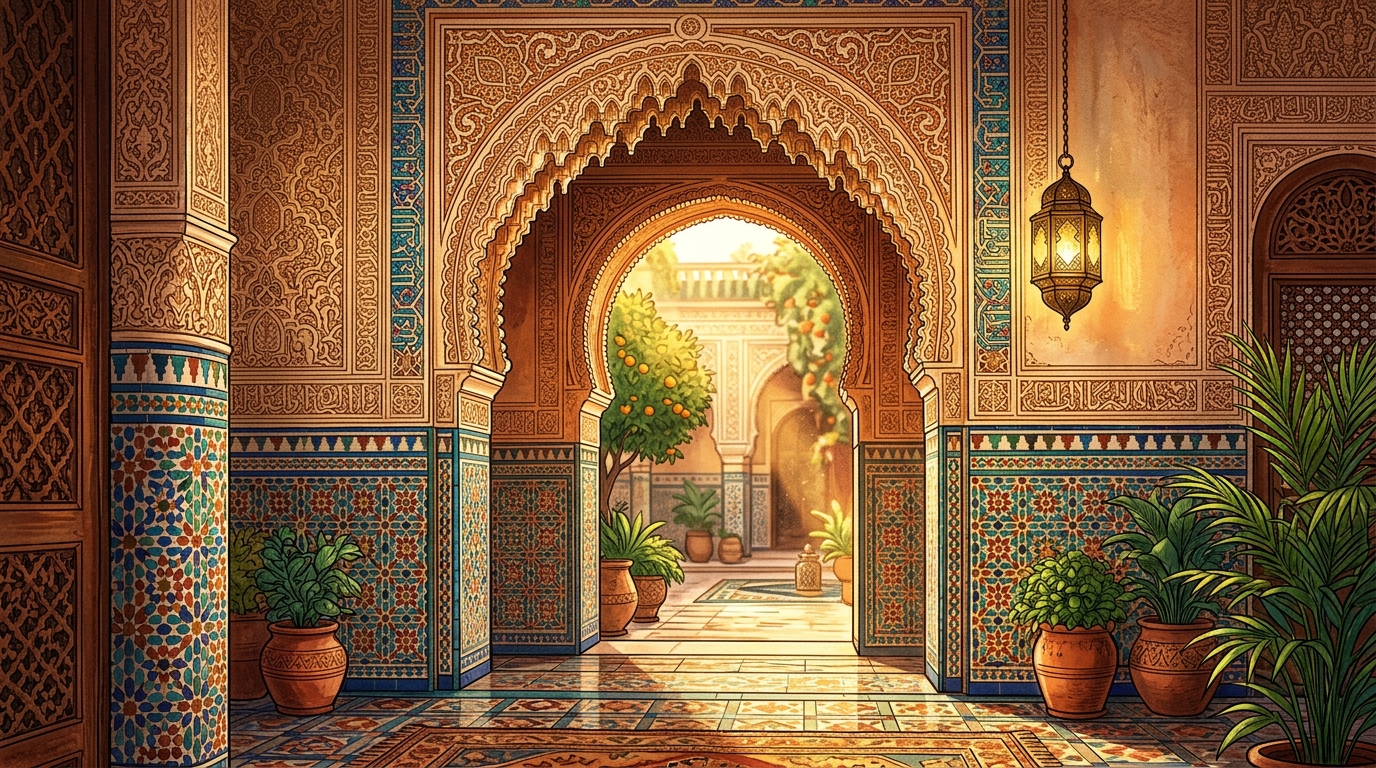
Andalusian refugees did not just settle into Moroccan cities — they redesigned them. The riad, the introverted house built around a central courtyard garden, spread through Morocco largely on the strength of the Hispano-Moorish domestic architecture that Andalusian families and craftsmen brought with them from the 11th century onward, under the Almoravid and Almohad dynasties and again with each later wave of exiles. The logic of the riad, a private oasis of greenery and water sealed off from the noise of the street, is a direct descendant of the courtyard houses of Cordoba, Seville and Granada.
The same is true of zellige, the hand-cut, glazed terracotta tilework assembled into radiating geometric star patterns that decorates fountains, medersas and riad walls across the country. The craft evolved through the exchange between Andalusian and Moroccan artisans as tilemakers who had worked in Iberia merged their techniques with local Fassi clay traditions, producing some of the finest surviving examples in buildings like Fes's Medersa el-Attarine. Alongside zellige, Andalusian craftsmen also carried over the vocabulary of carved stucco and muqarnas, the honeycombed, stalactite-like plaster vaulting that Moroccan and Andalusian builders had already been developing in parallel for centuries and which refugee artisans helped refine further in Moroccan royal buildings.
The result is a shared architectural language that makes it genuinely difficult, standing in a courtyard in Fes or Marrakech, to say where Andalusian design ends and Moroccan design begins — which is, in a sense, exactly the point. Centuries of resettlement fused the two traditions so completely that Moroccans today simply call it their own heritage, while acknowledging its Andalusian root.
The music of exile: Gharnati, Andalusian classical song and the nuba
Among everything Andalusian refugees carried into exile, music may be the most intimately preserved. Andalusian classical music traces its roots to the courts of Al-Andalus during the ninth to fifteenth centuries, and when its patrons and practitioners were forced into exile, the tradition migrated with them rather than dying with the civilization that produced it. In Morocco it survives above all through the nuba, a structured suite of vocal and instrumental movements that unfolds across a fixed sequence of rhythms, moving from slow and stately to fast and light.
Morocco's Andalusian orchestras are most closely associated with Fes, Rabat and Tetouan, cities that each absorbed major waves of exiles and, in turn, became custodians of the repertoire. In the eighteenth century, the Tetouan-born musician al-Haik is credited with compiling and codifying the surviving nubat, effectively rescuing the tradition from fragmentation and giving Morocco's Andalusian music its enduring canonical form. Chefchaouen, settled heavily by Andalusian and Morisco refugees in the same era, kept its own strand of the tradition alive within a smaller, more intimate community.
A closely related style, Gharnati — named for Granada, the city whose fall triggered the last great wave of exile — took root further east in Tlemcen and later spread into Morocco as well, particularly in Oujda and Rabat. Whether performed as Gharnati or under the broader Andalusian classical umbrella, the music functions today as a kind of living archive: melodies, poetic forms and instrumental conventions that predate the fall of Granada, still rehearsed and performed in Moroccan conservatories and private circles more than five centuries later.
A refined table: how Al-Andalus shaped Fassi cuisine
Fes's reputation as Morocco's culinary capital is inseparable from its Andalusian refugee history. Families fleeing Al-Andalus brought with them advanced agricultural knowledge, refined table customs and a repertoire of intricate recipes that had themselves developed from the classical Arab cuisine which had traveled from Damascus to Iberia centuries earlier. Settling in Fes, these exiles introduced or popularized ingredients that remain signatures of the city's food today, among them almonds, oranges and sugar, alongside techniques for preserving lemons that gave Moroccan cooking one of its defining flavors.
The results show up on nearly every Fassi table: pigeon or chicken pastilla layering sweet and savory in the same dish, almonds and cinnamon paired with poultry, orange blossom water scenting pastries and syrups, and the slow, two-stage cooking methods that turn a simple tagine into something closer to a small ceremony. A 13th-century recipe collection from the period already describes cooking pigeon with cinnamon, almonds, saffron, onion and egg using a double-cooking process strikingly close to versions still made in Fassi kitchens today.
What makes this culinary inheritance distinct from a simple list of imported ingredients is the sensibility behind it: a preference for delicate, layered spicing over heat, and for the salty-sweet contrast that Andalusian and earlier Damascene cooking prized. That sensibility, carried across the strait in the luggage of refugee families, is what Moroccans and food historians alike still describe as the defining elegance of Fassi cuisine.
Tetouan and Chefchaouen: Andalusian towns rebuilt from ruin
If Fes shows how an Andalusian community folded into an existing metropolis, Tetouan and Chefchaouen show what happened when refugees built almost from scratch. Tetouan had been reduced to ruins by Castilian forces in the 15th century, and by its end the town was rebuilt by Andalusian exiles led by Sidi Ali al-Mandri, a military commander loyal to Boabdil who had fled Granada after its fall. Under his direction, and with the continued arrival of Muslim and Jewish refugees from Iberia over the following century, Tetouan rose again as a fortified medina laid out along Andalusian urban lines, complete with the walls, towers and dense street pattern still recognizable today. The city's Andalusian character was substantial enough that the medina was inscribed on the UNESCO World Heritage list in 1997 as a well-preserved model of that heritage, and Tetouan is still sometimes nicknamed Granada's daughter, with some local families said to keep keys to homes their ancestors once owned there.
Chefchaouen tells a related but distinct story. The town was founded in 1471 as a small fortress by Ali ibn Rashid al-Alami to help resist Portuguese incursions in the north, but it was the Andalusian and Morisco refugees who arrived during and after the Reconquista, and especially after 1492, who gave it much of its lasting character. They rebuilt and expanded the settlement with red-tiled roofs, interior courtyards and horseshoe arches that echoed the architecture they had left behind, and it was these Andalusian-descended residents who established the local custom of lime-washing walls in white and blue-toned washes, the practice now inseparable from Chefchaouen's identity as Morocco's blue city.
In both towns, the Andalusian imprint was never a decorative flourish added after the fact. It was the founding material — the walls, the street plans, the trades and the customs that refugees who had nowhere else to go used to build new lives, one generation after their old cities on the other side of the strait had stopped being theirs.


Frequently asked
Who were the Andalusian refugees who settled in Morocco?
They were Muslims, and later Christian converts of Muslim descent known as Moriscos, who fled or were expelled from Al-Andalus, the Muslim-ruled territory of the Iberian Peninsula, as the Christian Reconquista advanced between the 11th and early 17th centuries. Many also brought Jewish neighbors and craftsmen who left Iberia in the same waves.
What were the main waves of Andalusian migration to Morocco?
Key waves followed the fall of Toledo in 1085, the fall of Cordoba in 1236, the fall of Granada in 1492, and the expulsion of the Moriscos ordered by Spain in 1609, which continued through 1614. An earlier wave also arrived in Fes in 817-818 after a failed rebellion in Cordoba.
How many Andalusian refugees settled in Morocco?
Exact figures are debated, but historians estimate roughly 300,000 Moriscos were expelled from Spain between 1609 and 1614 alone, with tens of thousands resettling across Morocco in cities such as Fes, Tetouan, Rabat and Salé. Earlier waves after 1085, 1236 and 1492 added further families over the preceding centuries.
Why is there an Andalusian quarter in Fes?
Fes el-Bali developed as two riverside communities: the Qarawiyyin quarter, settled by families from Kairouan, and the Andalusian quarter, settled by Arab and Iberian families who fled a crushed rebellion in Cordoba in 817-818. A second wave of Granadan exiles, including figures tied to the last Nasrid emir Boabdil, reinforced the same quarter after 1492.
What is zellige and how is it connected to Al-Andalus?
Zellige is Morocco's hand-cut, glazed terracotta mosaic tilework, assembled into intricate geometric star patterns. Its development owes much to Andalusian tilemaking traditions that merged with Moroccan techniques as craftsmen moved back and forth across the strait and, later, as Andalusian artisans resettled permanently in cities like Fes.
What is a riad and where does its design come from?
A riad is a traditional Moroccan house built around an interior courtyard garden, designed to create a private, tranquil space shielded from the street. The concept spread through Morocco largely via Hispano-Moorish courtyard-house traditions carried over from Al-Andalus from the 11th century onward and reinforced by successive refugee settlements.
What is Gharnati music and how does it relate to Morocco?
Gharnati is a style of Andalusian classical music named after Granada, whose fall in 1492 triggered a major wave of exile. It developed strongly in Tlemcen and later spread into Morocco, especially Oujda and Rabat, alongside the broader Moroccan Andalusian classical tradition preserved through the nuba suites performed in Fes, Rabat and Tetouan.
How did Al-Andalus influence Moroccan food, especially in Fes?
Andalusian refugee families brought refined cooking techniques and ingredients such as almonds, oranges, sugar and preserved lemons into Fassi cuisine, along with a taste for sweet-and-savory combinations seen in dishes like pastilla and almond-and-cinnamon poultry preparations. This is a major reason Fes is regarded as Morocco's culinary capital.
Why is Tetouan called Granada's daughter?
Tetouan was rebuilt at the end of the 15th century by Andalusian exiles led by Sidi Ali al-Mandri, a commander loyal to the last Nasrid emir of Granada, Boabdil. The resulting Andalusian urban layout and architecture earned Tetouan its UNESCO World Heritage listing in 1997 and its enduring nickname referencing Granada.
Is Chefchaouen's blue color linked to Andalusian refugees?
Yes. Although Chefchaouen was founded in 1471 as a small fortress, it was substantially built up by Andalusian and Morisco refugees arriving during and after the Reconquista, who introduced the courtyard houses, red-tiled roofs and lime-washing customs, including white and blue tones, that gave the town its lasting character.
- Wikipedia — Expulsion of the Moriscos ↗
- Wikipedia — Fes el Bali ↗
- Wikipedia — Mosque of the Andalusians ↗
- Wikipedia — Tétouan ↗
- Wikipedia — Chefchaouen ↗
- Wikipedia — Andalusi classical music ↗
Video via official YouTube embeds; photos via Wikimedia Commons under their stated licenses. All rights belong to the respective owners; 212 Daily claims no ownership.