Al-Ala: How Morocco Became the Living Home of Andalusian Classical Music
From Baghdad to Cordoba: the tradition's deep origins
The story most commonly told about Andalusian classical music's origins begins with Ziryab, a musician who arrived in Cordoba from Baghdad in the 9th century and became court musician to the Umayyad emir Abd al-Rahman II. Ziryab is often credited with founding a new musical school in Cordoba and shaping the courtly style that would become Al-Andalus's signature sound, though historians note this single-founder story is partly legendary and the tradition's real development involved many hands over generations.
What is well documented is the setting: for centuries, Muslim, Jewish and Christian musicians and poets worked and performed together at the courts of Andalusian rulers, producing a hybrid art form built on structured suites, courtly poetry and formal modal theory. That cosmopolitan mix is part of why the music survived its journey into exile relatively intact — it was never the property of a single community, so no single community's expulsion could erase it.
The Reconquista's final act, the fall of Granada in 1492, triggered the last and largest wave of departures. Muslim and Jewish refugees fled across the Mediterranean and the Strait of Gibraltar into North Africa, and Moroccan cities — Fez and Tetouan above all, alongside Chefchaouen — became the principal places where this Iberian courtly repertoire was preserved, taught and passed down.
Morocco was not the only destination. Related Andalusian traditions took root elsewhere in the Maghreb as refugee communities scattered along the North African coast: a Gharnati and San'a repertoire developed in Algeria, and a Ma'luf tradition took hold in Tunisia and Libya. Each national tradition preserved a different slice of the shared Iberian inheritance, which is one reason the surviving nuba repertoires differ somewhat from country to country today even though they all trace back to the same courtly source.
The nuba: Morocco's Andalusian suite form
The core musical unit of Al-Ala is the nuba (also written nawba or nouba), a long suite built around a single dominant melodic mode. Tradition holds that Ziryab originally organized 24 nubas, one for each hour of the day; only a fraction of that original repertoire survives anywhere today. Morocco has preserved eleven complete nubas — Algeria's Gharnati and San'a traditions preserve a different subset, and Tunisia's Ma'luf tradition preserves twelve — each country's surviving repertoire reflecting which refugee communities settled where after 1492.
Each Moroccan nuba is structured in five successive movements called mizan, performed in a fixed order, each with its own tempo and rhythmic cycle: basit, qa'im wa nisf, btayhi, darj and quddam, moving generally from slower, weightier rhythms toward faster, lighter ones as the suite progresses. Woven through the mizan are sung poetic texts — the nuba's core is really a structured medley of classical Andalusian poetry set to music, so a full performance functions as much as a literary recital as a concert.
Overlaying the suite structure is the tab' system, a set of named melodic modes comparable to the Arabic maqam, each with its own scale and emotional character. Moroccan tradition recognizes eleven principal tuba' (plural tabai'a) — among them Raml al-Maya, Al-Maya, Al-Hijaz al-Kabir, Al-Isbahan and Al-Ushshaq — and performers and audiences alike associate specific modes with moods, times of day or seasons, echoing the tradition's origin as a music theoretically tied to the full arc of the day.
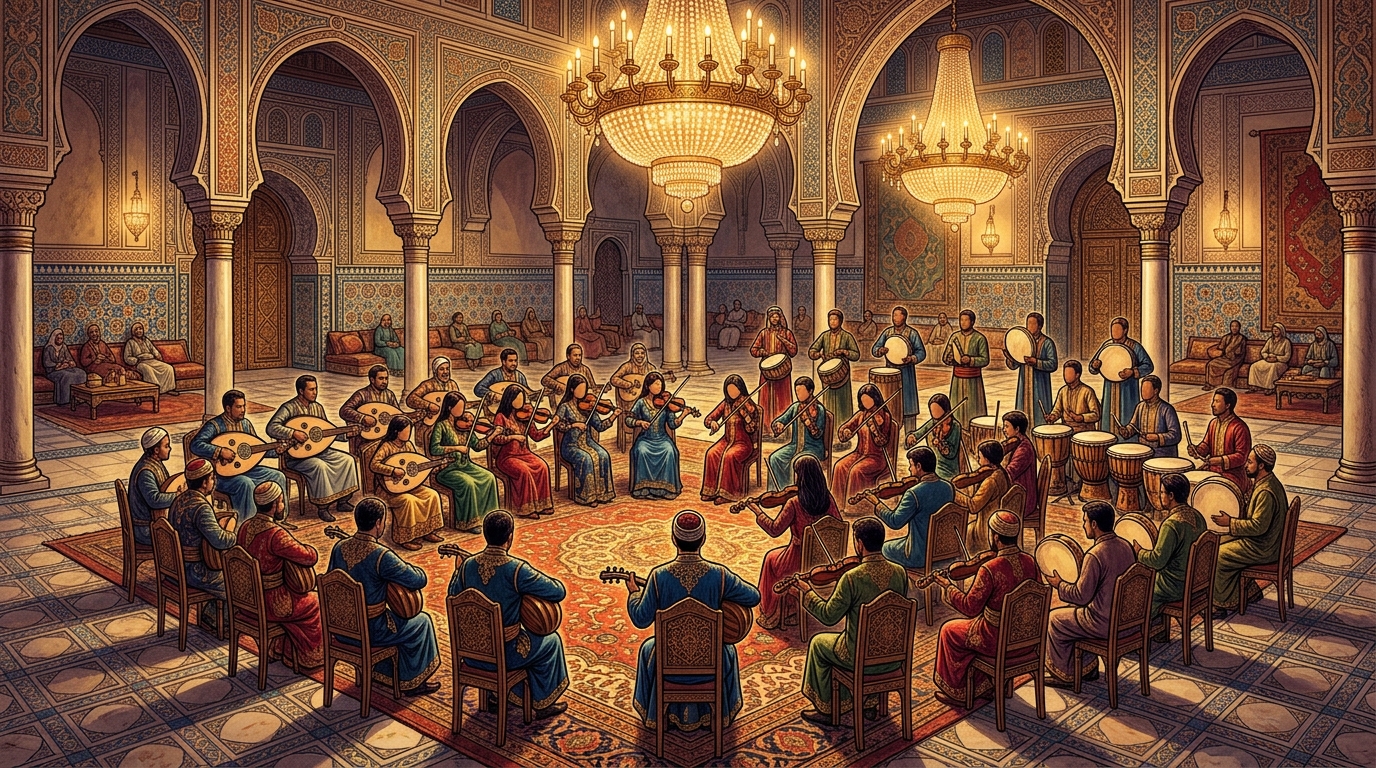
A full nuba performance is a considerable undertaking, typically opening with one or two instrumental preludes before the ensemble moves through the five mizan in sequence, with a soloist singer, a small vocal chorus and an instrumental group trading and combining throughout. The classic instrumentation includes the oud (lute), rebab (a bowed spike fiddle), kamanja (violin held vertically on the knee in the older style), qanun (plucked zither) and darbouka or taarija hand drums — the same family of instruments, notably, that also accompanies Morocco's Malhun sung-poetry tradition, a sign of how closely the country's classical and popular vernacular musics are related.
Fez, Tetouan and the keepers of the repertoire
Different Moroccan cities became associated with different strands of the inherited repertoire, and each built its own performing tradition around it. Fez is generally regarded as the senior Andalusian music center in Morocco; an Andalusian ensemble has existed there since 1912, and the city's Orchestre arabo-andalou de Fès — sometimes called the Orchestre El Hadj Abdelkrim Rais — is considered one of the oldest and most important groups of its kind. Tetouan, in the north, developed its own strong tradition; it was in Tetouan that the musician known as Al-Haik compiled and classified Morocco's surviving nuba repertoire toward the end of the 18th century, in a manuscript collection still referenced by scholars and performers today.
The Fez orchestra's modern history runs through two men. Abdelkrim Rais (1912-1996), a rebab virtuoso nicknamed the 'captain of Al-Ala,' took over its direction in 1946 after the death of his own teacher Mohammed al-Brihi, led it for half a century, and later also directed the Academy of Music of Fez. His student Mohamed Briouel, who studied with Rais from 1963, now directs both the orchestra and the Conservatory of Music in Fez, carrying the lineage into a third generation.
Beyond Fez and Tetouan, active Andalusian ensembles and associations exist in Rabat — where the Orchestre Chabab Al Andalous was founded in 1987 — as well as in Meknes, Salé, Oujda, Tangier and Safi. In the 1990s, Morocco's Ministry of Culture also assembled a national ensemble, the Orchestre arabo-andalou du Maroc, drawing musicians from several of these city traditions together under one banner to represent the repertoire as a unified national heritage.

A shared Muslim-Jewish heritage
One of Al-Ala's most distinctive features is that it was never the property of one religious community. Jewish musicians played a central role in performing and transmitting Arab-Andalusian music in Morocco's key centers — Fez, Rabat and Tetouan among them — and some parts of the tradition were preserved specifically through Jewish communal practice even as the same suites were performed in Muslim courtly and family settings. It is common in Moroccan Andalusian orchestras, historically and today, to find Muslim and Jewish musicians and singers performing side by side, often distinguishable only by the language of the texts they sing.
That shared custodianship extends into the Moroccan Jewish diaspora. Emile Zrihan, a Moroccan-born cantor who emigrated to Israel, built an international career as a soloist with the Andalusian Orchestra in Ashdod, performing a repertoire spanning Arabic mawwal, Hebrew liturgical piyyutim and the secular Andalusian songs of his Moroccan youth — a living link between Morocco's Al-Ala tradition and Jewish liturgical practice.
It is worth being precise about who belongs to this tradition and who does not. The celebrated oud player and composer Anouar Brahem, admired worldwide for his contemplative, jazz-inflected oud recordings, is Tunisian, born and raised in Tunis and trained there and in France — not Moroccan, and not a specialist in Morocco's specific Al-Ala repertoire, even though North African oud traditions share deep historical roots. Crediting him to Morocco's Andalusian scene would be a real, if easy, mistake.
Preservation, recording and the living tradition today
Al-Ala's survival into the present owes a great deal to a major documentation effort. Between 1989 and 1992, Morocco's Ministry of Culture co-produced a landmark anthology with the Maison des Cultures du Monde in Paris: 73 compact discs covering more than 81 hours of music, aiming to capture the entire known repertoire of Morocco's eleven surviving nubas, largely performed and recorded by the Orchestre arabo-andalou de Fès. That anthology remains a key reference for musicians, scholars and archivists studying the tradition.
The music is far from a museum piece. Orchestras in Fez, Tetouan, Rabat and beyond continue to perform full nubas and shorter selections at festivals, conservatories and cultural events across Morocco and abroad — including appearances by figures like Tangier's Sheikh Ahmed Zaïtouni, whose ensemble, founded in 1981, is known for its interpretation of the Nuba Al-Hijaz al-Kabir. Conservatories in Fez and other cities continue to train new generations of oud, rebab, violin and qanun players in the tradition's specific techniques and repertoire.
More than five centuries after Granada fell, that continuity is the real headline: a courtly music built in Islamic Spain, carried into exile by refugees, and kept alive since through master-to-student teaching in Moroccan medinas, is still performed largely as it always was — sung suites, named modes, and an audience that still recognizes each nuba by name.

Frequently asked
What is Al-Ala, or Moroccan Andalusian music?
Al-Ala is Morocco's classical Andalusian music tradition, inherited from Muslim Iberia (Al-Andalus) and preserved by Moroccan orchestras since Muslim and Jewish refugees carried it across the Strait of Gibraltar after the fall of Granada in 1492.
Who is credited with founding Andalusian classical music?
The musician Ziryab, who moved from Baghdad to Cordoba in the 9th century and became court musician to Abd al-Rahman II, is traditionally credited with founding the courtly musical school that shaped Al-Andalus's music, although historians note the single-founder narrative is only partly documented and the tradition developed over generations.
What is a nuba in Moroccan Andalusian music?
A nuba is a long musical suite built around one dominant melodic mode, combining instrumental sections with sung classical Andalusian poetry. Morocco has preserved eleven complete nubas out of a larger original repertoire tradition credits to Ziryab.
What is the tab' system?
The tab' (plural tabai'a) is Morocco's system of named melodic modes, comparable to the Arabic maqam, each carrying its own scale and emotional character. Moroccan tradition recognizes eleven principal tuba', including Raml al-Maya, Al-Maya and Al-Hijaz al-Kabir.
How is a nuba structured musically?
Each Moroccan nuba unfolds across five fixed movements called mizan — basit, qa'im wa nisf, btayhi, darj and quddam — performed in that order, generally moving from slower, heavier rhythms toward faster, lighter ones as the suite builds.
Which Moroccan cities are centers of Andalusian music?
Fez and Tetouan are the historic strongholds, with an Andalusian ensemble tradition in Fez dating to 1912 and Tetouan home to the 18th-century Al-Haik manuscript collection of the repertoire. Rabat, Meknes, Salé, Oujda, Tangier and Safi also maintain active Andalusian ensembles.
Who leads Morocco's most famous Andalusian orchestra today?
Mohamed Briouel directs the Orchestre arabo-andalou de Fès and the Conservatory of Music in Fez. He studied from 1963 under Abdelkrim Rais (1912-1996), the rebab virtuoso known as the 'captain of Al-Ala,' who led the Fez orchestra for fifty years.
Is Anouar Brahem part of Morocco's Andalusian music tradition?
No. Anouar Brahem is a Tunisian oud player and composer, born and trained in Tunis, known for contemplative jazz-inflected oud recordings. He is not Moroccan and is not a performer of Morocco's specific Al-Ala repertoire, despite sharing broader North African oud traditions.
What role did Jewish musicians play in Moroccan Andalusian music?
Jewish musicians were central to performing and preserving Al-Ala in cities like Fez, Rabat and Tetouan, with Muslim and Jewish performers often playing side by side in the same orchestras. Moroccan-born cantor Emile Zrihan carried this heritage into Israel, singing Andalusian repertoire alongside Hebrew liturgical piyyutim.
Is Moroccan Andalusian music still performed today?
Yes. Orchestras in Fez, Tetouan, Rabat and other cities regularly perform full nubas at festivals and cultural events, conservatories continue training new musicians in the tradition, and a major 1989-1992 recording anthology preserved more than 81 hours of the repertoire for future generations.
- Wikipedia — Andalusi classical music ↗
- Wikipedia — Andalusi nubah ↗
- Wikipedia — Abdelkrim Rais ↗
- Wikipedia — Anouar Brahem ↗
- Wikipedia (French) — Orchestre arabo-andalou de Fès ↗
- Morocco World News — The Andalusian Music: A Bridge Between Muslim and Jewish Heritage ↗
Video via official YouTube embeds; photos via Wikimedia Commons under their stated licenses. All rights belong to the respective owners; 212 Daily claims no ownership.