Amazigh Culture: A Complete Guide to Morocco's Indigenous People
Who Are the Amazigh?
The Amazigh are the original inhabitants of North Africa, an indigenous people whose presence in the region predates recorded history. The term commonly used in the West, 'Berber,' derives from the Greek and Latin word for 'barbarian,' a label applied to those who did not speak Greek or Latin. Many today reject it in favor of 'Amazigh' (plural 'Imazighen'), a self-designation often translated as 'free people' or 'noble people.'
Spread across a vast belt from the Atlantic coast of Morocco to the oases of western Egypt and deep into the Sahel, the Imazighen are not a single uniform group but a family of related peoples sharing linguistic and cultural roots. In Morocco alone they include the Rif in the north, the Amazigh of the Middle and High Atlas, the Souss region's Chleuh, and many others, each with distinct dialects and customs.
Estimates suggest that a very large share of Morocco's population is of Amazigh descent, and a substantial portion still speaks an Amazigh language as a mother tongue. Even among Moroccans who identify primarily as Arab, Amazigh heritage runs deep, woven into the country's genetics, place names, cuisine, and daily expressions. To understand Morocco is, in large part, to understand the Imazighen.
A History Older Than Empires
Amazigh history is a long chronicle of resilience against successive waves of outsiders. The ancient Imazighen built kingdoms such as Numidia and Mauretania and interacted with Phoenicians and Carthaginians along the coast. They were incorporated into the Roman Empire, where figures of Amazigh origin rose to prominence, including, by many accounts, the writer Apuleius and the Church father Saint Augustine.
The most transformative encounter came with the Arab conquests beginning in the seventh century, which brought Islam to North Africa. Over generations the Imazighen largely adopted Islam, but they retained their languages and many customs, and they were anything but passive subjects. Amazigh dynasties went on to rule vast empires: the Almoravids and the Almohads, founded by Amazigh reformers, governed territory stretching from Spain to sub-Saharan Africa and shaped the medieval Mediterranean world.
Through Ottoman influence in the east, European colonialism, and the formation of modern nation-states, the Imazighen often found themselves marginalized by centralizing powers and Arab-nationalist ideologies that downplayed their identity. Mountainous and desert regions, harder to control, became strongholds where Amazigh language and tradition survived most fully. This pattern, of cultural persistence in the highlands and at the desert's edge, defines much of Amazigh history.
Language and the Tifinagh Script
At the core of Amazigh identity is language. Tamazight is the broad term for the Amazigh language, which exists in several major Moroccan varieties: Tarifit in the Rif mountains, Tamazight in the central Atlas, and Tashelhit (Chleuh) in the Souss and the south. While these can differ significantly, they share a common Amazigh linguistic root that is distinct from Arabic.
Remarkably, the Amazigh possess their own ancient script: Tifinagh. Its origins reach back over two thousand years to the Libyco-Berber alphabets carved into rock across North Africa. Among the Tuareg of the Sahara, a form of Tifinagh remained in continuous use into modern times, a living link to antiquity. The script's distinctive geometric letters, circles, lines, and dots, are instantly recognizable.
In a landmark modern revival, Morocco's Royal Institute of Amazigh Culture (IRCAM) adopted and standardized a contemporary version, Neo-Tifinagh, in the early 2000s. It now appears on public buildings, road signs, and in schools, a powerful visual statement that the Amazigh language belongs to the official life of the nation. Seeing Tifinagh beside Arabic and French script on a Moroccan ministry is a recent but profound symbol of changing times.
Art, Symbols, and the Visual World
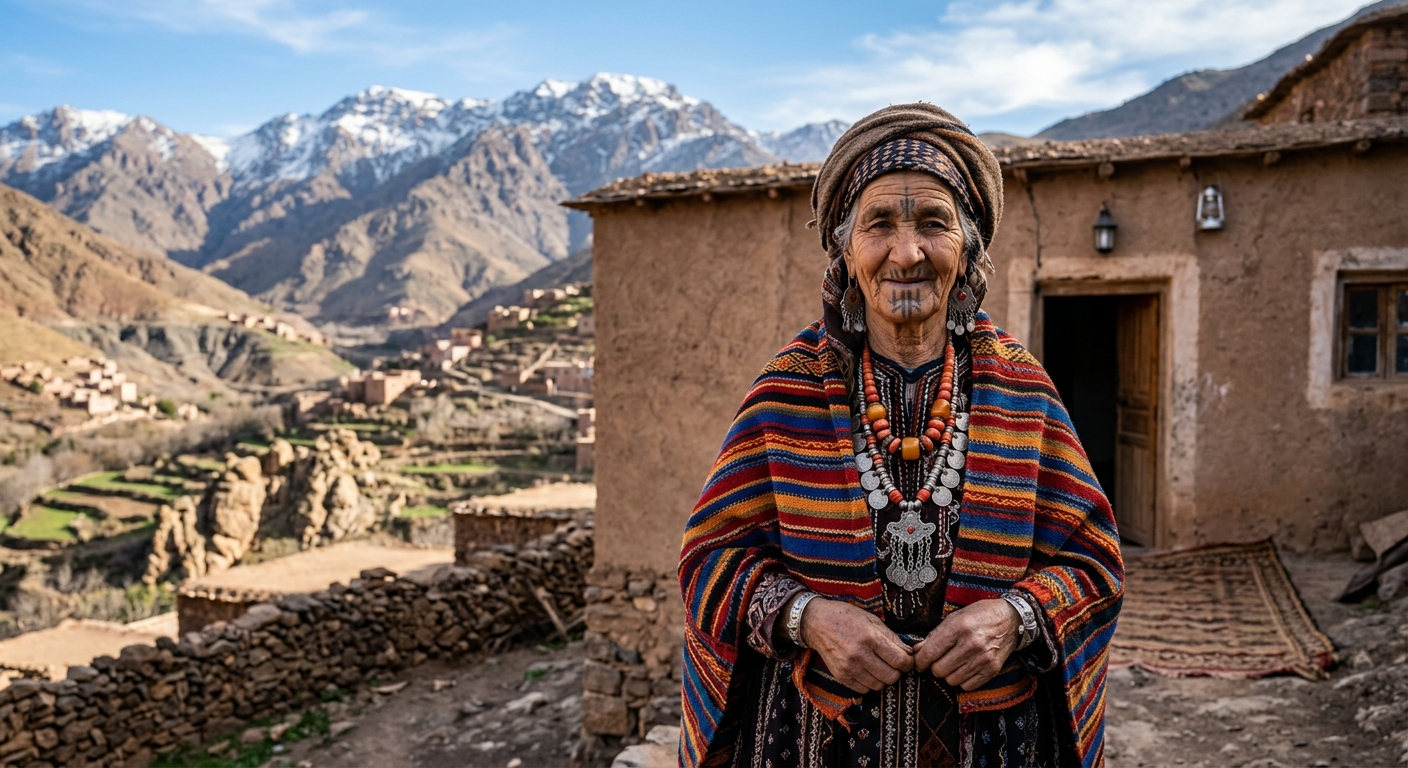
Amazigh culture expresses itself through a rich visual vocabulary of symbols, many tied to protection, fertility, and identity. These motifs appear on woven carpets, tattooed on skin, painted on pottery, etched into silver jewelry, and carved on doors and beams. Geometric forms, diamonds, zigzags, crosses, and stylized eyes, recur across regions, often carrying meanings to ward off the evil eye or invoke good fortune.
Textiles are perhaps the most celebrated Amazigh art form. Women in mountain and rural communities weave carpets and blankets whose patterns encode tribal affiliation, personal stories, and protective symbols. Each rug is a kind of woven autobiography, and the famous Beni Ourain and Azilal rugs prized in international design markets descend directly from these traditions. Silver jewelry, heavy with coral, amber, and enamel, similarly marked a woman's tribe and status.
Among the most striking and now fading traditions are facial and hand tattoos once worn by Amazigh women. These markings, applied at significant life stages, signified beauty, tribal belonging, marital status, and protection. With the spread of stricter religious attitudes toward tattooing and modernization, the practice has nearly vanished, surviving mainly on the faces of elderly women, a vivid, irreplaceable record of a disappearing world.
Music, Festivals, and Daily Life
Amazigh music is as varied as the people themselves. In the High Atlas, the ahwash is a powerful communal performance in which entire villages gather, men and women forming circles, singing call-and-response poetry and dancing to the beat of large frame drums called bendir. In the Souss region, the rwais are professional troubadours who travel and perform sophisticated sung poetry. In the Rif, distinctive rhythms and the female-led izran songs carry the region's voice.
Communal life and hospitality are central values. Many Amazigh communities historically governed themselves through assemblies of elders and customary law known as izerf, balancing collective decision-making with respect for kinship. Generosity to guests, mutual aid in agriculture (the tradition of tiwizi, collective labor), and strong bonds of village solidarity remain prized, even as urbanization and migration reshape these patterns.
The most vivid expression of the modern Amazigh calendar is Yennayer, the Amazigh New Year, celebrated in mid-January and marking the agricultural new year of an ancient calendar. Families prepare special meals, often a hearty couscous or porridge, and the festival has become a focal point of cultural pride. In 2024, Morocco officially designated Yennayer a national paid holiday, a decision widely seen as a milestone in the recognition of Amazigh identity.
The Modern Amazigh Revival
After decades in which Amazigh identity was downplayed by states emphasizing Arab unity, the late twentieth and early twenty-first centuries brought a determined cultural revival. Activists, scholars, musicians, and youth movements pressed for recognition of the language, the teaching of Tamazight in schools, the use of Amazigh names, and respect for Amazigh history as central, not peripheral, to North Africa.
Morocco responded with significant, if gradual, reforms. The creation of IRCAM in 2001, the introduction of Tamazight in schools, the launch of Amazigh-language media, and above all the 2011 constitution, which declared Tamazight an official language of the state alongside Arabic, marked historic shifts. The recognition of Yennayer as a national holiday and the growing visibility of Tifinagh in public space continue this trajectory.
Challenges remain. Implementation of language rights in education and administration has been uneven, rural Amazigh regions still face economic marginalization, and some traditions, like the women's tattoos, are passing beyond recovery. Yet the broad direction is unmistakable. After centuries on the margins of official narratives, the Imazighen, the free people, are reclaiming their rightful place at the heart of Morocco's identity. As the Amazigh saying affirms their resilience, the people endure like the mountains that shelter them.
| Group | Region | Language Variety |
|---|---|---|
| Rif (Rifians) | Northern Rif Mountains | Tarifit |
| Central Atlas Amazigh | Middle and High Atlas | Tamazight |
| Chleuh (Ishelhiyen) | Souss and southwest | Tashelhit |
| Tuareg (related) | Sahara (mainly south/east) | Tamasheq |
Major Amazigh groups and languages in Morocco
FAQ
What is the difference between Amazigh and Berber?
They refer to the same people. 'Berber' comes from the Greek and Latin word for 'barbarian' and is often considered pejorative, while 'Amazigh' (plural Imazighen) is the people's own name, generally translated as 'free' or 'noble people.'
Is Tamazight an official language in Morocco?
Yes. Morocco's 2011 constitution declared Tamazight an official language of the state alongside Arabic, a landmark in the recognition of Amazigh identity. Implementation in schools and administration continues to develop.
What is Tifinagh?
Tifinagh is the ancient Amazigh script, with origins reaching back over two thousand years to Libyco-Berber alphabets. A standardized modern version, Neo-Tifinagh, was adopted in Morocco in the early 2000s and now appears on signs, buildings, and in schools.
What is Yennayer?
Yennayer is the Amazigh New Year, celebrated in mid-January to mark the agricultural new year of an ancient calendar. It is observed with special meals and family gatherings, and Morocco officially recognized it as a national holiday in 2024.
What are Amazigh facial tattoos?
They were traditional tattoos worn mainly by Amazigh women, marking beauty, tribal identity, life stages, and protection from the evil eye. The practice has largely disappeared and now survives mostly on the faces of elderly women.
Loved this? Useful? React below — your feedback helps other readers.